



Properties, performance and stability of iridium-coated water oxidation electrodes based on anodized titanium felts
Literature Information
Publication Date
2020-12-10
DOI
10.1039/D0SE01577F
Impact Factor
6.367
Authors
André Hofer, Sebastian Bochmann
View Original
Abstract
This study explores the preparation of porous titanium felts as substrates for water oxidation electrodes. We approach the characterization of their performance in a holistic manner: not just a single performance parameter is considered, but instead a combination of short-term electrocatalytic proficiency in process-relevant conditions and long-term stability. The preparation combines two ingredients: (1) anodization of the felts to generate surface porosity with (2) atomic layer deposition (ALD) to coat the porous substrates with thin iridium films of 8 nm thickness. Samples generated with anodization in various conditions are characterized quantitatively in terms of their electrochemical performance (overpotential η10, maximum current density jmax, electrochemically active surface area expressed as roughness factor rf) and of their stability (electrochemical, chemical and physical). We find that electrodes obtained by anodization in water exhibit both lower stability and lower performance than their counterparts prepared in organic electrolytes. However, the electrode type that exhibits the best pure electrochemical performance (lowest η10 and highest jmax) also exhibits a fragile surface structure. For all samples, the very low catalyst loading on the order of tens of μg cm−2 ensures a significant materials cost reduction with respect to traditional preparative methods.
Recommended Journals

Journal of Peptide Science

Organic Process Research & Development

Journal of Saudi Chemical Society

Acta Materialia

Russian Journal of General Chemistry

Current Opinion in Solid State & Materials Science

Journal of Natural Medicines

Nature Medicine

Russian Journal of Organic Chemistry

Crystallography Reports
Related Literature
A planar chelating bitriazole N-heterocyclic carbeneligand and its rhodium(iii) and dirhodium(ii) complexes
Macarena Poyatos, William McNamara, Chris Incarvito, Eduardo Peris, Robert H. Crabtree
2007-05-14
Communication
DOI: 10.1039/B705246D
Retracted article: Biogenetic hypothesis and first steps towards a biomimetic synthesis of haouamines
Edmond Gravel, Erwan Poupon, Reynald Hocquemiller
2006-12-19
Communication
DOI: 10.1039/B613737G
Magnetic exchange coupling tunable by means of selective cation binding into poly(radical-armed) azacrowns
Kazuki Igarashi, Takashi Nogami
2006-10-31
Communication
DOI: 10.1039/B613637K
Magnetic canting or not? Two isomorphous 3D CoII and NiII coordination polymers with the rare non-interpenetrated (10,3)-d topological network, showing spin-canted antiferromagnetism only in the CoII system
Jian-Rong Li, Qun Yu, Ying Tao, Xian-He Bu, Joan Ribas, Stuart R. Batten
2007-03-01
Communication
DOI: 10.1039/B700569E
Scaffolded amino acids as a close structural mimic of type-3 copper binding sites
H. Bauke Albada, Fouad Soulimani, Bert M. Weckhuysen, Rob M. J. Liskamp
2007-11-02
Communication
DOI: 10.1039/B709400K
Samarium(ii) iodide-mediated intramolecular pinacol coupling reactions with cyclopropyl ketones
Sarah L. Foster, Sandeep Handa, Michael Krafft, David Rowling
2007-09-05
Communication
DOI: 10.1039/B712542A
Iridium-catalysed asymmetricallylic substitutions
Günter Helmchen, Axel Dahnz, Pierre Dübon, Mathias Schelwies, Robert Weihofen
2006-12-06
Feature Article
DOI: 10.1039/B614169B
Karman vortex street assisted patterning in the growth of silicon nanowires
Mingwang Shao, Hui Hu, Min Li, Huizhao Ban, Mengya Wang, Juan Jiang
2006-11-13
Communication
DOI: 10.1039/B613473D
Stereoselective construction of fluorinated indanone derivatives via a triple cascade Lewis acid-catalyzed reaction
Han-Feng Cui, Ke-Yan Dong, Guang-Wu Zhang, Lian Wang
2007-04-04
Communication
DOI: 10.1039/B702114C
Boron–oxygen luminescence centres in boron–nitrogen systems
Chengchun Tang, Yoshio Bando, Chunyi Zhi, Dmitri Golberg
2007-09-04
Communication
DOI: 10.1039/B711807D
You might also like
Compound Q&A
What regulatory guidelines apply to 4-Amino-3-bromophenol (CAS: 74440-80-5)?
4-Amino-3-bromophenol (CAS: 74440-80-5) falls under the classification of a haza...
74440-80-54-Amino-3-bromopheno...
Compound Q&A
How should (17beta)-3-Oxoestr-4-en-17-yl acetate (CAS: 1425-10-1) be stored?
(17beta)-3-Oxoestr-4-en-17-yl acetate should be stored in a cool, dry place away...
1425-10-1(17beta)-3-Oxoestr-4...
Compound Q&A
What are the physical and chemical properties of 2-[(2,2-Diethoxyethyl)disulfanyl]-1,1-diethoxyethane (CAS: 76505-71-0)?
2-[(2,2-Diethoxyethyl)disulfanyl]-1,1-diethoxyethane (CAS: 76505-71-0) is a colo...
76505-71-02-[(2,2-Diethoxyethy...
Compound Q&A
What is the market or research trend for 1-(β-D-ribofuranosyl)-1H-imidazo[4,5-c]pyridin-4-amine?
The market and research for 1-(β-D-ribofuranosyl)-1H-imidazo[4,5-c]pyridin-4-ami...
6736-58-91-(beta-D-Ribofurano...
Compound Q&A
How should waste containing Conjugated Estrogen (CAS: 12126-59-9) be handled?
Waste containing Conjugated Estrogen (CAS: 12126-59-9) should be collected and d...
12126-59-9Conjugated Estrogen
Compound Q&A
What is the market or research trend for Bis(2,2,2-trifluoroethyl) (methoxycarbonylmethyl)phosphonate?
The market for Bis(2,2,2-trifluoroethyl) (methoxycarbonylmethyl)phosphonate (CAS...
88738-78-7Bis(2,2,2-trifluoroe...
Compound Q&A
Are there alternatives to 3,4'-Di-O-methylellagic acid (CAS: 57499-59-9) in synthesis?
There are several alternatives to 3,4'-Di-O-methylellagic acid (CAS: 57499-59-9)...
57499-59-93,4'-Di-O-methylella...
Compound Q&A
What regulatory guidelines apply to 2-Chloro-N,N-dimethylpyridin-4-amine (CAS: 59047-70-0)?
2-Chloro-N,N-dimethylpyridin-4-amine (CAS: 59047-70-0) is regulated under the Gl...
59047-70-02-Chloro-N,N-dimethy...
Compound Q&A
What is cerium(3+);oxygen(2-);vanadium(5+) (CAS: 13597-19-8)?
Cerium(3+);oxygen(2-);vanadium(5+) (CAS: 13597-19-8) is a complex inorganic comp...
13597-19-8cerium(3+);oxygen(2-...
Compound Q&A
Is 7-Chloro-1-iodoisoquinoline (CAS: 1203579-27-4) safe?
7-Chloro-1-iodoisoquinoline (CAS: 1203579-27-4) is generally considered safe whe...
1203579-27-47-Chloro-1-iodoisoqu...
Source Journal
Recommended Compounds
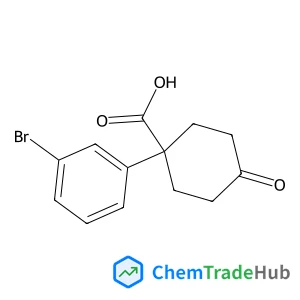
1-(3-Bromophenyl)-4-oxocyclohexanecarboxylic acid
CAS Number:
1385694-53-0
Molecular Formula:
C13H13BrO3
Recommended Suppliers




Disclaimer
This page provides academic journal information for reference and research purposes only. We are not affiliated with any journal publishers and do not handle publication submissions. For publication-related inquiries, please contact the respective journal publishers directly.
If you notice any inaccuracies in the information displayed, please contact us at support@chemtradehub.com. We will promptly review and address your concerns.