













A comparative study of undoped, boron-doped, and boron/fluorine dual-doped carbon nanoparticles obtained via solution plasma as catalysts for the oxygen reduction reaction
Literature Information
Publication Date
2020-06-18
DOI
10.1039/D0SE00708K
Impact Factor
6.367
Authors
Chayanaphat Chokradjaroen, Shuhei Kato, Kensuke Fujiwara, Hiroko Watanabe, Takahiro Ishii
View Original
Abstract
Boron/fluorine dual-doped carbons, which have never been reported for their oxygen reduction reaction (ORR) activity, were successfully synthesized through a one-step solution plasma (SP) process using mixtures of toluene, as a carbon source, and heterocyclic compounds containing boron and fluorine atoms, i.e., 2,4,6-tris(4-fluorophenyl)boroxin, 2,4,6-tris(3,4-difluorophenyl)boroxin and 2,4,6-tris(3,4,5-trifluorophenyl) boroxin. Therefore, in this study, the obtained undoped, boron-doped, and boron/fluorine dual-doped carbons, synthesized using SP, were investigated and compared to find their catalytic activity toward the ORR. The FE-SEM observation showed that the obtained carbons had a diameter in the nanoscale range. XRD and Raman measurements revealed that the synthesis via SP led to the generation of turbostratic carbons with structural defect sites. The carbon atoms were found to mainly interact with fluorine atoms through semi-ionic C–F bonding. All SP-synthesized carbon nanoparticles showed acceptable ORR activity in alkaline solution. However, boron/fluorine dual-doped carbon nanoparticles also drove the ORR through a two-electron pathway with low generation of the unstable peroxide, HO2−, compared to undoped and boron-doped carbon nanoparticles.
Recommended Journals
Related Literature
Efficient red emission from poly(vinyl butyral) films doped with a novel europium complex based on a terpyridyl ancillary ligand: synthesis, structural elucidation by Sparkle/RM1 calculation, and photophysical properties
Shaojun Liu, Youbing Li, Mingyong Shang, Lei Lei, Guoxia Wang, Jian He, Xuanlun Wang, Mangeng Lu
2015-12-14
Paper
DOI: 10.1039/C5PY01956G
Aqueous SET-LRP catalyzed with “in situ” generated Cu(0) demonstrates surface mediated activation and bimolecular termination
Shampa R. Samanta, Vasiliki Nikolaou, Shauni Keller, Michael J. Monteiro, Daniela A. Wilson, David M. Haddleton, Virgil Percec
2015-01-14
Paper
DOI: 10.1039/C4PY01748J
Lights on! A significant photoenhancement effect on ATRP by ambient laboratory light
Tao Zhang, Dan Gieseler, Rainer Jordan
2015-12-07
Communication
DOI: 10.1039/C5PY01858G
Inherent flame retardation of semi-aromatic polyesters via binding small-molecule free radicals and charring
Teng Fu, De-Ming Guo, Jia-Ning Wu, Xiao-Lin Wang, Xiu-Li Wang, Li Chen, Yu-Zhong Wang
2016-01-19
Paper
DOI: 10.1039/C5PY01938A
A synthetic strategy for the preparation of sub-100 nm functional polymer particles of uniform diameter
Kato L. Killops, Pontus Lundberg, Craig J. Hawker
2015-01-07
Communication
DOI: 10.1039/C4PY01703J
Multifunctional ATRP based pH responsive polymeric nanoparticles for improved doxorubicin chemotherapy in breast cancer by proton sponge effect/endo-lysosomal escape
Farhat Naz, Alok C. Bharti
2015-01-05
Paper
DOI: 10.1039/C4PY01698J
Ultrathin free-standing polymer membranes with chemically responsive luminescence via consecutive photopolymerizations
Jiming Yang, Ning Zhang, Qiliao Wang, Yongjiu Liang, Dewen Dong
2015-12-23
Paper
DOI: 10.1039/C5PY02013A
The construction of single-layer two-dimensional supramolecular organic frameworks in water through the self-assembly of rigid vertexes and flexible edges
Cheng-Bin Nie, Tian-You Zhou, Qiao-Yan Qi, Jie Fu, Xiao-Zhong Wang, Liyan Dai, Yingqi Chen, Xin Zhao
2015-01-12
Communication
DOI: 10.1039/C4PY01669F
A straightforward approach for the one-pot synthesis of cyclic polymers from RAFT polymers via thiol–Michael addition
Junfei Zhao, Yanyan Zhou, Yu Zhou, Nianchen Zhou, Xiangqiang Pan, Zhengbiao Zhang, Xiulin Zhu
2016-01-26
Paper
DOI: 10.1039/C5PY01861G
You might also like
Compound Q&A
Is 2-(2-chloroacetamido)-3-phenylpropanoic acid (CAS: 7765-11-9) safe?
2-(2-Chloroacetamido)-3-phenylpropanoic acid (CAS: 7765-11-9) is generally consi...
7765-11-92-(2-chloroacetamido...
Compound Q&A
Is 2-(Benzyloxy)-5-bromobenzoic acid (CAS: 62176-31-2) safe?
2-(Benzyloxy)-5-bromobenzoic acid can be handled safely if appropriate precautio...
62176-31-22-(Benzyloxy)-5-brom...
Compound Q&A
What is (4-Methyl-1,2,5-oxadiazol-3-yl)methanamine hydrochloride (CAS: 1159825-48-5)?
(4-Methyl-1,2,5-oxadiazol-3-yl)methanamine hydrochloride is a chemical compound ...
1159825-48-5(4-Methyl-1,2,5-oxad...
Compound Q&A
What is 2-(5-Hexylthiophen-2-yl)-4,4,5,5-tetramethyl-1,3,2-dioxaborolane (CAS: 917985-54-7)?
2-(5-Hexylthiophen-2-yl)-4,4,5,5-tetramethyl-1,3,2-dioxaborolane (CAS: 917985-54...
917985-54-72-(5-Hexylthiophen-2...
Compound Q&A
Are there alternatives to 4-(8-Methyl-9H-1,3-dioxolo[4,5-h][2,3]benzodiazepin-5-yl)benzenamine (CAS: 102771-26-6) in synthesis?
While 4-(8-Methyl-9H-1,3-dioxolo[4,5-h][2,3]benzodiazepin-5-yl)benzenamine (CAS:...
102771-26-64-(8-Methyl-9H-1,3-d...
Compound Q&A
What is the market or research trend for tert-butyl 3-hydroxy-4,5,7,8-tetrahydro-2H-pyrazolo[3,4-d]azepine-6-carboxylate (CAS: 851376-80-2)?
The market for tert-butyl 3-hydroxy-4,5,7,8-tetrahydro-2H-pyrazolo[3,4-d]azepine...
851376-80-2tert-butyl 3-hydroxy...
Compound Q&A
How should waste containing 3,5-Diamino-1H-pyrazole-4-carbonitrile (CAS: 6844-58-2) be handled?
Waste containing 3,5-Diamino-1H-pyrazole-4-carbonitrile (CAS: 6844-58-2) should ...
6844-58-23,5-Diamino-1H-pyraz...
Compound Q&A
How is (6-Fluoro-3-pyridinyl)boronic acid (CAS: 351019-18-6) typically synthesized?
(6-Fluoro-3-pyridinyl)boronic acid can be synthesized through the reaction of 6-...
351019-18-6(6-Fluoro-3-pyridiny...
Compound Q&A
What industries use Dibenzyl carbonimidoylbiscarbamate (CAS: 10065-79-9)?
Dibenzyl carbonimidoylbiscarbamate (CAS: 10065-79-9) finds applications in vario...
10065-79-9Dibenzyl carbonimido...
Compound Q&A
What is the market or research trend for (beta,beta,2,3,4,5,6-~2~H_7_)Phenylalanine (CAS: 74228-83-4)?
The market for (beta,beta,2,3,4,5,6-~2~H_7_)Phenylalanine (CAS: 74228-83-4) is g...
74228-83-4(beta,beta,2,3,4,5,6...
Source Journal
Recommended Compounds
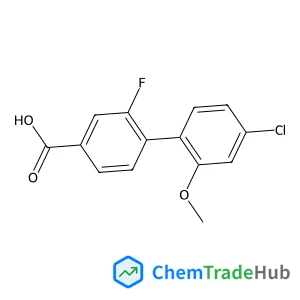
4-(4-Chloro-2-methoxyphenyl)-3-fluorobenzoic acid
CAS Number:
1261970-23-3
Molecular Formula:
C14H10ClFO3
![5-Chloropyrrolo[2,1-f][1,2,4]triazin-4(3H)-one structure](https://static.chemtradehub.com/structs/888/888720-60-3-4f7c.webp "5-Chloropyrrolo[2,1-f][1,2,4]triazin-4(3H)-one structure")
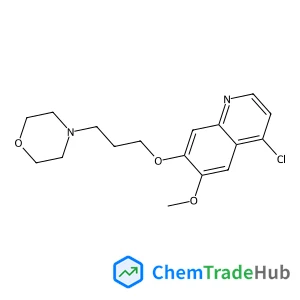
4-(3-((4-Chloro-6-methoxyquinolin-7-yl)oxy)propyl)morpholine
CAS Number:
205448-32-4
Molecular Formula:
C17H21ClN2O3
Recommended Suppliers




Disclaimer
This page provides academic journal information for reference and research purposes only. We are not affiliated with any journal publishers and do not handle publication submissions. For publication-related inquiries, please contact the respective journal publishers directly.
If you notice any inaccuracies in the information displayed, please contact us at support@chemtradehub.com. We will promptly review and address your concerns.