













Improved charge carrier dynamics of WS2 nanostructures by the way of CdS@WS2 heterostructures for use in water splitting and water purification
Literature Information
Publication Date
2020-06-08
DOI
10.1039/D0SE00533A
Impact Factor
6.367
Authors
Muthuraja Velpandian, Supriya Pulipaka, Akshay Tikoo, Praveen Meduri
View Original
Abstract
Heterostructures consisting of tungsten disulfide (WS2) and cadmium sulfide (CdS) have shown longer emission decay life time and significantly quenched fluorescence emission in comparison to pure materials (WS2 and CdS). CdS@WS2 heterostructures also show a significant enhancement in light absorption across the entire visible spectrum with a change in the slope of the absorption edge pertaining to WS2 nanostructures in the heterostructures. This leads to higher number of charge carriers, improved charge separation as well as charge migration from the material surface to the back contact. In photoelectrochemical water splitting, the heterostructures exhibited a twentyfold increase in photocurrent density (0.15 mA cm−2) at 1.23 V vs. RHE in comparison to pristine sulfides. The heterostructures also showed a good reduction ratio of >83% in 120 minutes [Cr(VI) to Cr(III)] in a mixture of Cr(VI)/Ni(II) ions and RhB. Hence, CdS@WS2 heterostructures with improved charge carrier dynamics can find several applications as photocatalysts.
Related Literature
Revealing nanoscale optical properties and morphology in perfluoropentacene films by confocal and tip-enhanced near-field optical microscopy and spectroscopy
Xiao Wang, Frank Schreiber, Alfred J. Meixner, Dai Zhang
2016-05-24
Paper
DOI: 10.1039/C6CP01153E
Valley polarization and p-/n-type doping of monolayer WTe2 on top of Fe3O4(111)‡
Yan Song, Qian Zhang, Wenbo Mi, Xiaocha Wang
2016-05-06
Paper
DOI: 10.1039/C6CP01986B
Enhancement of island size by dynamic substrate disorder in simulations of graphene growth
Gwilym Enstone, Gavin R. Bell
2016-05-10
Paper
DOI: 10.1039/C6CP00788K
How protonation and deprotonation of 9-methylguanine alter its singlet O2 addition path: about the initial stage of guanine nucleoside oxidation
Huayu Teng
2016-05-10
Paper
DOI: 10.1039/C6CP01350C
Spectroscopic observation of nitrogen anions N− in solid matrices
I. B. Bykhalo, A. A. Pelmenev, S. Mao, A. Meraki, P. T. McColgan, D. M. Lee, V. V. Khmelenko
2016-05-18
Paper
DOI: 10.1039/C6CP01080F
“XA6” octahedra influencing the arrangement of anionic groups and optical properties in inverse-perovskite [B6O10]XA3 (X = Cl, Br; A = alkali metal)
Zhihua Yang, Bin Yang, Shilie Pan
2016-05-09
Paper
DOI: 10.1039/C6CP01288D
Mechanisms of charge accumulation in the dark operation of perovskite solar cells
Teresa S. Ripolles, Ajay K. Baranwal, Koji Nishinaka, Yuhei Ogomi, Germà Garcia-Belmonte, Shuzi Hayase
2016-04-28
Paper
DOI: 10.1039/C6CP01427E
Morphology-controlled syntheses of α-MnO2 for electrochemical energy storage
Weidong He, Wenjin Yang, Chenggang Wang, Xiaolong Deng, Baodan Liu, Xijin Xu
2016-05-10
Paper
DOI: 10.1039/C6CP02548J
Correlating structure and electronic band-edge properties in organolead halide perovskites nanoparticles
Qiushi Zhu, Alexander Generalov, Dörthe Haase, Stefan Carlson, Yuran Niu, Jimmy Heimdal, Anders Engdahl, Maria E. Messing, Tonu Pullerits
2016-05-10
Paper
DOI: 10.1039/C6CP01843B
Synthesis, photophysical, electrochemical and electrochemiluminescence properties of A2B2 zinc porphyrins: the effect of π-extended conjugation
Elizabeth K. Galván-Miranda, Hiram M. Castro-Cruz, J. Arturo Arias-Orea, Matteo Iurlo, Giovanni Valenti, Massimo Marcaccio, Norma A. Macías-Ruvalcaba
2016-05-03
Paper
DOI: 10.1039/C6CP01926A
You might also like
Compound Q&A
Is 4-Benzyl-2,2-dimethylmorpholine (CAS: 84761-04-6) safe?
4-Benzyl-2,2-dimethylmorpholine is generally considered safe when handled under ...
84761-04-64-Benzyl-2,2-dimethy...
Compound Q&A
What is (5,6-Dimethoxy-3-pyridinyl)boronic acid (CAS: 1346526-61-1)?
(5,6-Dimethoxy-3-pyridinyl)boronic acid is a chemical compound with the molecula...
1346526-61-1(5,6-Dimethoxy-3-pyr...
Compound Q&A
How is 1,1,3,3-Tetramethyl-1,3-bis(2-methyl-2-propanyl)disiloxane (CAS: 67875-55-2) typically synthesized?
1,1,3,3-Tetramethyl-1,3-bis(2-methyl-2-propanyl)disiloxane is synthesized throug...
67875-55-21,1,3,3-Tetramethyl-...
Compound Q&A
What are the main uses of (2R,4S)-1-Boc-4-methylpyrrolidine-2-carboxylic acid (CAS: 1018818-04-6)?
(2R,4S)-1-Boc-4-methylpyrrolidine-2-carboxylic acid is primarily used as a build...
1018818-04-6(2R,4S)-1-Boc-4-meth...
Compound Q&A
What precautions should be taken when handling 2,3-Dichloroacrylonitrile (CAS: 22410-58-8)?
When handling 2,3-Dichloroacrylonitrile, it is crucial to wear appropriate perso...
22410-58-82,3-Dichloroacryloni...
Compound Q&A
How should (S)-1-(o-Tolyl)ethanamine hydrochloride (CAS: 1332832-16-2) be stored?
(S)-1-(o-Tolyl)ethanamine hydrochloride should be stored in a cool, dry place to...
1332832-16-2(S)-1-(o-Tolyl)ethan...
Compound Q&A
What are the physical and chemical properties of Benzyl [1-(hydroxyamino)-1-imino-2-methyl-2-propanyl]carbamate (CAS: 518047-98-8)?
Benzyl [1-(hydroxyamino)-1-imino-2-methyl-2-propanyl]carbamate (CAS: 518047-98-8...
518047-98-8Benzyl [1-(hydroxyam...
Compound Q&A
What industries use 2-Methyloxazole-5-carbaldehyde (CAS: 885273-42-7)?
2-Methyloxazole-5-carbaldehyde is used in the pharmaceutical industry for the sy...
885273-42-72-Methyloxazole-5-ca...
Compound Q&A
What is the market or research trend for 2-Methyl-2-propanyl 4-[(1S)-1-hydroxyethyl]-1-piperidinecarboxylate (CAS: 389889-82-1)?
The market for 2-Methyl-2-propanyl 4-[(1S)-1-hydroxyethyl]-1-piperidinecarboxyla...
389889-82-12-Methyl-2-propanyl ...
Compound Q&A
Is 1-Butyl-3-methylpyridinium bromide (CAS: 26576-85-2) safe?
1-Butyl-3-methylpyridinium bromide is generally considered safe for laboratory u...
26576-85-21-Butyl-3-methylpyri...
Source Journal
Recommended Compounds
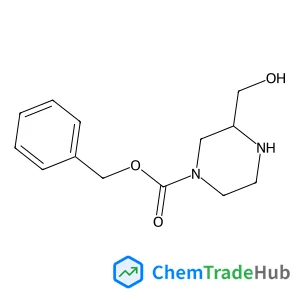
Benzyl 3-(hydroxymethyl)-1-piperazinecarboxylate
CAS Number:
191739-40-9
Molecular Formula:
C13H18N2O3

Recommended Suppliers





Disclaimer
This page provides academic journal information for reference and research purposes only. We are not affiliated with any journal publishers and do not handle publication submissions. For publication-related inquiries, please contact the respective journal publishers directly.
If you notice any inaccuracies in the information displayed, please contact us at support@chemtradehub.com. We will promptly review and address your concerns.