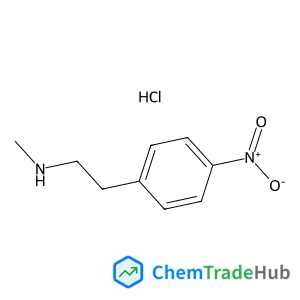
N-Methyl-2-(4-nitrophenyl)ethanamine hydrochloride (1:1)
CAS Number:
166943-39-1
Molecular Formula:
C9H13ClN2O2
Man-Su Tu, Ke-Wei Chen, Ping Wu, Yu-Chen Zhang, Xiao-Qin Liu, Feng Shi
Enantioenriched indole derivatives are widely found in natural products, pharmaceuticals and bioactive compounds. Therefore, developing efficient methods for the synthesis of enantioenriched indole derivatives has become an important goal in the community of organic chemistry. To this end, chemists have designed and developed a variety of indole-containing platform molecules and their related catalytic asymmetric reactions. Among these approaches, vinylindoles have proved to be versatile platform molecules for accessing enantioenriched indole derivatives via catalytic asymmetric reactions, especially organocatalytic asymmetric reactions. Based on this approach, a plethora of chiral indole derivatives have been synthesized with optical purity and structural complexity. This review summarizes advances in vinylindole-based organocatalytic asymmetric reactions since 2008 and includes the applications of some methodologies in the total synthesis of natural products. In addition, this review points out the remaining challenges in this research area to be confronted by organic chemists, which will shed light on the future development of this area.
Dietrich Gudat, Timo Gans-Eichler, Martin Nieger
DOI: 10.1039/B409657F
Soumendra Rana, Bijoy Kundu, Susheel Durani
DOI: 10.1039/B410532J
Kazuhisa Fujimoto, Natsuko Oimoto, Kahori Katsuno, Masahiko Inouye
DOI: 10.1039/B403615H
Thi X. T. Sayle, Stephen C. Parker, Dean C. Sayle
DOI: 10.1039/B408752F
Chuanlang Zhan, Lizhu Liu, Yanbiao Zhou, Minghua Liu
DOI: 10.1039/B402956A
Yolanda Vida Pol, Rafael Suau, Ezequiel Perez-Inestrosa, Dario M. Bassani
DOI: 10.1039/B402298J
Houjin Huang, Masafumi Ata, Yoko Yoshimoto
DOI: 10.1039/B402196G
Robert J. P. Corriu, Ahmad Mehdi, Catherine Reyé, Chloé Thieuleux
DOI: 10.1039/B314415A
Ying Liu, Li Mu, Baohong Liu, Song Zhang, Pengyuan Yang, Jilie Kong
DOI: 10.1039/B400776J
Marcin Drąg, Adam Jezierski, Pawel Kafarski
DOI: 10.1039/B401633E
When handling 2-Chloro-1,2-bis(4-methylphenyl)ethanone (CAS: 71193-32-3), it is ...
4-Ethoxy-3-(5-methyl-4-oxo-7-propyl-1,4-dihydroimidazo[5,1-f][1,2,4]triazin-2-yl...
Methyl 3-Oxo-4-Androsten-17-Carboxylate (CAS: 2681-55-2) should be stored in a c...
(R)-3-Amino-4-(3-hexylphenylamino)-4-oxobutylphosphonic acid is primarily used i...
2-Methyl-2-propanyl 3-amino-3-carbamoyl-1-azetidinecarboxylate (CAS: 1254120-14-...
There are alternative reagents that can be used in synthesis instead of (E)-4-(t...
[2-(3-Chlorophenyl)-1,3-thiazol-4-yl]methanol (CAS: 121202-20-8) is a crystallin...
The market and research trends for Methyl (2S)-[(4S)-2,2-dimethyl-1,3-dioxolan-4...
The market for 1-Bromo-2-isocyanatoethane (CAS: 42865-19-0) is driven by its use...
4-Nitro-D-phenylalanine hydrochloride (CAS: 147065-06-3) is primarily used in re...

Organic Chemistry Frontiers publishes high-quality research from across organic chemistry. Emphases are placed on studies that make significant contributions to the field of organic chemistry by reporting either new or significantly improved protocols or methodologies. Topics include, but are not limited to the following: Organic synthesis Development of synthetic methodologies Catalysis Natural products Functional organic materials Supramolecular and macromolecular chemistry Physical and computational organic chemistry