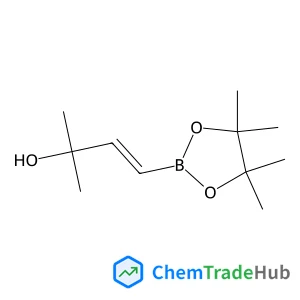
(E)-2-methyl-4-(4,4,5,5-tetramethyl-1,3,2-dioxaborolan-2-yl)but-3-en-2-ol
CAS Number:
581802-26-8
Molecular Formula:
C11H21BO3
Tomasz J. Idzik, Zofia M. Myk, Łukasz Struk, Magdalena Perużyńska, Gabriela Maciejewska, Marek Droździk, Jacek G. Sośnicki
A novel method for the inter- and intramolecular arylation of enelactams (3,4-dihydropyridin-2-ones), up to 99% yield, triggered by triisopropylsilyltrifluoromethanesulfonate (TIPSOTf) is proposed. It offers high synthetic usefulness, especially for the synthesis of polycyclic systems obtained from conformationally rigid δ-enelactams, for which the use of the conventional method, involving cyclization by treatment with TfOH, failed. Multinuclear (1H, 13C, 19F and 29Si) NMR spectroscopy applied for the reaction monitoring as well as DOSY NMR experiment permitted identification of the intermediates and proposition of the reaction mechanism. In the process of checking the scope of the method application, condensed and bridged polycyclic piperidin-2-ones, including a derivative of alangiifoliumine A, were obtained. The inhibition of malignant melanoma A375 cell proliferation by some benzoquinolizidine derivatives (up to IC50 = 5.3 ± 0.4 μM) was evidenced.
Alessio Russo, Alessandra Lattanzi
DOI: 10.1039/C002587A
Feng Zhou, Weimin Liu, Qunji Xue
DOI: 10.1039/B914630J
Hong-Bin Yao, Xiao-Bo Li, Shu-Juan Liu, Shu-Hong Yu
DOI: 10.1039/B914329G
Min Li, Sergio L. De Rooy, David K. Bwambok, Bilal El-Zahab, John F. DiTusa, Isiah M. Warner
DOI: 10.1039/B917683G
Ayellet L. Zelikoff, Jacob Kopilov, Israel Goldberg, Geoffrey W. Coates, Moshe Kol
DOI: 10.1039/B915211C
Vitor Francisco Ferreira, Sabrina Baptista Ferreira, Fernando de Carvalho da Silva
DOI: 10.1039/C0OB00277A
Pelin Arslan, Akinori Jyo
DOI: 10.1039/C0OB00282H
Alejandra Sornosa-Ten, M. Teresa Albelda, Juan C. Frías, Enrique García-España, José M. Llinares, Ana Budimir, Ivo Piantanida
DOI: 10.1039/C000124D
Anupam Bandyopadhyay, Neha Agrawal, Sachitanand M. Mali, Sandip V. Jadhav, Hosahudya N. Gopi
DOI: 10.1039/C0OB00199F
Fosca Conti, Enrico Negro, Vito Di Noto
DOI: 10.1039/B913870F
(1R,3S)-1,3-Cyclopentanediol finds applications in various industries. In the ph...
When handling N'-[4-(Dimethylamino)phenyl]-N,N-dimethyl-1,4-benzenediamine, it i...
There are several alternatives to 5-(2,4-Difluorophenyl)-2-methoxypyrimidine in ...
1-(3-Methoxyphenoxy)propan-2-ol (CAS: 382141-68-6) must comply with the Globally...
Tetrodotoxin Citrate is extremely dangerous and should be handled with extreme c...
2-Methyl-2-propanyl [(1R,3S)-3-hydroxycyclopentyl]carbamate (CAS: 225641-84-9) i...
Waste containing 4-(2-Hydroxyhexafluoroisopropyl)Benzoic Acid (CAS: 16261-80-6) ...
2-Methyl-2-proanyl {(2S)-1-[(benzyloxy)amino]-3-hydroxy-3-methyl-1-oxo-2-butanyl...
Benzeneethanamine, α-ethyl-, hydrochloride (1:1) is an organic compound with the...
In the synthesis of compounds similar to 3-{(E)-[4-(Dimethylamino)phenyl]diazeny...

Organic Chemistry Frontiers publishes high-quality research from across organic chemistry. Emphases are placed on studies that make significant contributions to the field of organic chemistry by reporting either new or significantly improved protocols or methodologies. Topics include, but are not limited to the following: Organic synthesis Development of synthetic methodologies Catalysis Natural products Functional organic materials Supramolecular and macromolecular chemistry Physical and computational organic chemistry