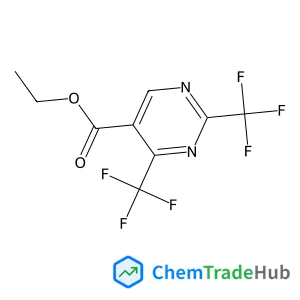
Ethyl 2,4-bis(trifluoromethyl)-5-pyrimidinecarboxylate
CAS Number:
188781-15-9
Molecular Formula:
C9H6F6N2O2
Safiya Nisar, Sonal Chauhan, Gurmeet Singh, Virender Singh, Sunita Rattan
Natural protein-based polymers may serve as a potential source for developing advanced porous organic macromolecules, possessing exquisite control over the pores, which impart exceptional properties to these materials. Here, we describe a strategy to design, synthesize and develop an intelligent, dual stimuli responsive highly porous grafted polymer with exquisite control over the functionality of pores. The monomer 2-(4-((acrylamido)methyl)-1H-1,2,3-triazol-1-yl)-4-vinylbenzoic acid as a cross-linker, having pH responsive (acidic functional groups) and thermo-responsive (triazole and acrylamide groups) functional groups, was successfully prepared via click chemistry, for grafting onto the backbone of the natural polymer soy protein isolate (SPI) via microwave irradiation. Alkene groups were introduced at both the sides of the monomer, prior to grafting with SPI. Furthermore, to increase the hydrogen bonding network in the polymer, the pH responsive crosslinker 4-(4-hydroxyphenyl)butanoic acid (HPBA) was introduced while grafting. The grafted soy protein isolate polymer, SPI-g-[2-(4-((acrylamido)methyl)-1H-1,2,3-triazol-1-yl)-4-vinylbenzoicacid-co-4-(4-hydroxyphenyl) butanoic acid]-g-SPI, [SPI-g-(ATVBA-co-HPBA)-g-SPI], is characterized by using TGA for thermal stability, SEM and TEM for visual confirmation, NMR, LCMS and FTIR for grafting confirmation, XRD for crystallinity, MTT assay for cytotoxicity, and BET for analyzing the porous network structure. The size and morphological changes of [SPI-g-(ATVBA-co-HPBA)-g-SPI] are studied under different parameters for its potential use as an advanced porous macromolecule based superabsorbent polymer (SAP).
DOI: 10.1039/D1CP04065K
Jonathan Utterson, Radek Erban
DOI: 10.1039/D1CP04056A
Tahereh Ghaed-Sharaf, Akbar Omidvar
DOI: 10.1039/D1CP05550J
Fuhui Zhang, Yuan Yuan, Yichi Chen, Jianfang Chen, Yanzhi Guo, Xuemei Pu
DOI: 10.1039/D1CP05736G
Jiajia Zhang, Chenggen Xie, Lijuan Chen
DOI: 10.1039/D1CP05552F
Joost M. Bakker, Fumitaka Mafuné
DOI: 10.1039/D1CP05760J
Meng-Xu Jiang, Ágúst Kvaran
DOI: 10.1039/D1CP05714F
Kai Hong Luo, Struan H. Robertson
DOI: 10.1039/D2CP00065B
Jari Peltola, Prasenjit Seal, Niko Vuorio, Petri Heinonen, Arkke Eskola
DOI: 10.1039/D1CP02270A
When handling lithium chloride hydrate (1:1:1) (CAS: 16712-20-2), it is importan...
4-(4H-1,2,4-Triazol-4-yl)piperidine is generally considered safe for use in phar...
Waste containing 1,3-Thiazole-2-carboxamide (CAS: 16733-85-0) should be collecte...
5-(Difluoromethyl)-2-fluorobenzonitrile (CAS: 934175-58-3) is subject to regulat...
Methyl 3-acetamido-2-thiophenecarboxylate can be synthesized by the reaction of ...
4-Isoquinolinecarbonitrile is a chemical compound with the CAS number 34846-65-6...
Store Methyl 1H-1,2,3-triazole-4-carboxylate (CAS: 877309-59-6) in a cool, dry p...
6-Bromo[1,3]thiazolo[5,4-b]pyridin-2-amine (CAS: 1160791-13-8) is subject to the...
(2S,3S)-2-Ammonio-3-(3,4-dihydroxyphenyl)-3-hydroxypropanoate (CAS: 23651-95-8) ...
7-Bromo-3-methyl-3,4-dihydroquinazolin-4-one is a solid with a crystalline form....

Polymer Chemistry welcomes submissions in all areas of polymer science that have a strong focus on macromolecular chemistry. Manuscripts may cover a broad range of fields, yet no direct application focus is required.