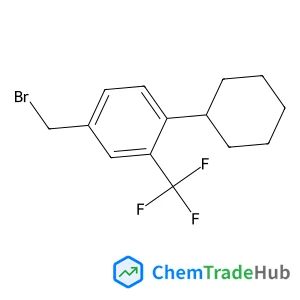
4-(Bromomethyl)-1-cyclohexyl-2-(trifluoromethyl)benzene
CAS Number:
800381-60-6
Molecular Formula:
C14H16BrF3
A graphical abstract is available for this content

Crystallography Reports

Russian Journal of Organic Chemistry

Organic Process Research & Development

Russian Journal of General Chemistry

Current Opinion in Colloid & Interface Science

Journal of Peptide Science

Russian Journal of Applied Chemistry

Chemical Communications

New Journal of Chemistry

Chemistry Education Research and Practice
Yang Zhang, Jinlin He, Dongling Cao, Mingzu Zhang, Peihong Ni
DOI: 10.1039/C4PY00538D
Chi Zhang, Milan Maric
DOI: 10.1039/C4PY00300D
Benjamin B. Noble, Leesa M. Smith, Michelle L. Coote
DOI: 10.1039/C4PY00190G
Roukaya Hamiye, Ali Alaaeddine, Mouhamad Awada, Benjamin Campagne, Sylvain Caillol, Sophie M. Guillaume, Bruno Ameduri, Jean-François Carpentier
DOI: 10.1039/C4PY00547C
Deyang Yu, Chunhui Luo, Wenxin Fu, Zhibo Li
DOI: 10.1039/C4PY00480A
Bo-Geng Li
DOI: 10.1039/C4PY00622D
Liang-Wei Zhu, Wu Yang, Ling-Shu Wan, Zhi-Kang Xu
DOI: 10.1039/C4PY00491D
Dandan Tang, Xiao Jiang, Huanhuan Liu, Cangxia Li, Youliang Zhao
DOI: 10.1039/C4PY00332B
When handling lithium chloride hydrate (1:1:1) (CAS: 16712-20-2), it is importan...
4-(4H-1,2,4-Triazol-4-yl)piperidine is generally considered safe for use in phar...
Waste containing 1,3-Thiazole-2-carboxamide (CAS: 16733-85-0) should be collecte...
5-(Difluoromethyl)-2-fluorobenzonitrile (CAS: 934175-58-3) is subject to regulat...
Methyl 3-acetamido-2-thiophenecarboxylate can be synthesized by the reaction of ...
4-Isoquinolinecarbonitrile is a chemical compound with the CAS number 34846-65-6...
Store Methyl 1H-1,2,3-triazole-4-carboxylate (CAS: 877309-59-6) in a cool, dry p...
6-Bromo[1,3]thiazolo[5,4-b]pyridin-2-amine (CAS: 1160791-13-8) is subject to the...
(2S,3S)-2-Ammonio-3-(3,4-dihydroxyphenyl)-3-hydroxypropanoate (CAS: 23651-95-8) ...
7-Bromo-3-methyl-3,4-dihydroquinazolin-4-one is a solid with a crystalline form....

Physical Chemistry Chemical Physics (PCCP) is an international journal co-owned by 19 physical chemistry and physics societies from around the world. This journal publishes original, cutting-edge research in physical chemistry, chemical physics and biophysical chemistry. To be suitable for publication in PCCP, articles must include significant innovation and/or insight into physical chemistry; this is the most important criterion that reviewers and Editors will judge against when evaluating submissions. The journal has a broad scope and welcomes contributions spanning experiment, theory, computation and data science. Topical coverage includes spectroscopy, dynamics, kinetics, statistical mechanics, thermodynamics, electrochemistry, catalysis, surface science, quantum mechanics, quantum computing and machine learning. Interdisciplinary research areas such as polymers and soft matter, materials, nanoscience, energy, surfaces/interfaces, and biophysical chemistry are welcomed if they demonstrate significant innovation and/or insight into physical chemistry. Joined experimental/theoretical studies are particularly appreciated when complementary and based on up-to-date approaches.
![N-[2-(2-Pyridinyl)ethyl]-1-propanamine structure](https://static.chemtradehub.com/structs/554/55496-57-6-22b4.webp "N-[2-(2-Pyridinyl)ethyl]-1-propanamine structure")