


Semifluorinated, kinked polyarylenes via direct arylation polycondensation
Literature Information
Publication Date
2020-10-07
DOI
10.1039/D0PY00973C
Impact Factor
5.582
Authors
Fabian Kempe, Felix Riehle, Hartmut Komber, Rukiya Matsidik, Michael Walter, Michael Sommer
View Original
Abstract
Semifluorinated, amorphous polyarylenes PmmpF4 with kinked backbone structure were prepared from a meta-substituted, biphenol-based monomer with varying alkoxy substituents R and 1,2,4,5-tetrafluorobenzene (pF4) via direct arylation polymerization (DAP). The chemistry employed is simple, scalable and does not rely on tedious purification techniques. Polycondensation occurs cleanly without major side reactions. Despite the clean polycondensation reaction, very high molar mass materials are difficult to obtain, which is ascribed to an unusual solubility behavior compared to non-fluorinated analogs, and similar, yet more linear tetrafluorobenzene copolymers based on fluorene or carbazole. In order to investigate this phenomenon further, the side chain-dependent properties PmmpF4 are investigated using linear, branched and cyclic side-chains. While the glass transition temperature of PmmpF4 is a strong function of R and can be varied between 35 °C and 197 °C for constant backbone structure and molecular weight, solubility cannot be improved by using longer linear or branched side chains. Density functional theory calculations suggest significant polarization-type non-covalent interactions between tetrafluorobenzene and the biphenol-based monomer as origin for the observed limited solubility, which guide the design of both kinked and straight conjugated polymers with high molar mass and solubility.
Recommended Journals

Atomization and Sprays

Polycyclic Aromatic Compounds

Cellulose

Herald of the Russian Academy of Sciences

Main Group Chemistry

Bioorganic & Medicinal Chemistry Letters

Medicinal Chemistry Research

Chinese Journal of Chemistry

Journal of Asian Natural Products Research

Critical Reviews in Solid State and Materials Sciences
Related Literature
Raman spectroscopy of endoliths from Antarctic cold desert environments
Susana E. Jorge Villar, Howell G. M. Edwards, Charles S. Cockell
2004-12-07
Paper
DOI: 10.1039/B410854J
New chemical evidence for the ability to generate radical molecular ions of polyenes from ESI and HR-MALDI mass spectrometry
Thais Guaratini, Ricardo L. Vessecchi, Francisco C. Lavarda, Patrícia M. B. G. Maia Campos, Zeki Naal, Paul J. Gates, Norberto P. Lopes
2004-10-22
Paper
DOI: 10.1039/B412154F
Direct injection analysis of bisphenol A in serum by combination of isotope imprinting with liquid chromatography-mass spectrometry
Kaori Hoshina, Ken Hosoya, Jun Haginaka
2004-12-01
Communication
DOI: 10.1039/B412641F
Novel approach for mono-segmented flow micro-titration with sequential injection using a lab-on-valve system: a model study for the assay of acidity in fruit juices
Lop Pathimapornlert
2005-01-10
Paper
DOI: 10.1039/B413585G
Effects of semicore electrons on stopping power in helium-irradiated aluminum nanosheets
Su-Na Pang, Feng Wang, Ya-Ting Sun, Fei Mao, Cong-Zhang Gao
2023-06-22
Paper
DOI: 10.1039/D3CP01506H
Pressurised hot water extraction–microporous membrane liquid–liquid extraction coupled on-line with gas chromatography–mass spectrometry in the analysis of pesticides in grapes
K. Lüthje, T. Hyötyläinen, M. Rautiainen-Rämä, M.-L. Riekkola
2004-11-24
Paper
DOI: 10.1039/B409276G
Correlation-driven topological phase transition in 2D valleytronic materials: a mini-review
Xiao-Shu Guo, San-Dong Guo
2023-06-19
Review Article
DOI: 10.1039/D3CP01368E
You might also like
Compound Q&A
What are the main uses of 1H-Indazole-6-carbonitrile (CAS: 141290-59-7)?
1H-Indazole-6-carbonitrile finds applications in pharmaceuticals, where it serve...
141290-59-71H-Indazole-6-carbon...
Compound Q&A
How should waste containing Dioctyl (2E)-2-butenedioate (CAS: 2997-85-5) be handled?
Waste containing Dioctyl (2E)-2-butenedioate (CAS: 2997-85-5) should be collecte...
2997-85-5Dioctyl (2E)-2-buten...
Compound Q&A
What industries use Sodium [(1,2-benzoxazol-3-ylmethyl)sulfonyl]azanide (CAS: 68291-98-5)?
Sodium [(1,2-benzoxazol-3-ylmethyl)sulfonyl]azanide is primarily used in pharmac...
68291-98-5Sodium [(1,2-benzoxa...
Compound Q&A
Are there alternatives to Dimethyl 4-(4,4,5,5-tetramethyl-1,3,2-dioxaborolan-2-yl)-2,6-pyridinedicarboxylate (CAS: 741709-66-0) in synthesis?
Dimethyl 4-(4,4,5,5-tetramethyl-1,3,2-dioxaborolan-2-yl)-2,6-pyridinedicarboxyla...
741709-66-0Dimethyl 4-(4,4,5,5-...
Compound Q&A
How should waste containing 2-Fluoro-6-hydrazinopyridine (CAS: 80714-39-2) be handled?
Waste containing 2-Fluoro-6-hydrazinopyridine (CAS: 80714-39-2) should be manage...
80714-39-22-Fluoro-6-hydrazino...
Compound Q&A
What is 6-Formyl-2-pyridinecarboxylic acid (CAS: 499214-11-8)?
6-Formyl-2-pyridinecarboxylic acid is an organic compound with the molecular for...
499214-11-86-Formyl-2-pyridinec...
Compound Q&A
What is the market or research trend for 3-(3,4-dimethoxyphenyl)-2,5-dimethyl-N-(2-morpholin-4-ylethyl)pyrazolo[1,5-a]pyrimidin-7-amine (CAS: 900874-91-1)?
Research trends for this compound indicate a focus on its potential applications...
900874-91-13-(3,4-dimethoxyphen...
Compound Q&A
How is 9H-Tribenzo[b,d,f]azepine (CAS: 29875-73-8) typically synthesized?
9H-Tribenzo[b,d,f]azepine is typically synthesized via a multi-step process invo...
29875-73-89H-Tribenzo[b,d,f]az...
Compound Q&A
How is 1-Cyclopropyl-7-ethoxy-6-fluoro-8-methoxy-4-oxo-1,4-dihydro-3-quinolinecarboxylic acid (CAS: 1797982-51-4) typically synthesized?
1-Cyclopropyl-7-ethoxy-6-fluoro-8-methoxy-4-oxo-1,4-dihydro-3-quinolinecarboxyli...
1797982-51-41-Cyclopropyl-7-etho...
Compound Q&A
How should waste containing Methyl 3-oxo-1,2,3,4-tetrahydro-6-quinoxalinecarboxylate (CAS: 671820-52-3) be handled?
Waste containing Methyl 3-oxo-1,2,3,4-tetrahydro-6-quinoxalinecarboxylate (CAS: ...
671820-52-3Methyl 3-oxo-1,2,3,4...
Source Journal
Polymer Chemistry

CiteScore:
8.6
Self-citation Rate:
7.3%
Articles per Year:
457
Polymer Chemistry welcomes submissions in all areas of polymer science that have a strong focus on macromolecular chemistry. Manuscripts may cover a broad range of fields, yet no direct application focus is required.
Recommended Compounds
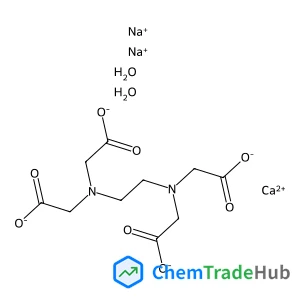
EthylenediaminetetraaceticacidcalciumDisodiumsalthydrate
CAS Number:
23411-34-9
Molecular Formula:
C10H16CaN2Na2O10
Recommended Suppliers




Disclaimer
This page provides academic journal information for reference and research purposes only. We are not affiliated with any journal publishers and do not handle publication submissions. For publication-related inquiries, please contact the respective journal publishers directly.
If you notice any inaccuracies in the information displayed, please contact us at support@chemtradehub.com. We will promptly review and address your concerns.