












Raman spectroscopy of endoliths from Antarctic cold desert environments
Literature Information
Publication Date
2004-12-07
DOI
10.1039/B410854J
Impact Factor
4.616
Authors
Susana E. Jorge Villar, Howell G. M. Edwards, Charles S. Cockell
View Original
Abstract
Six endolithic communities from Antarctic cold desert environments have been analysed by Raman spectroscopy. The extreme conditions that the organisms have to withstand in cold environments leads to the adoption of different survival strategies and adaptation of the geological environment. Production of radiation- and desiccation-protective biomolecules is identifiable but the displacement of potentially protective minerals onto the rock surface has also been detected as a protective mechanism against UV-radiation. In this work, Raman spectroscopy is demonstrated as a valuable technique to determine the organic and inorganic compounds used by microorganisms as protective mechanisms against extreme stress conditions. The data from this study will be useful for construction of molecular recognition biomarkers and remote Raman spectral sensing experiments proposed for terrestrial extremophiles in stressed environments.
Related Literature
Passivity and electrocatalysis of nanostructured nickel encapsulated in carbon
Gareth E. Haslam, Xiao-Yao Chin, G. Tim Burstein
2011-06-22
Paper
DOI: 10.1039/C1CP20701F
Role of water in atomic resolution AFM in solutions
Matthew Watkins, Max L. Berkowitz
2011-06-13
Paper
DOI: 10.1039/C1CP21021A
Hydrogen bonding and chemical shift assignments in carbazole functionalized isocyanides from solid-state NMR and first-principles calculations
Chandrakala M. Gowda, Filipe Vasconcelos, Erik Schwartz, Ernst R. H. van Eck, Martijn Marsman, Jeroen J. L. M. Cornelissen, Alan E. Rowan, Gilles A. de Wijs, Arno P. M. Kentgens
2011-06-15
Paper
DOI: 10.1039/C1CP20304E
Adsorption of collagen onto single walled carbon nanotubes: a molecular dynamics investigation
Ravimohan Gopalakrishnan, Kanagasabai Balamurugan, Ettayapuram Ramaprasad Azhagiya Singam, Subramanian Sundaraman, Venkatesan Subramanian
2011-06-21
Paper
DOI: 10.1039/C1CP20107G
Photolytic processing of secondary organic aerosols dissolved in cloud droplets
Adam P. Bateman, Sergey A. Nizkorodov, Julia Laskin, Alexander Laskin
2011-05-26
Paper
DOI: 10.1039/C1CP20526A
Different crystal morphologies lead to slightly different conformations of light-harvesting complex II as monitored by variations of the intrinsic fluorescence lifetime
Amandine Maréchal, Alexander V. Ruban, Bruno Robert, Andrew A. Pascal, Norbert C. A. de Ruijter, Rienk van Grondelle
2011-06-14
Paper
DOI: 10.1039/C1CP20331B
Fluorescence correlation spectroscopy evidence for structural heterogeneity in ionic liquids
Jianchang Guo, Gary A. Baker, Patrick C. Hillesheim, Sheng Dai, Robert W. Shaw, Shannon M. Mahurin
2011-06-09
Communication
DOI: 10.1039/C1CP20929A
Structure–property interplay of proton conducting membranes based on PBI5N, SiO2–Im and H3PO4 for high temperature fuel cells
Vito Di Noto, Matteo Piga, Guinevere A. Giffin, Eliana Quartarone, Pierpaolo Righetti, Piercarlo Mustarelli, Aldo Magistris
2011-05-19
Paper
DOI: 10.1039/C1CP20902G
Rainbows and glories in the angular scattering of the state-to-state F + H2 reaction at Etrans = 0.04088 eV
Chengkui Xiahou, J. N. L. Connor, Dong H. Zhang
2011-06-22
Paper
DOI: 10.1039/C1CP21044K
You might also like
Compound Q&A
What are the main uses of 1H-Indazole-6-carbonitrile (CAS: 141290-59-7)?
1H-Indazole-6-carbonitrile finds applications in pharmaceuticals, where it serve...
141290-59-71H-Indazole-6-carbon...
Compound Q&A
How should waste containing Dioctyl (2E)-2-butenedioate (CAS: 2997-85-5) be handled?
Waste containing Dioctyl (2E)-2-butenedioate (CAS: 2997-85-5) should be collecte...
2997-85-5Dioctyl (2E)-2-buten...
Compound Q&A
What industries use Sodium [(1,2-benzoxazol-3-ylmethyl)sulfonyl]azanide (CAS: 68291-98-5)?
Sodium [(1,2-benzoxazol-3-ylmethyl)sulfonyl]azanide is primarily used in pharmac...
68291-98-5Sodium [(1,2-benzoxa...
Compound Q&A
Are there alternatives to Dimethyl 4-(4,4,5,5-tetramethyl-1,3,2-dioxaborolan-2-yl)-2,6-pyridinedicarboxylate (CAS: 741709-66-0) in synthesis?
Dimethyl 4-(4,4,5,5-tetramethyl-1,3,2-dioxaborolan-2-yl)-2,6-pyridinedicarboxyla...
741709-66-0Dimethyl 4-(4,4,5,5-...
Compound Q&A
How should waste containing 2-Fluoro-6-hydrazinopyridine (CAS: 80714-39-2) be handled?
Waste containing 2-Fluoro-6-hydrazinopyridine (CAS: 80714-39-2) should be manage...
80714-39-22-Fluoro-6-hydrazino...
Compound Q&A
What is 6-Formyl-2-pyridinecarboxylic acid (CAS: 499214-11-8)?
6-Formyl-2-pyridinecarboxylic acid is an organic compound with the molecular for...
499214-11-86-Formyl-2-pyridinec...
Compound Q&A
What is the market or research trend for 3-(3,4-dimethoxyphenyl)-2,5-dimethyl-N-(2-morpholin-4-ylethyl)pyrazolo[1,5-a]pyrimidin-7-amine (CAS: 900874-91-1)?
Research trends for this compound indicate a focus on its potential applications...
900874-91-13-(3,4-dimethoxyphen...
Compound Q&A
How is 9H-Tribenzo[b,d,f]azepine (CAS: 29875-73-8) typically synthesized?
9H-Tribenzo[b,d,f]azepine is typically synthesized via a multi-step process invo...
29875-73-89H-Tribenzo[b,d,f]az...
Compound Q&A
How is 1-Cyclopropyl-7-ethoxy-6-fluoro-8-methoxy-4-oxo-1,4-dihydro-3-quinolinecarboxylic acid (CAS: 1797982-51-4) typically synthesized?
1-Cyclopropyl-7-ethoxy-6-fluoro-8-methoxy-4-oxo-1,4-dihydro-3-quinolinecarboxyli...
1797982-51-41-Cyclopropyl-7-etho...
Compound Q&A
How should waste containing Methyl 3-oxo-1,2,3,4-tetrahydro-6-quinoxalinecarboxylate (CAS: 671820-52-3) be handled?
Waste containing Methyl 3-oxo-1,2,3,4-tetrahydro-6-quinoxalinecarboxylate (CAS: ...
671820-52-3Methyl 3-oxo-1,2,3,4...
Source Journal
Analyst

CiteScore:
7.8
Self-citation Rate:
5.6%
Articles per Year:
653
Analyst publishes analytical and bioanalytical research that reports premier fundamental discoveries and inventions, and the applications of those discoveries, unconfined by traditional discipline barriers.
Recommended Compounds
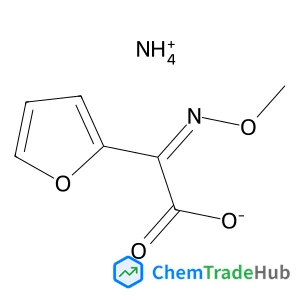
Ammonium (Z)-2-(furan-2-yl)-2-(methoxyimino)acetate
CAS Number:
97148-39-5
Molecular Formula:
C7H10N2O4
Recommended Suppliers






Disclaimer
This page provides academic journal information for reference and research purposes only. We are not affiliated with any journal publishers and do not handle publication submissions. For publication-related inquiries, please contact the respective journal publishers directly.
If you notice any inaccuracies in the information displayed, please contact us at support@chemtradehub.com. We will promptly review and address your concerns.