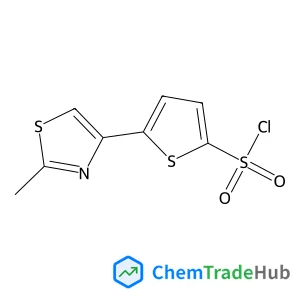
5-(2-Methyl-1,3-thiazol-4-yl)-2-thiophenesulfonyl chloride
CAS Number:
215434-25-6
Molecular Formula:
C8H6ClNO2S3
Conor Rocks, Dilli Babu Padmanaban, Paul Maguire, Vladimir Svrcek, Davide Mariotti
Shine on you crazy carbon! In this work, nitrogen-doped carbon quantum dots (N-CQDs) are synthesized using a simple custom atmospheric pressure microplasma. The method is facile, rapid, and environmentally friendly and the N-CQDs can be produced in a few minutes with no need for high temperature, complicated chemical techniques, or surface ligands. The N-CQDs are formed using molecular precursors and can be produced in different solvent mixtures. Material characterization techniques show a high degree of nitrogen doping on the QD surface with the amount of nitrogen depending on initial reaction conditions. The N-CQDs show interesting quantum confined optical properties that depend on the amount of nitrogen incorporation. Importantly, the band energy structure of the N-CQDs is elucidated and they are incorporated into a photovoltaic device as the photoactive layer achieving an extraordinary open-circuit voltage of 1.8 V and a power conversion efficiency of 0.8% (champion device), amongst the highest reported to date for group IV and carbon based quantum dots.

Russian Journal of Bioorganic Chemistry

Chemistry Education Research and Practice

New Journal of Chemistry

Journal of Saudi Chemical Society

Russian Chemical Bulletin

Russian Journal of General Chemistry

Chemical Communications

Current Opinion in Colloid & Interface Science

Nature Medicine

Journal of Natural Medicines
Kristina Tschulik, Christopher Batchelor-McAuley, Her-Shuang Toh, Emma J. E. Stuart, Richard G. Compton
DOI: 10.1039/C3CP54221A
Shiladitya Banerjee, Peter Saalfrank
DOI: 10.1039/C3CP53535E
Katharina Großmann, Susanne Wicker, Udo Weimar, Nicolae Barsan
DOI: 10.1039/C3CP52782D
Mohamed Hassan
DOI: 10.1039/C3CP53922A
Hongying Zhuo, Qingzhong Li, Wenzuo Li, Jianbo Cheng
DOI: 10.1039/C3CP54006E
Rajib Ghosh, Dipak K. Palit
DOI: 10.1039/C3CP53886A
DOI: 10.1039/C3CP53673D
Fabien Picaud, Sebastian Kraszewski, Christophe Ramseyer, Philippe Déjardin, Jean Marc Janot, François Henn
DOI: 10.1039/C3CP52123K
Hiroyasu Nishi, Takahito Nagano, Susumu Kuwabata, Tsukasa Torimoto
DOI: 10.1039/C3CP53946F
Waste containing 6-Chloro-5-(2'-hydroxy-3'-methoxy-4-biphenylyl)-3-(3-methoxyphe...
(3alpha,5alpha)-3-Hydroxypregnane-11,20-dione is primarily used in the pharmaceu...
The market for 4-Amino-6-chloro-2-pyridinecarboxylic acid (CAS: 546141-56-4) is ...
Alternatives to (2-Benzoylethyl)trimethylammonium chloride (CAS: 24472-88-6) in ...
N-[4-Nitro-3-(trifluoromethyl)phenyl]acetamide (CAS: 393-12-4) is generally safe...
Alternative reagents such as other phosphates or similar functional groups can b...
There are alternatives to N,N'-Bis(3-aminopropyl)-1,3-propanediamine (CAS: 4605-...
When handling Aluminium trihexadecanoate, it is important to use appropriate per...
(1,1-Dioxido-3-oxo-1,2-benzothiazol-2(3H)-yl)acetic acid is a chemical compound ...
Several alternatives to 5,5-dimethyloxolan-2-one (CAS: 3123-97-5) can be used in...