












Highly active bimetallic nickel catalysts for alternating copolymerization of carbon dioxide with epoxides
Literature Information
Publication Date
2020-04-13
DOI
10.1039/D0PY00174K
Impact Factor
5.582
Authors
Yu-Chia Su, Chih-Hsiang Tsui, Chen-Yen Tsai, Bao-Tsan Ko
View Original
Abstract
We reported a series of well-characterized di-nuclear nickel catalysts containing 1,3-diamine-bis(benzotriazole phenolate) derivatives for high-performance copolymerization of CO2 and epoxides. The di-nickel di-acetate complex 1 was found to be a highly active catalyst to alternatingly copolymerize CO2 with cyclohexene oxide (CHO), producing poly(cyclohexene carbonate)s (PCHCs) with a high turnover frequency (TOF) up to 7800 h−1 under optimized conditions. Interestingly, complex 1 also appears to be the first example of nickel-catalyzed CO2-copolymerization with CHO that could proceed at 1 atm CO2 pressure. Not only has the excellent catalysis of CO2/CHO copolymerization by di-Ni 1 been enabled, but also 1 has been further applied to effectively catalyze the copolymerization of CO2 with 4-vinyl-1,2-cyclohexene oxide or cyclopentene oxide (CPO) to obtain the corresponding polycarbonates. Particularly, 1 was also reported for the first time to be highly efficient for nickel-catalyzed CO2/CPO copolymerization and enabled the formation of poly(cyclopentene carbonate)s with a TOF > 700 h−1 and excellent carbonate linkage contents (>99%). Kinetic studies of the Ni-catalyzed CO2-copolymerization of CHO were performed and the activation energy for PCHC formation by 1 is 60.6 kJ mol−1.
Related Literature
Proline pre-conditioning of cell monolayers increases post-thaw recovery and viability by distinct mechanisms to other osmolytes‡
Trisha L. Bailey, Juan Ramon Hernandez-Fernaud
2021-05-18
Research Article
DOI: 10.1039/D1MD00078K
N-Aryl mercaptoacetamides as potential multi-target inhibitors of metallo-β-lactamases (MBLs) and the virulence factor LasB from Pseudomonas aeruginosa
Samir Yahiaoui, Katrin Voos, Jörg Haupenthal, Thomas A. Wichelhaus, Denia Frank, Lilia Weizel, Marco Rotter, Steffen Brunst, Jan S. Kramer, Ewgenij Proschak, Christian Ducho
2021-07-29
Research Article
DOI: 10.1039/D1MD00187F
Recent advances in urea- and thiourea-containing compounds: focus on innovative approaches in medicinal chemistry and organic synthesis
Riccardo Ronchetti, Andrea Carotti, Antimo Gioiello, Emidio Camaioni
2021-05-13
Review Article
DOI: 10.1039/D1MD00058F
Design, synthesis, and biological evaluation of pyrazole-linked aloe emodin derivatives as potential anticancer agents‡
Bandi Siva, Sravanthi Vadlamudi, Surendar Reddy Bathula, Hashnu Dutta, K. Suresh Babu
2021-04-26
Research Article
DOI: 10.1039/D0MD00315H
Recent developments on MOF-based platforms for antibacterial therapy
Yiwei Liu, Luyi Zhou, Ying Dong, Rui Wang, Ying Pan, Shuze Zhuang, Dong Liu, Jianqiang Liu
2021-04-09
Review Article
DOI: 10.1039/D0MD00416B
Novel fluorinated ring-fused chlorins as promising PDT agents against melanoma and esophagus cancer
Nelson A. M. Pereira, Bruno F. O. Nascimento, João Pina, Gonçalo Brites, J. Sérgio Seixas de Melo, Marta Pineiro, Teresa M. V. D. Pinho e Melo
2021-04-14
Research Article
DOI: 10.1039/D0MD00433B
SAR study of 4-arylazo-3,5-diamino-1H-pyrazoles: identification of small molecules that induce dispersal of Pseudomonas aeruginosa biofilms
Charlotte U. Jansen, Jesper Uhd, Jens B. Andersen, Louise D. Hultqvist, Tim H. Jakobsen, Martin Nilsson, Michael Givskov, Tim Tolker-Nielsen, Katrine M. Qvortrup
2021-09-03
Research Article
DOI: 10.1039/D1MD00275A
You might also like
Compound Q&A
How should waste containing 6-Chloro-5-(2'-hydroxy-3'-methoxy-4-biphenylyl)-3-(3-methoxyphenyl)-1H-pyrrolo[3,2-d]pyrimidine-2,4(3H,5H)-dione (CAS: 1346607-05-3) be handled?
Waste containing 6-Chloro-5-(2'-hydroxy-3'-methoxy-4-biphenylyl)-3-(3-methoxyphe...
1346607-05-36-Chloro-5-(2'-hydro...
Compound Q&A
What are the main uses of (3alpha,5alpha)-3-Hydroxypregnane-11,20-dione (CAS: 23930-19-0)?
(3alpha,5alpha)-3-Hydroxypregnane-11,20-dione is primarily used in the pharmaceu...
23930-19-0(3alpha,5alpha)-3-Hy...
Compound Q&A
What is the market or research trend for 4-Amino-6-chloro-2-pyridinecarboxylic acid (CAS: 546141-56-4)?
The market for 4-Amino-6-chloro-2-pyridinecarboxylic acid (CAS: 546141-56-4) is ...
546141-56-44-Amino-6-chloro-2-p...
Compound Q&A
Are there alternatives to (2-Benzoylethyl)trimethylammonium chloride (CAS: 24472-88-6) in synthesis?
Alternatives to (2-Benzoylethyl)trimethylammonium chloride (CAS: 24472-88-6) in ...
24472-88-6(2-Benzoylethyl)trim...
Compound Q&A
Is N-[4-Nitro-3-(trifluoromethyl)phenyl]acetamide (CAS: 393-12-4) safe?
N-[4-Nitro-3-(trifluoromethyl)phenyl]acetamide (CAS: 393-12-4) is generally safe...
393-12-4N-[4-Nitro-3-(triflu...
Compound Q&A
Are there alternatives to [(4R,5R,6S)-5-hydroxy-10-imino-3,7-dioxa-1,9-diazatricyclo[6.4.0.02,6]dodeca-8,11-dien-4-yl]methyl dihydrogen phosphate (CAS: 39679-56-6) in synthesis?
Alternative reagents such as other phosphates or similar functional groups can b...
39679-56-6[(4R,5R,6S)-5-hydrox...
Compound Q&A
Are there alternatives to N,N'-Bis(3-aminopropyl)-1,3-propanediamine (CAS: 4605-14-5) in synthesis?
There are alternatives to N,N'-Bis(3-aminopropyl)-1,3-propanediamine (CAS: 4605-...
4605-14-5N,N'-Bis(3-aminoprop...
Compound Q&A
What precautions should be taken when handling Aluminium trihexadecanoate (CAS: 555-35-1)?
When handling Aluminium trihexadecanoate, it is important to use appropriate per...
555-35-1Aluminium trihexadec...
Compound Q&A
What is (1,1-Dioxido-3-oxo-1,2-benzothiazol-2(3H)-yl)acetic acid (CAS: 52188-11-1)?
(1,1-Dioxido-3-oxo-1,2-benzothiazol-2(3H)-yl)acetic acid is a chemical compound ...
52188-11-1(1,1-Dioxido-3-oxo-1...
Compound Q&A
Are there alternatives to 5,5-dimethyloxolan-2-one (CAS: 3123-97-5) in synthesis?
Several alternatives to 5,5-dimethyloxolan-2-one (CAS: 3123-97-5) can be used in...
3123-97-55,5-dimethyloxolan-2...
Source Journal
Polymer Chemistry

CiteScore:
8.6
Self-citation Rate:
7.3%
Articles per Year:
457
Polymer Chemistry welcomes submissions in all areas of polymer science that have a strong focus on macromolecular chemistry. Manuscripts may cover a broad range of fields, yet no direct application focus is required.
Recommended Compounds
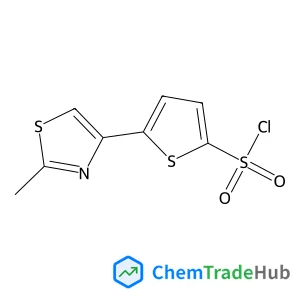
5-(2-Methyl-1,3-thiazol-4-yl)-2-thiophenesulfonyl chloride
CAS Number:
215434-25-6
Molecular Formula:
C8H6ClNO2S3

2-Methyl-2-propanyl 4-(5-iodo-2-pyrimidinyl)-1-piperazinecarboxylate
CAS Number:
1027616-32-5
Molecular Formula:
C13H19IN4O2
![(3-{[4-(Aminomethyl)-6-(trifluoromethyl)-2-pyridinyl]oxy}phenyl)[(3R,4R)-3-fluoro-4-hydroxy-1-pyrrolidinyl]methanone structure](https://static.chemtradehub.com/structs/200/2007885-39-2-affc.webp "(3-{[4-(Aminomethyl)-6-(trifluoromethyl)-2-pyridinyl]oxy}phenyl)[(3R,4R)-3-fluoro-4-hydroxy-1-pyrrolidinyl]methanone structure")
(3-{[4-(Aminomethyl)-6-(trifluoromethyl)-2-pyridinyl]oxy}phenyl)[(3R,4R)-3-fluoro-4-hydroxy-1-pyrrolidinyl]methanone
CAS Number:
2007885-39-2
Molecular Formula:
C18H17F4N3O3
Recommended Suppliers



Disclaimer
This page provides academic journal information for reference and research purposes only. We are not affiliated with any journal publishers and do not handle publication submissions. For publication-related inquiries, please contact the respective journal publishers directly.
If you notice any inaccuracies in the information displayed, please contact us at support@chemtradehub.com. We will promptly review and address your concerns.