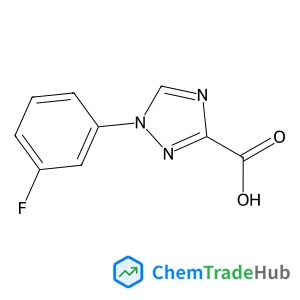
1-(3-Fluorophenyl)-1H-1,2,4-triazole-3-carboxylic acid
CAS Number:
1292369-51-7
Molecular Formula:
C9H6FN3O2
Marcelo Lopes Pereira Junior, Wiliam Ferreira da Cunha, Luiz Antonio Ribeiro Junior
Recently, laser-assisted chemical vapor deposition has been used to synthesize a free-standing, continuous, and stable monolayer amorphous carbon (MAC). MAC is a pure carbon structure composed of randomly distributed five, six, seven, and eight atom rings, which is different from that of disordered graphene. More recently, amorphous MAC-based nanotubes (a-CNT) and nanoscrolls (a-CNS) were proposed. In this work, we have investigated (through fully atomistic reactive molecular dynamics simulations) the mechanical properties and sublimation points of pristine and a-CNT and a-CNS. The results showed that a-CNT and a-CNS have distinct elastic properties and fracture patterns compared to those of their pristine analogs. Both a-CNT and a-CNS presented a non-elastic regime before their total rupture, whereas the CNT and CNS underwent a direct conversion to fractured forms after a critical strain threshold. The critical strain values for the fracture of the a-CNT and a-CNS are about 30% and 25%, respectively, and they are lower than those of the corresponding CNT and CNS cases. Although less resilient to tension, the amorphous tubular structures have similar thermal stability in relation to the pristine cases with sublimation points of 5500 K, 6300 K, 5100 K, and 5900 K for a-CNT, CNT, a-CNS, and CNS, respectively. An interesting result is that the nanostructure behavior is substantially different depending on whether it is a nanotube or a nanoscroll, thus indicating that the topology plays an important role in defining its elastic properties.
J. Milewski
DOI: 10.1039/C8CP02440E
DOI: 10.1039/C8CP02814A
Agustín Lorenzo, Waldemar A. Marmisollé, Marcelo Ceolín, Omar Azzaroni
DOI: 10.1039/C7CP08139A
M. E. Sasin, A. G. Smolin, K.-H. Gericke, E. Tokunaga, O. S. Vasyutinskii
DOI: 10.1039/C8CP02708K
Sheng-Lung Chou, Jen-Iu Lo, Yu-Chain Peng, Hsiao-Chi Lu, Bing-Ming Cheng
DOI: 10.1039/C8CP00078F
Alexander M. Khenkin, Irena Efremenko, Jan M. L. Martin, Ronny Neumann
DOI: 10.1039/C7CP08610E
Urmimala Dey, Swastika Chatterjee
DOI: 10.1039/C8CP01500G
M. Oujja, J. G. Izquierdo, L. Bañares, R. de Nalda, M. Castillejo
DOI: 10.1039/C8CP02825G
Juan Carlos Coa, Wilson Cardona-Galeano, Albeiro Restrepo
DOI: 10.1039/C8CP04174A
Waste containing N-Methoxy-N-methyl-1,3-thiazole-5-carboxamide (CAS: 898825-89-3...
N-(4-Biphenylyl)dibenzo[b,d]furan-4-amine should be stored in a tightly sealed c...
The market for 3-Acetamido-5-amino-2,4,6-triiodobenzoic acid (CAS: 1713-07-1) is...
Benzyl 2-O-acetyl-3,4,6-tri-O-benzyl-beta-D-galactopyranoside (CAS: 61820-03-9) ...
2-Ethylpiperazine dihydrochloride (CAS: 438050-52-3) is regulated under the Glob...
1,1'-[1,3-Phenylenebis(methylene)]bis(3-methyl-1H-pyrrole-2,5-dione) (CAS: 11946...
Several alternatives can be used in the synthesis of 5-Fluoro-2-(1-pyrrolidinyl)...
Proper personal protective equipment (PPE) must be worn when handling this compo...
When handling 6-Bromoimidazo[1,2-a]pyridin-8-amine, it is important to wear appr...
Alternatives to (2S,4R)-4-(4-Nitrobenzyl)pyrrolidine-2-carboxylic acid hydrochlo...

Physical Chemistry Chemical Physics (PCCP) is an international journal co-owned by 19 physical chemistry and physics societies from around the world. This journal publishes original, cutting-edge research in physical chemistry, chemical physics and biophysical chemistry. To be suitable for publication in PCCP, articles must include significant innovation and/or insight into physical chemistry; this is the most important criterion that reviewers and Editors will judge against when evaluating submissions. The journal has a broad scope and welcomes contributions spanning experiment, theory, computation and data science. Topical coverage includes spectroscopy, dynamics, kinetics, statistical mechanics, thermodynamics, electrochemistry, catalysis, surface science, quantum mechanics, quantum computing and machine learning. Interdisciplinary research areas such as polymers and soft matter, materials, nanoscience, energy, surfaces/interfaces, and biophysical chemistry are welcomed if they demonstrate significant innovation and/or insight into physical chemistry. Joined experimental/theoretical studies are particularly appreciated when complementary and based on up-to-date approaches.