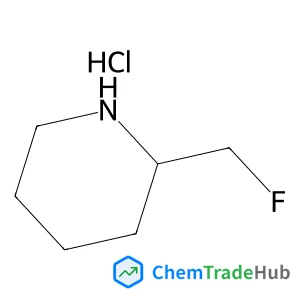
(2S)-2-(Fluoromethyl)piperidine hydrochloride (1:1)
CAS Number:
886216-73-5
Molecular Formula:
C6H13ClFN
Alexander M. Khenkin, Irena Efremenko, Jan M. L. Martin, Ronny Neumann
The reactivity of the H5PV2Mo10O40 polyoxometalate and its analogues as an electron transfer and electron transfer–oxygen transfer oxidant has been extensively studied in the past and has been shown to be useful in many transformations. One of the hallmarks of this oxidant is the possibility of its re-oxidation with molecular oxygen, thus enabling aerobic catalytic cycles. Although the re-oxidation reaction was known, the kinetics and mechanism of this reaction have not been studied in any detail. Experimentally, we show that both the one- and two-electron reduced polyoxometalate are reactive with O2, the two-electron one more so. The reactions are first-order in the polyoxometalate and O2. Solvents also have a considerable effect, protic solvents being preferred over aprotic ones. H5PV2Mo10O40 was reduced either by an electron transfer reaction (H2) or an electron transfer–oxygen transfer reaction (Ph3P). Similar rate constants and activation parameters were observed for both. DFT calculations carried out on the re-oxidation reactions strongly suggest an inner-sphere process. The process involves first the formation of a coordinatively unsaturated site (CUS) and subsequently the binding of O2 to form superoxo and then peroxo η2-O2 adducts. Most interestingly, although vanadium is the reactive redox centre as well as a necessary component for the oxidative activity of H5PV2Mo10O40, and a CUS can be formed at both Mo and V sites, O2 coordination occurs mostly at the Mo CUSs, preferably those where the vanadium centers are distal to each other.
Sunghwan Shin, Francesco Greco, Florian Maier, Hans-Peter Steinrück
DOI: 10.1039/D0CP04811A
Sandrine Denis-Quanquin, Alessio Bartocci, Florence Szczepaniak, Francois Riobé, Olivier Maury, Nicolas Giraud
DOI: 10.1039/D0CP06570F
Matteo Busato, Valentina Migliorati, Alessandra Del Giudice, Valerio Di Lisio, Pierpaolo Tomai, Alessandra Gentili, Paola D'Angelo
DOI: 10.1039/D1CP01105G
Hani El Moll, Ryan Purdy, Kevin B. Vincent, Philip Spence, Jean-Pierre Malval, John Fielden
DOI: 10.1039/D0CP06610A
S. Carniato, R. Püttner, J. B. Martins, D. Céolin, R. Feifel
DOI: 10.1039/D1CP00607J
DOI: 10.1039/D0CP06002J
Satoshi Uchida, Tetsu Kiyobayashi
DOI: 10.1039/D1CP00967B
F. Crasto de Lima, A. Fazzio
DOI: 10.1039/D1CP01030A
Rizalina T. Saragi, Marcos Juanes, Gang Feng, Alberto Lesarri
DOI: 10.1039/D1CP00997D
Yutichai Mueanngern, Cheng-Han Li, Meiling Spelic, Joshua Graham, Nathan Pimental, Yehia Khalifa, Joerg R. Jinschek, L. Robert Baker
DOI: 10.1039/D1CP00637A
Waste containing N-Methoxy-N-methyl-1,3-thiazole-5-carboxamide (CAS: 898825-89-3...
N-(4-Biphenylyl)dibenzo[b,d]furan-4-amine should be stored in a tightly sealed c...
The market for 3-Acetamido-5-amino-2,4,6-triiodobenzoic acid (CAS: 1713-07-1) is...
Benzyl 2-O-acetyl-3,4,6-tri-O-benzyl-beta-D-galactopyranoside (CAS: 61820-03-9) ...
2-Ethylpiperazine dihydrochloride (CAS: 438050-52-3) is regulated under the Glob...
1,1'-[1,3-Phenylenebis(methylene)]bis(3-methyl-1H-pyrrole-2,5-dione) (CAS: 11946...
Several alternatives can be used in the synthesis of 5-Fluoro-2-(1-pyrrolidinyl)...
Proper personal protective equipment (PPE) must be worn when handling this compo...
When handling 6-Bromoimidazo[1,2-a]pyridin-8-amine, it is important to wear appr...
Alternatives to (2S,4R)-4-(4-Nitrobenzyl)pyrrolidine-2-carboxylic acid hydrochlo...

Physical Chemistry Chemical Physics (PCCP) is an international journal co-owned by 19 physical chemistry and physics societies from around the world. This journal publishes original, cutting-edge research in physical chemistry, chemical physics and biophysical chemistry. To be suitable for publication in PCCP, articles must include significant innovation and/or insight into physical chemistry; this is the most important criterion that reviewers and Editors will judge against when evaluating submissions. The journal has a broad scope and welcomes contributions spanning experiment, theory, computation and data science. Topical coverage includes spectroscopy, dynamics, kinetics, statistical mechanics, thermodynamics, electrochemistry, catalysis, surface science, quantum mechanics, quantum computing and machine learning. Interdisciplinary research areas such as polymers and soft matter, materials, nanoscience, energy, surfaces/interfaces, and biophysical chemistry are welcomed if they demonstrate significant innovation and/or insight into physical chemistry. Joined experimental/theoretical studies are particularly appreciated when complementary and based on up-to-date approaches.