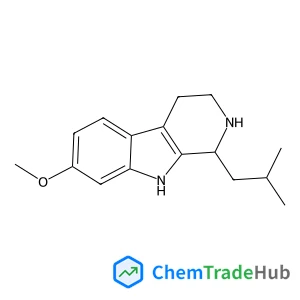
1-Isobutyl-7-methoxy-2,3,4,9-tetrahydro-1H-beta-carboline
CAS Number:
175975-76-5
Molecular Formula:
C16H22N2O
Swaroop Chandra, B. Suryaprasad, N. Ramanathan, K. Sundararajan
The role of nitrogen, the first member of the pnicogen group, as an electron donor in hypervalent non-covalent interactions has been established long ago, while observation of its electron accepting capability is still elusive experimentally, and remains quite intriguing, conceptually. In the light of minimal computational exploration of this novel class of pnicogen bonding so far, the present work provides experimental proof with unprecedented clarity, for the existence of N(acceptor)⋯N(donor) interaction using the model nitromethane (NM) molecule with ammonia (AM) as a Lewis base in NM–AM aggregates. The NM–AM dimer, in which the nitrogen atom of NM (as a unique pnicogen) accepts electrons from AM (the traditional electron donor), was synthesized at low temperatures under isolated conditions within inert gas matrixes and was characterized using infrared spectroscopy. The experimental generation of the NM–AM dimer stabilized via N⋯N interaction has strong corroboration from ab initio calculations. Furthermore, confirmation regarding the directional prevalence of this N⋯N interaction over C–H⋯N and N–H⋯O hydrogen bonding is elucidated quantitatively by quantum theory of atoms in molecules (QTAIM), electrostatic potential mapping (ESP), natural bond orbital (NBO), non-covalent interaction (NCI) and energy decomposition (ED) analyses. The present study also allows the extension of σ-hole/π-hole driven interactions to the atoms of the second period, in spite of their low polarizability.

Science Progress

Journal of Physics and Chemistry of Solids

Organic Preparations and Procedures International

European Journal of Wood and Wood Products

Journal of Heterocyclic Chemistry

Journal of Catalysis

Pharmacological Reviews

Russian Chemical Reviews

Planta Medica

Proceedings of the National Academy of Sciences of the United States of America
Teruaki Hasegawa, Tomohisa Fujisawa, Munenori Numata, Mariko Umeda, Takahiro Matsumoto, Taro Kimura, Shiro Okumura, Kazuo Sakurai, Seiji Shinkai
DOI: 10.1039/B407409B
David R. Spring
DOI: 10.1039/B409495F
S. Chandrasekhar, Ch. Narsihmulu, N. Ramakrishna Reddy, S. Shameem Sultana
DOI: 10.1039/B409053P
Xueguang Wang, Kyle S. K. Lin, Jerry C. C. Chan, Soofin Cheng
DOI: 10.1039/B408022J
Evonne A. Baldauff
DOI: 10.1039/B406230B
Michel Frigoli, Georg H. Mehl
DOI: 10.1039/B407561G
Kazumasa Funabiki, Wataru Hashimoto, Masaki Matsui
DOI: 10.1039/B408226E
Lukas J. Gooßen, Debasis Koley, Holger Hermann, Walter Thiel
DOI: 10.1039/B409144B
Ian J. Munslow, Andrew R. Wade, Robert J. Deeth, Peter Scott
DOI: 10.1039/B409113B
Feng Li, Jingnan Cui, Rong Zhang
DOI: 10.1039/B408566C
N-(4-Methoxybenzyl)-2-pyridinamine (CAS: 52818-63-0) is increasingly being used ...
When handling Ethyl 4-(2-chlorophenyl)-1,3-thiazole-2-carboxylate, appropriate p...
Diethyldiselane (CAS: 628-39-7) is classified under the Globally Harmonized Syst...
The market for oxocopper (CAS: 12053-18-8) is primarily driven by its use in cat...
The market for 5-{[(2-Methyl-2-propanyl)oxy]carbonyl}-5-azaspiro[2.4]heptane-7-c...
2-(1-Pyrrolidinyl)-4-pyridinamine is a chemical compound with the CAS number 359...
2-(3-Pyridinyl)-1-azabicyclo[2.2.2]octane (CAS: 91556-75-1) is a crystalline sol...
(S)-Alpha-allyl-proline hydrochloride is usually synthesized via a Wittig reacti...
3-Methyl-1,2-oxazole-5-carboxylic acid (CAS: 4857-42-5) is an organic compound w...
Lys-SMCC-DM1 is synthesized via a multi-step process involving the coupling of S...

Physical Chemistry Chemical Physics (PCCP) is an international journal co-owned by 19 physical chemistry and physics societies from around the world. This journal publishes original, cutting-edge research in physical chemistry, chemical physics and biophysical chemistry. To be suitable for publication in PCCP, articles must include significant innovation and/or insight into physical chemistry; this is the most important criterion that reviewers and Editors will judge against when evaluating submissions. The journal has a broad scope and welcomes contributions spanning experiment, theory, computation and data science. Topical coverage includes spectroscopy, dynamics, kinetics, statistical mechanics, thermodynamics, electrochemistry, catalysis, surface science, quantum mechanics, quantum computing and machine learning. Interdisciplinary research areas such as polymers and soft matter, materials, nanoscience, energy, surfaces/interfaces, and biophysical chemistry are welcomed if they demonstrate significant innovation and/or insight into physical chemistry. Joined experimental/theoretical studies are particularly appreciated when complementary and based on up-to-date approaches.
![(2R,6S)-6-[(Benzyloxy)methyl]-4-{[(2-methyl-2-propanyl)oxy]carbonyl}-2-morpholinecarboxylic acid structure](https://static.chemtradehub.com/structs/109/1093085-91-6-3382.webp "(2R,6S)-6-[(Benzyloxy)methyl]-4-{[(2-methyl-2-propanyl)oxy]carbonyl}-2-morpholinecarboxylic acid structure")
![1-{3-[4-Amino-3-(4-phenoxyphenyl)-1H-pyrazolo[3,4-d]pyrimidin-1-yl]-1-piperidinyl}-2,3-dihydroxy-1-propanone structure](https://static.chemtradehub.com/structs/122/1226872-27-0-e037.webp "1-{3-[4-Amino-3-(4-phenoxyphenyl)-1H-pyrazolo[3,4-d]pyrimidin-1-yl]-1-piperidinyl}-2,3-dihydroxy-1-propanone structure")