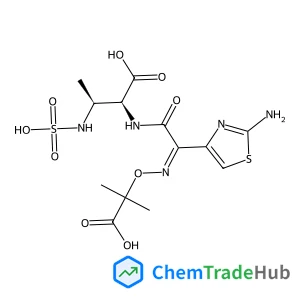
Aztreonam USP Related Compound A (Open-ring Aztreonam)
CAS Number:
87500-74-1
Molecular Formula:
C13H19N5O9S2
Critical Casimir force (CCF) is a solvent fluctuation introduced interaction between particles dispersed in a binary solvent. Recently, it has been demonstrated that the CCF induced attraction between particles can trigger particle size-sensitive aggregation, and has thus been used as an efficient way to purify nanoparticles by size. Here, combining small angle neutron scattering and dynamic light scattering, we investigate the effects of size and concentration on this particle size separation method. Increasing the particle concentration does not significantly affect the purification method, but the solvent composition needs to be adjusted for an optimized efficiency. This purification method is further demonstrated to work also very efficiently for systems with particle size ranging from 15 nm to about 50 nm with a very large size polydispersity. These results indicate that for both short-ranged and long-ranged attraction relative to the particle diameter, the CCF introduced particle aggregation is always size sensitive. This implies that particle aggregation is strongly affected by size polydispersity for many colloidal systems. We further propose a method to use light scattering to help identify the temperature range within which this particle purification method can work efficiently instead of using neutron scattering.
Lijun Huo, Zhaojun Li, Xia Guo, Yue Wu, Maojie Zhang, Long Ye, Shaoqing Zhang, Jianhui Hou
DOI: 10.1039/C3PY00074E
Jacquelin K. Kammeyer, Angela P. Blum, Lisa Adamiak, Nathan C. Gianneschi
DOI: 10.1039/C3PY00526G
Venkata S. Pavan K. Neti, Xiaofei Wu, Shuguang Deng, Luis Echegoyen
DOI: 10.1039/C3PY00798G
Xunshan Liu, Yuanshuai Huang, Zhencai Cao, Chao Weng, Huajie Chen, Songting Tan
DOI: 10.1039/C3PY00614J
Benjamin Canniccioni, Sophie Monge, Ghislain David, Jean-Jacques Robin
DOI: 10.1039/C3PY00426K
DOI: 10.1039/C3PY00216K
Kai-Steffen Krannig, Jin Huang, Andreas Heise, Helmut Schlaad
DOI: 10.1039/C3PY00428G
Saadyah E. Averick, Krzysztof Matyjaszewski
DOI: 10.1039/C3PY00055A
Ali Ghadban, Eric Reynaud, Marguerite Rinaudo, Luca Albertin
DOI: 10.1039/C3PY00730H
Haibo Wang, Fangming Xu, Yin Wang, Xiangsheng Liu, Qiao Jin, Jian Ji
DOI: 10.1039/C3PY00139C
6-(3-Fluorophenyl)picolinic acid is generally considered safe for laboratory use...
(3R)-3-Pyrrolidinol is used in the pharmaceutical industry as a precursor for dr...
When handling (4R,5R)-4,5-Diethoxycarbonyl-2,2-dimethyldioxolane (CAS: 59779-75-...
1-(6-Chloroimidazo[1,2-b]pyridazin-3-yl)ethanone is often synthesized via a mult...
The market for N-Ethyl-3,4-dimethylbenzylamine (CAS: 39180-83-1) remains steady,...
Tert-butyl 3-(pyrrolidin-1-yl)azetidine-1-carboxylate is a chemical compound wit...
1-Bromo-3-chloro-2,4-dimethoxybenzene (CAS: 1228956-93-1) falls under the classi...
The safety of 8-Bromo-2-methyl-3,4-dihydroisoquinolin-1(2H)-one (CAS: 1368622-07...
Benzyl [(3S)-2,6-dioxo-3-piperidinyl]carbamate is generally safe when handled wi...
1-{[4-(4,4,5,5-Tetramethyl-1,3,2-dioxaborolan-2-yl)phenyl]sulfonyl}pyrrolidine s...

Physical Chemistry Chemical Physics (PCCP) is an international journal co-owned by 19 physical chemistry and physics societies from around the world. This journal publishes original, cutting-edge research in physical chemistry, chemical physics and biophysical chemistry. To be suitable for publication in PCCP, articles must include significant innovation and/or insight into physical chemistry; this is the most important criterion that reviewers and Editors will judge against when evaluating submissions. The journal has a broad scope and welcomes contributions spanning experiment, theory, computation and data science. Topical coverage includes spectroscopy, dynamics, kinetics, statistical mechanics, thermodynamics, electrochemistry, catalysis, surface science, quantum mechanics, quantum computing and machine learning. Interdisciplinary research areas such as polymers and soft matter, materials, nanoscience, energy, surfaces/interfaces, and biophysical chemistry are welcomed if they demonstrate significant innovation and/or insight into physical chemistry. Joined experimental/theoretical studies are particularly appreciated when complementary and based on up-to-date approaches.