












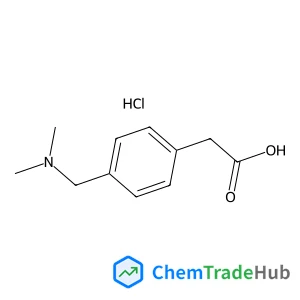
4-(Dimethylaminomethyl)phenylacetic acid hydrochloride
CAS Number:
99985-52-1
Molecular Formula:
C11H16ClNO2
Laura Abella, Adam Philips, Jochen Autschbach
The sodium anion (Na−) was once thought to behave like a ‘genuine’ anion, with both the [Ne] core and the 3s valence shell interacting very weakly with their environments. In the present work, following a recent study of the surprisingly small quadrupolar line widths of Na−, NMR shielding calculations were carried out for the Na−/Na+ [2.2.2]cryptand system solvated in methylamine, based on ab initio molecular dynamics simulations, followed by detailed analyses of the shielding constants. The results confirm that Na− does not act like a quasi-free ion that interacts only weakly with its surroundings. Rather, the filled 3s shell of Na− interacts strongly with its chemical environment, but only weakly with the ion's own core and the nucleus, and it isolates the core from the chemical environment. As a consequence, the Na− ion appears in NMR experiments like a free ion.
Dolos Foguet-Albiol, Khalil A. Abboud, George Christou
DOI: 10.1039/B507748F
Jeane Bordini, Peter C. Ford, Elia Tfouni
DOI: 10.1039/B507407J
Hanh. V. Ly, Taryn. D. Forster, Darren Maley, Masood Parvez, Roland Roesler
DOI: 10.1039/B508152A
Steven Dickson, Darrell Dean, Robert. D. Singer
DOI: 10.1039/B508400H
A. J. (Ton) Dirks, Sander S. van Berkel, Nikos S. Hatzakis, Joost A. Opsteen, Floris L. van Delft, Jeroen J. L. M. Cornelissen, Alan E. Rowan, Jan C. M. van Hest, Floris P. J. T. Rutjes, Roeland J. M. Nolte
DOI: 10.1039/B508428H
Michihiro Shirakawa, Norifumi Fujita, Takahiro Tani, Kenji Kaneko, Seiji Shinkai
DOI: 10.1039/B506148B
Sibylle Müller, Klaus Müllen
DOI: 10.1039/B509220E
Hiroyuki Katayama, Hiroshi Yari, Masaki Tanaka, Fumiyuki Ozawa
DOI: 10.1039/B504436G
Tsutomu Kimura, Toshiaki Murai
DOI: 10.1039/B507755A
Waste containing N-Methoxy-N-methyl-1,3-thiazole-5-carboxamide (CAS: 898825-89-3...
N-(4-Biphenylyl)dibenzo[b,d]furan-4-amine should be stored in a tightly sealed c...
The market for 3-Acetamido-5-amino-2,4,6-triiodobenzoic acid (CAS: 1713-07-1) is...
Benzyl 2-O-acetyl-3,4,6-tri-O-benzyl-beta-D-galactopyranoside (CAS: 61820-03-9) ...
2-Ethylpiperazine dihydrochloride (CAS: 438050-52-3) is regulated under the Glob...
1,1'-[1,3-Phenylenebis(methylene)]bis(3-methyl-1H-pyrrole-2,5-dione) (CAS: 11946...
Several alternatives can be used in the synthesis of 5-Fluoro-2-(1-pyrrolidinyl)...
Proper personal protective equipment (PPE) must be worn when handling this compo...
When handling 6-Bromoimidazo[1,2-a]pyridin-8-amine, it is important to wear appr...
Alternatives to (2S,4R)-4-(4-Nitrobenzyl)pyrrolidine-2-carboxylic acid hydrochlo...

Physical Chemistry Chemical Physics (PCCP) is an international journal co-owned by 19 physical chemistry and physics societies from around the world. This journal publishes original, cutting-edge research in physical chemistry, chemical physics and biophysical chemistry. To be suitable for publication in PCCP, articles must include significant innovation and/or insight into physical chemistry; this is the most important criterion that reviewers and Editors will judge against when evaluating submissions. The journal has a broad scope and welcomes contributions spanning experiment, theory, computation and data science. Topical coverage includes spectroscopy, dynamics, kinetics, statistical mechanics, thermodynamics, electrochemistry, catalysis, surface science, quantum mechanics, quantum computing and machine learning. Interdisciplinary research areas such as polymers and soft matter, materials, nanoscience, energy, surfaces/interfaces, and biophysical chemistry are welcomed if they demonstrate significant innovation and/or insight into physical chemistry. Joined experimental/theoretical studies are particularly appreciated when complementary and based on up-to-date approaches.
![2-Methyl-2-propanyl {3-[4-(4,4,5,5-tetramethyl-1,3,2-dioxaborolan-2-yl)phenyl]-3-oxetanyl}carbamate structure](https://static.chemtradehub.com/structs/127/1279090-25-3-1b84.webp "2-Methyl-2-propanyl {3-[4-(4,4,5,5-tetramethyl-1,3,2-dioxaborolan-2-yl)phenyl]-3-oxetanyl}carbamate structure")
![[(5-Methyl-1,3,4-thiadiazol-2-yl)sulfanyl]acetic acid structure](https://static.chemtradehub.com/structs/509/50918-26-8-4ce8.webp "[(5-Methyl-1,3,4-thiadiazol-2-yl)sulfanyl]acetic acid structure")






