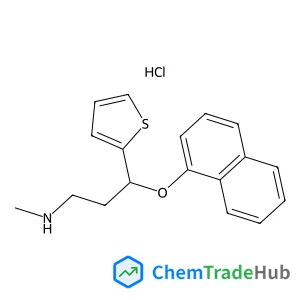
N-Methyl-3-(1-naphthyloxy)-3-(2-thienyl)-1-propanamine hydrochloride (1:1)
CAS Number:
1188266-11-6
Molecular Formula:
C18H20ClNOS
Dong Chen, Chun-Lei Wang
Exploring the manipulation of magnetism in perovskite oxides is scientifically interesting and of great technical importance in next-generation magnetic memory. Dual control of magnetism in superlattices through epitaxial strain and ferroelectric polarization may induce rich physical properties. In this work, we demonstrated a strong magnetoelectric coupling that appears in an La0.75Sr0.25MnO3/BaTiO3 superlattice. Reversible transitions in ferromagnetism, ferrimagnetism and anti-ferromagnetism, with strong magnetoelectric coupling, are achieved by precisely controlling the magnitude and spin-direction of the magnetic moments of Mn. Half-metallicity is demonstrated in the MnO2 layers, accompanied by the spin polarization of the superlattice varying from 100% to 0%. We realize the coexistence of ferroelectric polarization and metallicity, i.e., “ferroelectric metal”. The variation in strain and re-orientation of polarization lead to a change in interfacial Ti–O and Mn–O bond lengths, and hence a hybridization state, determining the magnetism of our system. The purpose-designed LSMO/BTO superlattice with intrinsic magnetoelectric coupling is a particularly interesting model system that can provide guidance for the development of spintronic devices.
Alexander M. Funk, Peter Harvey, Katie-Louise N. A. Finney, Mark A. Fox, Alan M. Kenwright, Nicola J. Rogers, P. Kanthi Senanayake, David Parker
DOI: 10.1039/C5CP02210J
Jing Wu, Haiqin Cui, Xuliang Zhang, Yunbo Luan, Liqiang Jing
DOI: 10.1039/C5CP02084K
Christoph Bannwarth, Stefan Grimme
DOI: 10.1039/C5CP01417D
Yi-Ping Lin, Chiun-Yan Lin, Yen-Hung Ho, Thi-Nga Do, Ming-Fa Lin
DOI: 10.1039/C5CP02496J
ZhongCheng Xiang, Zhong Zhang, XiJin Xu, Qin Zhang, QingBao Wang, Chengwu Yuan
DOI: 10.1039/C5CP01509J
Junwei Lucas Bao, Prasenjit Seal, Donald G. Truhlar
DOI: 10.1039/C5CP01979F
Jingtian Kang, Changguo Wang, Defeng Li, Ge He, Huifeng Tan
DOI: 10.1039/C5CP01984B
Jonas Elm, Patrick Norman, Kurt V. Mikkelsen
DOI: 10.1039/C5CP01012H
Junfeng Niu, Yunrong Dai, Lifeng Yin, Jianying Shang, John C. Crittenden
DOI: 10.1039/C5CP02244D
Vitaly V. Chaban, Eudes Eterno Fileti
DOI: 10.1039/C5CP00350D
Waste containing 6-Chloro-5-(2'-hydroxy-3'-methoxy-4-biphenylyl)-3-(3-methoxyphe...
(3alpha,5alpha)-3-Hydroxypregnane-11,20-dione is primarily used in the pharmaceu...
The market for 4-Amino-6-chloro-2-pyridinecarboxylic acid (CAS: 546141-56-4) is ...
Alternatives to (2-Benzoylethyl)trimethylammonium chloride (CAS: 24472-88-6) in ...
N-[4-Nitro-3-(trifluoromethyl)phenyl]acetamide (CAS: 393-12-4) is generally safe...
Alternative reagents such as other phosphates or similar functional groups can b...
There are alternatives to N,N'-Bis(3-aminopropyl)-1,3-propanediamine (CAS: 4605-...
When handling Aluminium trihexadecanoate, it is important to use appropriate per...
(1,1-Dioxido-3-oxo-1,2-benzothiazol-2(3H)-yl)acetic acid is a chemical compound ...
Several alternatives to 5,5-dimethyloxolan-2-one (CAS: 3123-97-5) can be used in...

Physical Chemistry Chemical Physics (PCCP) is an international journal co-owned by 19 physical chemistry and physics societies from around the world. This journal publishes original, cutting-edge research in physical chemistry, chemical physics and biophysical chemistry. To be suitable for publication in PCCP, articles must include significant innovation and/or insight into physical chemistry; this is the most important criterion that reviewers and Editors will judge against when evaluating submissions. The journal has a broad scope and welcomes contributions spanning experiment, theory, computation and data science. Topical coverage includes spectroscopy, dynamics, kinetics, statistical mechanics, thermodynamics, electrochemistry, catalysis, surface science, quantum mechanics, quantum computing and machine learning. Interdisciplinary research areas such as polymers and soft matter, materials, nanoscience, energy, surfaces/interfaces, and biophysical chemistry are welcomed if they demonstrate significant innovation and/or insight into physical chemistry. Joined experimental/theoretical studies are particularly appreciated when complementary and based on up-to-date approaches.
![1-oxaspiro[4.4]nonan-6-one structure](https://static.chemtradehub.com/structs/134/134179-01-4-e051.webp "1-oxaspiro[4.4]nonan-6-one structure")