












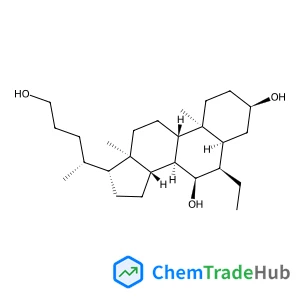
(3alpha,5beta,6alpha,7alpha)-6-Ethylcholane-3,7,24-triol
CAS Number:
1537866-49-1
Molecular Formula:
C26H46O3
Junfeng Niu, Yunrong Dai, Lifeng Yin, Jianying Shang, John C. Crittenden
Triclosan (TCS) is a potential threat to the environment and human health. Photocatalysis can be used to degrade TCS, but the photocatalytic efficiency is usually limited by the photoabsorptivity and photostability of the photocatalyst. In addition, some toxic by-products might also be generated during photocatalytic processes. In this study, we prepared Au-coated Cu2O nanowire arrays (Au–Cu2O NWAs) by beam sputtering Au onto Cu2O nanowires grown from a Cu foil. We found that photocatalytic degradation of TCS under visible light (420 nm < λ < 780 nm) irradiation and Au–Cu2O NWAs had several advantages. Au–Cu2O NWAs had good photoabsorptivity, high photostability (negligible activity loss after 16 runs), excellent photocatalytic activity (47.6 times faster than that of Cu2O), and low yield of dichlorodibenzo-dioxins/dichlorohydroxydibenzofurans. The degradation intermediates were identified as chlorophenoxyphenol, phenoxyphenol, chlorophenol, catechol, phenol, benzoquinone, and lower volatile acids. We developed the degradation pathway of TCS which follows electron reduction and then oxidation by reactive oxygen species. The mechanism was developed and strengthened using the radical trapping and other measurements. The unusual mechanism and photostability of Au–Cu2O NWAs were attributed to the Au/Cu2O/Cu “sandwich”-like structure. This structure yields a sustained and steady internal electric field, raises the conduction band of Cu2O, reinforces the reductive activity of the photo-generated electrons, and eliminates the photo-generated holes that are responsible for the photo-etching of Cu2O.
Ji-Na Hao, Kaiming Ge, Guoli Chen, Bin Dai
DOI: 10.1039/D3CS00356F
Dameng Yang, Nicholas J. Turner
DOI: 10.1039/D3CS00391D
Xianhai Tian, Yuliang Liu, Shahboz Yakubov, Jonathan Schütte, Shunsuke Chiba, Joshua P. Barham
DOI: 10.1039/D2CS00581F
Divita Mathur, Sebastián A. Díaz, Ryan D. Pensack, Bernard Yurke, Austin Biaggne, Joseph S. Melinger, William B. Knowlton, Igor L. Medintz
DOI: 10.1039/D0CS00936A
Moritz Thürlemann, Sereina Riniker
DOI: 10.1039/D3SC04317G
Yonghua Liu
DOI: 10.1039/D3SC04688E
Tyler J. Hannah, Saurabh S. Chitnis
DOI: 10.1039/D3CS00765K
Hao Lan, Jiawei Wang, Liwei Cheng, Dandan Yu, Hua Wang, Lin Guo
DOI: 10.1039/D3CS00860F
Andrew J. deMello, Maosheng Yao, Junji Cao
DOI: 10.1039/D3CS00417A
Fulong Zhu, Wei Guo, Yongzhu Fu
DOI: 10.1039/D3CS00703K
Waste containing 6-Chloro-5-(2'-hydroxy-3'-methoxy-4-biphenylyl)-3-(3-methoxyphe...
(3alpha,5alpha)-3-Hydroxypregnane-11,20-dione is primarily used in the pharmaceu...
The market for 4-Amino-6-chloro-2-pyridinecarboxylic acid (CAS: 546141-56-4) is ...
Alternatives to (2-Benzoylethyl)trimethylammonium chloride (CAS: 24472-88-6) in ...
N-[4-Nitro-3-(trifluoromethyl)phenyl]acetamide (CAS: 393-12-4) is generally safe...
Alternative reagents such as other phosphates or similar functional groups can b...
There are alternatives to N,N'-Bis(3-aminopropyl)-1,3-propanediamine (CAS: 4605-...
When handling Aluminium trihexadecanoate, it is important to use appropriate per...
(1,1-Dioxido-3-oxo-1,2-benzothiazol-2(3H)-yl)acetic acid is a chemical compound ...
Several alternatives to 5,5-dimethyloxolan-2-one (CAS: 3123-97-5) can be used in...

Physical Chemistry Chemical Physics (PCCP) is an international journal co-owned by 19 physical chemistry and physics societies from around the world. This journal publishes original, cutting-edge research in physical chemistry, chemical physics and biophysical chemistry. To be suitable for publication in PCCP, articles must include significant innovation and/or insight into physical chemistry; this is the most important criterion that reviewers and Editors will judge against when evaluating submissions. The journal has a broad scope and welcomes contributions spanning experiment, theory, computation and data science. Topical coverage includes spectroscopy, dynamics, kinetics, statistical mechanics, thermodynamics, electrochemistry, catalysis, surface science, quantum mechanics, quantum computing and machine learning. Interdisciplinary research areas such as polymers and soft matter, materials, nanoscience, energy, surfaces/interfaces, and biophysical chemistry are welcomed if they demonstrate significant innovation and/or insight into physical chemistry. Joined experimental/theoretical studies are particularly appreciated when complementary and based on up-to-date approaches.
![1-[6-(1H-Imidazol-1-yl)-3-pyridinyl]methanamine structure](https://static.chemtradehub.com/structs/914/914637-08-4-8825.webp "1-[6-(1H-Imidazol-1-yl)-3-pyridinyl]methanamine structure")




