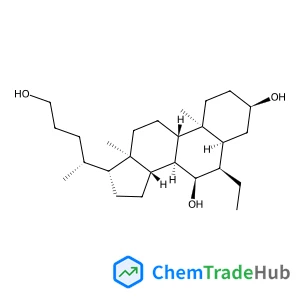
(3alpha,5beta,6alpha,7alpha)-6-Ethylcholane-3,7,24-triol
CAS Number:
1537866-49-1
Molecular Formula:
C26H46O3
Metallocarbohedrenes or metcars belong to one of the classes of stable nanoclusters having a specific stoichiometry. In spite of the available theoretical and experimental studies, the structure of pristine Ti8C12 metcar is still uncertain. We study the geometric structure of a titanium metcar, Ti8C12, together with its electronic properties and chemical activity towards adsorption and activation of CO2 molecule by means of density functional theory. Our results suggest that the CO2 molecule is strongly adsorbed and undergoes a significantly high degree of activation onto the Ti8C12 metcar. The migration of charge from titanium metcar to CO2 molecule attributes the high degree of activation of this molecule. In the infrared vibrational spectra for CO2 molecule adsorbed onto Ti8C12, we find a new signal which is absent in the corresponding spectra for gaseous CO2. In addition to adsorption energy, we also estimate the energy barrier for the dissociation of CO2 molecule to CO and O fragments on a Ti8C12 cluster. As a whole, this work reveals the ground state geometry of Ti8C12 metcar and highlights the role of this metcar in CO2 adsorption and activation, which are the key steps in designing potential catalysts for CO2 capture and its conversion to industrially valuable chemicals.

Molecular Pharmacology

Science

Helvetica Chimica Acta

Journal of Catalysis

Journal of Heterocyclic Chemistry

Russian Chemical Reviews

Proceedings of the National Academy of Sciences of the United States of America

Israel Journal of Chemistry

Organic Preparations and Procedures International

Journal of Physics and Chemistry of Solids
Shosuke Kojo, Hiromi Uchino, Mayu Yoshimura, Kyoko Tanaka
DOI: 10.1039/B409941A
Cheng-Yong Su, Andrea M. Goforth, Mark D. Smith, Hans-Conrad zur Loye
DOI: 10.1039/B406126H
Daniel C. H. Oakes, Brian S. Kimberley, Vernon C. Gibson, David J. Jones, Andrew J. P. White, David J. Williams
DOI: 10.1039/B409870F
Chang-Cheng You, Chantu R. Saha-Möller, Frank Würthner
DOI: 10.1039/B407551J
Narottam Gharah, Santu Chakraborty, Alok K. Mukherjee, Ramgopal Bhattacharyya
DOI: 10.1039/B408946D
Teruaki Hasegawa, Tomohisa Fujisawa, Munenori Numata, Mariko Umeda, Takahiro Matsumoto, Taro Kimura, Shiro Okumura, Kazuo Sakurai, Seiji Shinkai
DOI: 10.1039/B407409B
Mangesh T. Bore, Hien N. Pham, Timothy L. Ward, Abhaya K. Datye
DOI: 10.1039/B407575G
David R. Kelly, Alastair Meek, Stanley M. Roberts
DOI: 10.1039/B404379K
Ana Galet, M. Carmen Muñoz, Víctor Martínez, José Antonio Real
DOI: 10.1039/B409974E
Heqing Jiang, Lina Huang, Zhijun Zhang, Tao Xu, Weimin Liu
DOI: 10.1039/B408497G
Waste containing 6-Chloro-5-(2'-hydroxy-3'-methoxy-4-biphenylyl)-3-(3-methoxyphe...
(3alpha,5alpha)-3-Hydroxypregnane-11,20-dione is primarily used in the pharmaceu...
The market for 4-Amino-6-chloro-2-pyridinecarboxylic acid (CAS: 546141-56-4) is ...
Alternatives to (2-Benzoylethyl)trimethylammonium chloride (CAS: 24472-88-6) in ...
N-[4-Nitro-3-(trifluoromethyl)phenyl]acetamide (CAS: 393-12-4) is generally safe...
Alternative reagents such as other phosphates or similar functional groups can b...
There are alternatives to N,N'-Bis(3-aminopropyl)-1,3-propanediamine (CAS: 4605-...
When handling Aluminium trihexadecanoate, it is important to use appropriate per...
(1,1-Dioxido-3-oxo-1,2-benzothiazol-2(3H)-yl)acetic acid is a chemical compound ...
Several alternatives to 5,5-dimethyloxolan-2-one (CAS: 3123-97-5) can be used in...

Physical Chemistry Chemical Physics (PCCP) is an international journal co-owned by 19 physical chemistry and physics societies from around the world. This journal publishes original, cutting-edge research in physical chemistry, chemical physics and biophysical chemistry. To be suitable for publication in PCCP, articles must include significant innovation and/or insight into physical chemistry; this is the most important criterion that reviewers and Editors will judge against when evaluating submissions. The journal has a broad scope and welcomes contributions spanning experiment, theory, computation and data science. Topical coverage includes spectroscopy, dynamics, kinetics, statistical mechanics, thermodynamics, electrochemistry, catalysis, surface science, quantum mechanics, quantum computing and machine learning. Interdisciplinary research areas such as polymers and soft matter, materials, nanoscience, energy, surfaces/interfaces, and biophysical chemistry are welcomed if they demonstrate significant innovation and/or insight into physical chemistry. Joined experimental/theoretical studies are particularly appreciated when complementary and based on up-to-date approaches.