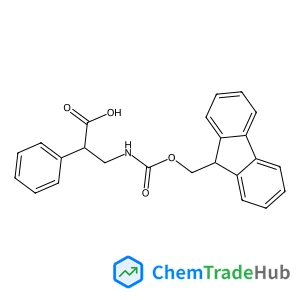
(S)-3-((((9H-Fluoren-9-yl)methoxy)carbonyl)amino)-2-phenylpropanoic acid
CAS Number:
1217663-60-9
Molecular Formula:
C24H21NO4
Interactions of the analgesic medications dextropropoxyphene (DPP, opioid), paracetamol (PCL, nonnarcotic), tramadol (TDL, nonnarcotic), ibuprofen (IBN, nonsteroidal anti-inflammatory drug (NSAID)), and naproxen (NPX, NSAID) with pristine graphene (GN) and nitrogen-doped GN (NGN; containing only graphitic N atoms) nanosheets were explored using density functional theory (DFT) in the gas and aqueous phases. Calculations in the aqueous phase were performed using the integral equation formalism polarized continuum model (IEFPCM). Calculated geometry-optimized structures, partial atomic charges (determined using Natural Bond Orbital analysis), highest occupied molecular orbital (HOMO)-lowest unoccupied molecular orbital (LUMO) energy gaps, work functions (determined using time-dependent DFT), and molecular electrostatic potential plots showed that the adsorption process is physical in nature (viz. physisorption), primarily due to noncovalent π–π and van der Waals interactions. In addition, calculated adsorption energies (ΔEad) were exergonic, indicating that formation of the analgesic/GN and analgesic/NGN complexes is thermodynamically favorable in the gas (ΔEad values for analgesic/GN and analgesic/NGN were in the range of −66.56 kJ mol−1 to −106.78 kJ mol−1) and aqueous phases (ΔEad values for analgesic/GN and analgesic/NGN complexes were in the range of −58.75 kJ mol−1 to −100.46 kJ mol−1). Generally, for GN and NGN, adsorption was more endergonic in the aqueous phase by as much as +10.41 kJ mol−1. Calculated solvation energies (ΔEsolvation) were exergonic for all analgesic/GN complexes (ΔEsolvation values were in the range of −56.50 kJ mol−1 to −66.17 kJ mol−1) and analgesic/NGN complexes (ΔEsolvation values were in the range of −77.26 kJ mol−1 to −87.96 kJ mol−1), with analgesic/NGN complexes exhibiting greater stability in aqueous solutions (∼20 kJ mol−1 more stable). In summary, the results of this theoretical study demonstrate that the adsorption and solvation of analgesics on GN and NGN nanosheets is thermodynamically favorable. In addition, generally, analgesic/NGN complexes exhibit higher adsorption affinities and solvation energies in the gas and aqueous phases. Therefore, GN and NGN nanosheets are potential adsorbents for extracting analgesic contaminants from aqueous environments such as aquatic ecosystems.
Carlos A. Polanco-Ramírez, Javier Carmona-Espíndola, José L. Gázquez, Paul W. Ayers
DOI: 10.1039/C7CP00691H
Chuan-Jian Zhong
DOI: 10.1039/C7CP01445G
Alberto Collauto, Royi Kaufmann, William N. Zagotta, Daniella Goldfarb
DOI: 10.1039/C7CP01925D
N. M. F. S. A. Cerqueira, H. Moorthy, P. A. Fernandes, M. J. Ramos
DOI: 10.1039/C7CP00277G
M. Mahdi Davari Esfahani, Qiang Zhu, Huafeng Dong, Shengnan Wang
DOI: 10.1039/C7CP00840F
Pedro P. Madeira, Helena Passos, Joana Gomes, João A. P. Coutinho, Mara G. Freire
DOI: 10.1039/C6CP08210F
DOI: 10.1039/C7CP02568H
Josep M. Anglada, Ramon Crehuet, Marilia Martins-Costa, Joseph S. Francisco, Manuel Ruiz-López
DOI: 10.1039/C7CP01976A
Xi Zhao, Chunzhen Wang, Haijiao Zheng, Zean Tian, Lina Hu
DOI: 10.1039/C7CP02111A
When considering alternatives to 1-(4-Chlorophenyl)-N-hydroxymethanimine (CAS: 3...
This compound should be stored in a cool, dry place away from direct sunlight. I...
3-(4-Bromophenyl)-5-(2-fluorophenyl)-1,2,4-oxadiazole is synthesized through a m...
5-Chloro-2-(4-chlorophenyl)-4-methyl-6-[3-(1-piperidinyl)propoxy]pyrimidine (CAS...
2-Chloro-4-(difluoromethoxy)pyridine is used in the pharmaceutical industry for ...
3-Chloro-6-methylpyridazine (CAS: 1121-79-5) is classified under the Globally Ha...
Several alternatives can be used in the synthesis of Methyl 4,5-dimethyl-2-nitro...
Alternatives to (2E,2'E)-3,3'-(1,4-Phenylene)bisacrylaldehyde include other acry...
3-Amino-5-chloropyridin-2-ol hydrochloride is an organic compound with the CAS n...
When handling 6,7-Difluoro-2,3-dihydro-4H-chromen-4-one, it is essential to wear...

Physical Chemistry Chemical Physics (PCCP) is an international journal co-owned by 19 physical chemistry and physics societies from around the world. This journal publishes original, cutting-edge research in physical chemistry, chemical physics and biophysical chemistry. To be suitable for publication in PCCP, articles must include significant innovation and/or insight into physical chemistry; this is the most important criterion that reviewers and Editors will judge against when evaluating submissions. The journal has a broad scope and welcomes contributions spanning experiment, theory, computation and data science. Topical coverage includes spectroscopy, dynamics, kinetics, statistical mechanics, thermodynamics, electrochemistry, catalysis, surface science, quantum mechanics, quantum computing and machine learning. Interdisciplinary research areas such as polymers and soft matter, materials, nanoscience, energy, surfaces/interfaces, and biophysical chemistry are welcomed if they demonstrate significant innovation and/or insight into physical chemistry. Joined experimental/theoretical studies are particularly appreciated when complementary and based on up-to-date approaches.