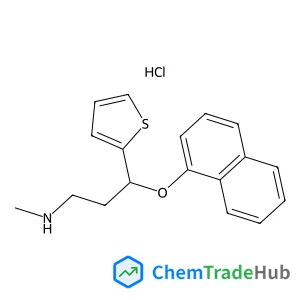
N-Methyl-3-(1-naphthyloxy)-3-(2-thienyl)-1-propanamine hydrochloride (1:1)
CAS Number:
1188266-11-6
Molecular Formula:
C18H20ClNOS
Amit Kumar, Pradeep Kumar
In the present work, we have investigated the effect of catalysts (ammonia, formic acid, ammonia dimer, and ammonia water complex) on the oxidation of CO via a simple Criegee intermediate by means of kinetics and quantum chemical calculations. Our finding suggests that, in the presence of ammonia and ammonia dimer the title reaction becomes a barrierless reaction with respect to the isolated reactants (energy barrier = ∼−0.53 and ∼−0.27 kcal mol−1, respectively), whereas in the presence of formic acid and ammonia–water complex the energy barrier of the CI + CO reaction becomes ∼2.84 and ∼0.82 kcal mol−1, respectively. However, among all the catalysts, due to the very low concentration of the ammonia dimer, its contribution towards the title reaction is insignificant as compared to that of the other catalysts. In addition, the relative rate of the other catalyzed channels against the uncatalyzed reaction suggests that the rate of the catalyzed CI + CO reaction is ∼8–10 orders of magnitude lower than the uncatalyzed reaction. However, the concentration of bimolecular complexes formed in the presence of catalysts (except the ammonia dimer) is ∼1–8 orders of magnitude higher than the concentration of bimolecular complexes formed in the uncatalyzed reaction.
Maria Fumanal, Jordi Ribas-Arino, Vincent Robert
DOI: 10.1039/C5CP02502H
S. S. Starchikov, I. S. Lyubutin, Chun-Rong Lin, Yaw-Teng Tseng, K. O. Funtov, Yu. L. Ogarkova, T. V. Dmitrieva, A. G. Ivanova
DOI: 10.1039/C5CP01846C
Yasaman Ghadar, Aurora E. Clark
DOI: 10.1039/C5CP90093J
Alejandra García-Gómez, Gelines Moreno-Fernández, Belén Lobato, Teresa A. Centeno
DOI: 10.1039/C5CP01904D
Huarong Tang, Dongmei Lu, Chao Wu
DOI: 10.1039/C5CP01793A
ZhongCheng Xiang, Zhong Zhang, XiJin Xu, Qin Zhang, QingBao Wang, Chengwu Yuan
DOI: 10.1039/C5CP01509J
DOI: 10.1039/C5CP90089A
Myeongjin Kim, Ilgeun Oh, Jooheon Kim
DOI: 10.1039/C5CP01728A
Liu Cui, Peng Tan
DOI: 10.1039/C5CP01771H
J. Tomko, J. J. Naddeo, R. Jimenez, Y. Tan, M. Steiner, J. M. Fitz-Gerald, D. M. Bubb, S. M. O'Malley
DOI: 10.1039/C5CP01965F
Waste containing 6-Chloro-5-(2'-hydroxy-3'-methoxy-4-biphenylyl)-3-(3-methoxyphe...
(3alpha,5alpha)-3-Hydroxypregnane-11,20-dione is primarily used in the pharmaceu...
The market for 4-Amino-6-chloro-2-pyridinecarboxylic acid (CAS: 546141-56-4) is ...
Alternatives to (2-Benzoylethyl)trimethylammonium chloride (CAS: 24472-88-6) in ...
N-[4-Nitro-3-(trifluoromethyl)phenyl]acetamide (CAS: 393-12-4) is generally safe...
Alternative reagents such as other phosphates or similar functional groups can b...
There are alternatives to N,N'-Bis(3-aminopropyl)-1,3-propanediamine (CAS: 4605-...
When handling Aluminium trihexadecanoate, it is important to use appropriate per...
(1,1-Dioxido-3-oxo-1,2-benzothiazol-2(3H)-yl)acetic acid is a chemical compound ...
Several alternatives to 5,5-dimethyloxolan-2-one (CAS: 3123-97-5) can be used in...

Physical Chemistry Chemical Physics (PCCP) is an international journal co-owned by 19 physical chemistry and physics societies from around the world. This journal publishes original, cutting-edge research in physical chemistry, chemical physics and biophysical chemistry. To be suitable for publication in PCCP, articles must include significant innovation and/or insight into physical chemistry; this is the most important criterion that reviewers and Editors will judge against when evaluating submissions. The journal has a broad scope and welcomes contributions spanning experiment, theory, computation and data science. Topical coverage includes spectroscopy, dynamics, kinetics, statistical mechanics, thermodynamics, electrochemistry, catalysis, surface science, quantum mechanics, quantum computing and machine learning. Interdisciplinary research areas such as polymers and soft matter, materials, nanoscience, energy, surfaces/interfaces, and biophysical chemistry are welcomed if they demonstrate significant innovation and/or insight into physical chemistry. Joined experimental/theoretical studies are particularly appreciated when complementary and based on up-to-date approaches.