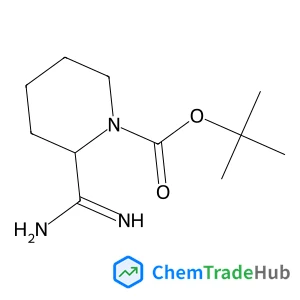
2-Methyl-2-propanyl 2-carbamimidoyl-1-piperidinecarboxylate
CAS Number:
1258640-98-0
Molecular Formula:
C11H21N3O2
Liu Cui, Peng Tan
Heat conduction of double-walled carbon nanotubes (DWCNTs) with intertube additional carbon atoms was investigated for the first time using a molecular dynamics method. By analyzing the phonon vibrational density of states (VDOS), we revealed that the intertube additional atoms weak the heat conduction along the tube axis. Moreover, the phonon participation ratio (PR) demonstrates that the heat transfer in DWCNTs is dominated by low frequency modes. The added atoms cause the mode weight factor (MWF) of the outer tube to decrease and that of the inner tube to increase, which implies a lower thermal conductivity. The effects of temperature, tube length, and the number and distribution of added atoms were studied. Furthermore, an orthogonal array testing strategy was designed to identify the most important structural factor. It is indicated that the tendencies of thermal conductivity of DWCNTs with added atoms change with temperature and length are similar to bare ones. In addition, thermal conductivity decreases with the increasing number of added atoms, more evidently for atom addition concentrated at some cross-sections rather than uniform addition along the tube length. Simultaneously, the number of added atoms at each cross-section has a considerably more remarkable impact, compared to the tube length and the density of chosen cross-sections to add atoms.
Qilong Wu, Fangfang Zhu, Gordon Wallace, Xiangdong Yao, Jun Chen
DOI: 10.1039/D3CS00714F
Yudong Xue
DOI: 10.1039/D3CS00706E
Mohammad Rafiee, Dylan J. Abrams, Luana Cardinale, Zachary Goss, Shannon S. Stahl
DOI: 10.1039/D2CS00706A
Albert Poater
DOI: 10.1039/D3CS00725A
Jinmin Miao, Jiajun Dong, Yiming Miao, Yunpeng Bai, Zihan Qu, Brenson A. Jassim, Bo Huang, Quyen Nguyen, Yuan Ma, Allison A. Murray, Jinyue Li
DOI: 10.1039/D3SC04541B
Xinke Kong, Lin Ru, Junjun Ge, Yalei Deng, Pan-ke Zhang, Yuanyuan Wang
DOI: 10.1039/D3SC04296K
Daniel M. Adrion, Waruni V. Karunaratne, Steven A. Lopez
DOI: 10.1039/D3SC03805J
David E. Salazar Marcano, Nada D. Savić, Kilian Declerck, Shorok A. M. Abdelhameed, Tatjana N. Parac-Vogt
DOI: 10.1039/D3CS00195D
Waste containing 6-Chloro-5-(2'-hydroxy-3'-methoxy-4-biphenylyl)-3-(3-methoxyphe...
(3alpha,5alpha)-3-Hydroxypregnane-11,20-dione is primarily used in the pharmaceu...
The market for 4-Amino-6-chloro-2-pyridinecarboxylic acid (CAS: 546141-56-4) is ...
Alternatives to (2-Benzoylethyl)trimethylammonium chloride (CAS: 24472-88-6) in ...
N-[4-Nitro-3-(trifluoromethyl)phenyl]acetamide (CAS: 393-12-4) is generally safe...
Alternative reagents such as other phosphates or similar functional groups can b...
There are alternatives to N,N'-Bis(3-aminopropyl)-1,3-propanediamine (CAS: 4605-...
When handling Aluminium trihexadecanoate, it is important to use appropriate per...
(1,1-Dioxido-3-oxo-1,2-benzothiazol-2(3H)-yl)acetic acid is a chemical compound ...
Several alternatives to 5,5-dimethyloxolan-2-one (CAS: 3123-97-5) can be used in...

Physical Chemistry Chemical Physics (PCCP) is an international journal co-owned by 19 physical chemistry and physics societies from around the world. This journal publishes original, cutting-edge research in physical chemistry, chemical physics and biophysical chemistry. To be suitable for publication in PCCP, articles must include significant innovation and/or insight into physical chemistry; this is the most important criterion that reviewers and Editors will judge against when evaluating submissions. The journal has a broad scope and welcomes contributions spanning experiment, theory, computation and data science. Topical coverage includes spectroscopy, dynamics, kinetics, statistical mechanics, thermodynamics, electrochemistry, catalysis, surface science, quantum mechanics, quantum computing and machine learning. Interdisciplinary research areas such as polymers and soft matter, materials, nanoscience, energy, surfaces/interfaces, and biophysical chemistry are welcomed if they demonstrate significant innovation and/or insight into physical chemistry. Joined experimental/theoretical studies are particularly appreciated when complementary and based on up-to-date approaches.
![N-{15-[(2,5-Dioxo-1-pyrrolidinyl)oxy]-15-oxo-3,6,9,12-tetraoxapentadec-1-yl}-2-(2-propyn-1-yloxy)acetamide structure](https://static.chemtradehub.com/structs/210/2101206-92-0-2eb5.webp "N-{15-[(2,5-Dioxo-1-pyrrolidinyl)oxy]-15-oxo-3,6,9,12-tetraoxapentadec-1-yl}-2-(2-propyn-1-yloxy)acetamide structure")
![1-[6-(1H-Imidazol-1-yl)-3-pyridinyl]methanamine structure](https://static.chemtradehub.com/structs/914/914637-08-4-8825.webp "1-[6-(1H-Imidazol-1-yl)-3-pyridinyl]methanamine structure")