












Ammonium salts as an inexpensive and convenient nitrogen source in the Cu-catalyzed amination of aryl halides at room temperature
Literature Information
Publication Date
2008-05-23
DOI
10.1039/B804637A
Impact Factor
6.222
Authors
Jinho Kim, Sukbok Chang
View Original
Abstract
Convenient and inexpensive ammonium salts such as NH4Cl and aqueous NH3 solution are found to be readily utilized in the Cu-catalyzed room temperature N-arylation of aryl halides, providing N-unprotected aniline derivatives in high yields.
Related Literature
Ultrafast permeation of seawater pervaporation using single-layered C2N via strain engineering
Zhongqiao Hu, Jun Wei
2017-06-08
Paper
DOI: 10.1039/C7CP01542A
Well incorporation of carbon nanodots with silicon nanowire arrays featuring excellent photocatalytic performances
Chia-Yun Chen, Po-Hsuan Hsiao, Ta-Cheng Wei, Ting-Chen Chen, Chien-Hsin Tang
2017-04-24
Paper
DOI: 10.1039/C7CP01674C
Multi-level quantum mechanics theories and molecular mechanics study of the double-inversion mechanism of the F− + CH3I reaction in aqueous solution
Peng Liu, Jingxue Zhang, Dunyou Wang
2017-05-25
Paper
DOI: 10.1039/C7CP02313H
Ionic behavior of organic–inorganic metal halide perovskite based metal-oxide-semiconductor capacitors
Yucheng Wang, Yuming Zhang, Tiqiang Pang, Jie Xu, Ziyang Hu, Yuejin Zhu, Xiaoyan Tang, Suzhen Luan, Renxu Jia
2017-04-20
Paper
DOI: 10.1039/C7CP01799E
Cage-like B39+ clusters with the bonding pattern of σ + π double delocalization: new members of the borospherene family
Xiao-Yun Zhao, Qiang Chen, Hai-Ru Li, Yue-Wen Mu, Hai-Gang Lu, Si-Dian Li
2017-04-05
Communication
DOI: 10.1039/C7CP00725F
Umbrella sampling molecular dynamics simulations reveal concerted ion movement through G-quadruplex DNA channels
Parisa Akhshi, Gang Wu
2017-03-16
Paper
DOI: 10.1039/C7CP01028A
Rovibrational quantum dynamical computations for deuterated isotopologues of the methane–water dimer
Edit Mátyus
2017-05-18
Paper
DOI: 10.1039/C7CP02061A
Extra electronic outer-shell peculiarities accessible under a joint XPS and DFT study
A. R. Cholach, A. A. Bryliakova
2017-05-22
Paper
DOI: 10.1039/C7CP00900C
You might also like
Compound Q&A
Are there alternatives to 1-(4-Chlorophenyl)-N-hydroxymethanimine (CAS: 3848-36-0) in synthesis?
When considering alternatives to 1-(4-Chlorophenyl)-N-hydroxymethanimine (CAS: 3...
3848-36-01-(4-Chlorophenyl)-N...
Compound Q&A
How should (1R,9S,10S,12S,14E,16S,19R,20R,21S,22R)-3,9,21-Trihydroxy-5,10,12,14,16,20,22-heptamethyl-23,24-dioxatetracyclo[17.3.1.1~6,9~.0~2,7~]tetracosa-2,5,7,14-tetraen-4-one (CAS: 183202-73-5) be stored?
This compound should be stored in a cool, dry place away from direct sunlight. I...
183202-73-5(1R,9S,10S,12S,14E,1...
Compound Q&A
How is 3-(4-Bromophenyl)-5-(2-fluorophenyl)-1,2,4-oxadiazole (CAS: 419553-16-5) typically synthesized?
3-(4-Bromophenyl)-5-(2-fluorophenyl)-1,2,4-oxadiazole is synthesized through a m...
419553-16-53-(4-Bromophenyl)-5-...
Compound Q&A
How is 5-Chloro-2-(4-chlorophenyl)-4-methyl-6-[3-(1-piperidinyl)propoxy]pyrimidine (CAS: 1639220-19-1) typically synthesized?
5-Chloro-2-(4-chlorophenyl)-4-methyl-6-[3-(1-piperidinyl)propoxy]pyrimidine (CAS...
1639220-19-15-Chloro-2-(4-chloro...
Compound Q&A
What industries use 2-Chloro-4-(difluoromethoxy)pyridine (CAS: 1206978-15-5)?
2-Chloro-4-(difluoromethoxy)pyridine is used in the pharmaceutical industry for ...
1206978-15-52-Chloro-4-(difluoro...
Compound Q&A
What regulatory guidelines apply to 3-Chloro-6-methylpyridazine (CAS: 1121-79-5)?
3-Chloro-6-methylpyridazine (CAS: 1121-79-5) is classified under the Globally Ha...
1121-79-53-Chloro-6-methylpyr...
Compound Q&A
Are there alternatives to Methyl 4,5-dimethyl-2-nitrobenzoate in synthesis?
Several alternatives can be used in the synthesis of Methyl 4,5-dimethyl-2-nitro...
90922-74-0Methyl 4,5-dimethyl-...
Compound Q&A
Are there alternatives to (2E,2'E)-3,3'-(1,4-Phenylene)bisacrylaldehyde in synthesis?
Alternatives to (2E,2'E)-3,3'-(1,4-Phenylene)bisacrylaldehyde include other acry...
63405-68-5(2E,2'E)-3,3'-(1,4-P...
Compound Q&A
What is 3-Amino-5-chloropyridin-2-ol hydrochloride (CAS: 1261906-29-9)?
3-Amino-5-chloropyridin-2-ol hydrochloride is an organic compound with the CAS n...
1261906-29-93-Amino-5-chloropyri...
Compound Q&A
What precautions should be taken when handling 6,7-Difluoro-2,3-dihydro-4H-chromen-4-one (CAS: 1092349-93-3)?
When handling 6,7-Difluoro-2,3-dihydro-4H-chromen-4-one, it is essential to wear...
1092349-93-36,7-Difluoro-2,3-dih...
Source Journal
Chemical Communications

CiteScore:
8.6
Self-citation Rate:
4.7%
Articles per Year:
2458
ChemComm publishes urgent research which is of outstanding significance and interest to experts in the field, while also appealing to the journal’s broad chemistry readership. Our communication format is ideally suited to short, urgent studies that are of such importance that they require accelerated publication. Our scope covers all topics in chemistry, and research at the interface of chemistry and other disciplines (such as materials science, nanoscience, physics, engineering and biology) where there is a significant novelty in the chemistry aspects. Major topic areas covered include: Analytical Chemistry Catalysis Chemical Biology and medicinal chemistry Computational Chemistry and Machine Learning Energy and sustainable chemistry Environmental Chemistry Green Chemistry Inorganic Chemistry Materials Chemistry Nanoscience Organic Chemistry Physical Chemistry Polymer Chemistry Supramolecular Chemistry
Recommended Compounds

5-(3,4-Dimethoxybenzyl)-2,4-pyrimidinediamine hydrochloride (1:1)
CAS Number:
2507-23-5
Molecular Formula:
C13H17ClN4O2
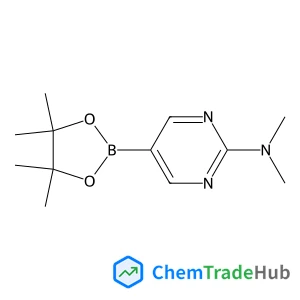
N,N-Dimethyl-5-(4,4,5,5-tetramethyl-1,3,2-dioxaborolan-2-yl)-2-pyrimidinamine
CAS Number:
1032759-30-0
Molecular Formula:
C12H20BN3O2
Recommended Suppliers





Disclaimer
This page provides academic journal information for reference and research purposes only. We are not affiliated with any journal publishers and do not handle publication submissions. For publication-related inquiries, please contact the respective journal publishers directly.
If you notice any inaccuracies in the information displayed, please contact us at support@chemtradehub.com. We will promptly review and address your concerns.