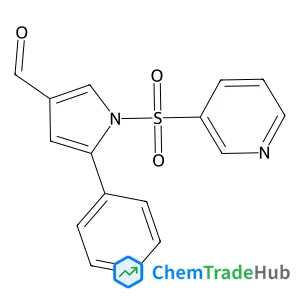
5-Phenyl-1-(pyridin-3-ylsulfonyl)-1H-pyrrole-3-carbaldehyde
CAS Number:
881676-90-0
Molecular Formula:
C16H12N2O3S
Hao Li, Jens K. Nørskov
Conventional oxygen electrocatalysts are expensive for industrial use. Transition metal oxides (TMOs), as a more economical option, have emerged as an alternative to potentially replace conventional precious metal catalysts. However, many experimental studies have suggested that although a few of the TMOs supported by conductive substrates are stable under electrocatalytic conditions, their performances are far from the industrial level, especially in the acidic oxygen reduction reaction (ORR). At present, their ORR and also oxygen evolution reaction (OER) performances are still not well understood. In this study, we analyze the effects of the support on ORR/OER adsorbate binding to TMO catalysts. We show that for wide bandgap TMOs (e.g., ZrO2 and HfO2), the use of a metal support leads to a marked enhancement of the adsorbate binding strengths due to a significant induced electron charge gain in the adsorbates, and a considerable up-shift in the ORR/OER adsorbate binding scaling relation. Meanwhile, these support-induced effects are significant even with relatively thick TMO layers on a thin metal substrate, requiring a large thickness cutoff to eliminate the influence. In contrast, the metal-like TMOs (e.g., PdO2 and SnO2) are less affected by the metal support. This study suggests that the thickness of the TMO layer can be used to tune the adsorption properties of electronegative adsorbates and thus provides an interesting new design option for oxygen electrocatalysis.
Jay R. Walton, Luis A. Rivera-Rivera, Robert R. Lucchese, John W. Bevan
DOI: 10.1039/C7CP02407J
Zean Tian, Rangsu Liu, Lili Zhou, Zhaoyang Hou
DOI: 10.1039/C7CP00865A
Chao Wang, Chao Sui, Shuyuan Zhao, Zhisen Zhang, Xiaodong He
DOI: 10.1039/C7CP00312A
D. Harries
DOI: 10.1039/C7CP01921A
Julin Joseph, Aji A. Anappara
DOI: 10.1039/C7CP02731A
Parisa Akhshi, Gang Wu
DOI: 10.1039/C7CP01028A
Liang Liu, Alain Walcarius
DOI: 10.1039/C7CP01775H
Gábor Schuszter, Tünde Gehér-Herczegh, Árpád Szűcs, Ágota Tóth, Dezső Horváth
DOI: 10.1039/C7CP00986K
When considering alternatives to 1-(4-Chlorophenyl)-N-hydroxymethanimine (CAS: 3...
This compound should be stored in a cool, dry place away from direct sunlight. I...
3-(4-Bromophenyl)-5-(2-fluorophenyl)-1,2,4-oxadiazole is synthesized through a m...
5-Chloro-2-(4-chlorophenyl)-4-methyl-6-[3-(1-piperidinyl)propoxy]pyrimidine (CAS...
2-Chloro-4-(difluoromethoxy)pyridine is used in the pharmaceutical industry for ...
3-Chloro-6-methylpyridazine (CAS: 1121-79-5) is classified under the Globally Ha...
Several alternatives can be used in the synthesis of Methyl 4,5-dimethyl-2-nitro...
Alternatives to (2E,2'E)-3,3'-(1,4-Phenylene)bisacrylaldehyde include other acry...
3-Amino-5-chloropyridin-2-ol hydrochloride is an organic compound with the CAS n...
When handling 6,7-Difluoro-2,3-dihydro-4H-chromen-4-one, it is essential to wear...

Physical Chemistry Chemical Physics (PCCP) is an international journal co-owned by 19 physical chemistry and physics societies from around the world. This journal publishes original, cutting-edge research in physical chemistry, chemical physics and biophysical chemistry. To be suitable for publication in PCCP, articles must include significant innovation and/or insight into physical chemistry; this is the most important criterion that reviewers and Editors will judge against when evaluating submissions. The journal has a broad scope and welcomes contributions spanning experiment, theory, computation and data science. Topical coverage includes spectroscopy, dynamics, kinetics, statistical mechanics, thermodynamics, electrochemistry, catalysis, surface science, quantum mechanics, quantum computing and machine learning. Interdisciplinary research areas such as polymers and soft matter, materials, nanoscience, energy, surfaces/interfaces, and biophysical chemistry are welcomed if they demonstrate significant innovation and/or insight into physical chemistry. Joined experimental/theoretical studies are particularly appreciated when complementary and based on up-to-date approaches.