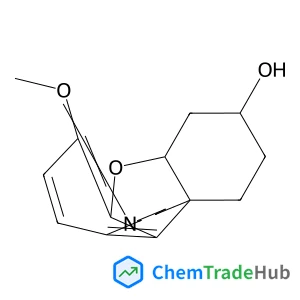
5,7,8'-Trihydroxy-2',2'-dimethyl-2'H,4H-3,6'-bichromen-4-one
CAS Number:
129280-33-7
Molecular Formula:
C20H16O6
Yuan Zhao, Xiaoliang Liu, Lin Li, Shitan Wang, Youzhen Li, Haipeng Xie, Dongmei Niu, Han Huang, Yongli Gao
X-ray photoelectron spectroscopy (XPS), ultraviolet photoelectron spectroscopy (UPS), atomic force microscopy (AFM) and X-ray diffraction (XRD) were applied to investigate the electronic structure and molecular packing of C8-BTBT on HOPG with an ultrathin C60 interlayer. It was found that C8-BTBT displays a Vollmer–Weber (V–W) growth mode on HOPG, with an ultrathin C60 interlayer (0.7 nm). Compared to the uniform lying-down growth mode as directly grown on HOPG, the C8-BTBT molecules here adopt a lying-down orientation at low coverage with some small tilt angles because the π–π interaction between C8-BTBT and HOPG is partly disturbed by the C60 interlayer, delivering a higher highest occupied molecular orbital (HOMO) in C8-BTBT. An interface dipole of 0.14 eV is observed due to electron transport from C8-BTBT to C60. The upward and downward band bending in C8-BTBT and C60, respectively, near the C8-BTBT/C60 interface reduces the hole transport barrier at the interface, facilitating the hole injection from C60 to C8-BTBT, while a large electron transfer barrier from C60 to C8-BTBT is detected at this interface, which effectively limits electron injection from C60 to C8-BTBT. The HOMO of C8-BTBT near the interface is largely lifted up by the C60 insertion layer, which causes a p-doping effect and increases the hole mobility in C8-BTBT. Furthermore, owing to the lowest occupied molecular orbital (LUMO) of C60 residing in the gap of C8-BTBT, charge transfer occurs between C60 and the trap states in C8-BTBT to effectively passivate the trapping states. Our efforts aid a better understanding of the electron structure and film growth of anisotropic molecules and provide a useful strategy to improve the performance of C8-BTBT-based devices.

Atomization and Sprays

Journal of Chemical Sciences

Bioorganic & Medicinal Chemistry Letters

Herald of the Russian Academy of Sciences

Electroanalysis

Medicinal Chemistry Research

Journal of Asian Natural Products Research

Bioorganic & Medicinal Chemistry

Main Group Chemistry

Journal of the Indian Institute of Science
Florian Evers, Christian Reichhart, Roland Steitz, Metin Tolan, Claus Czeslik
DOI: 10.1039/B925134K
DOI: 10.1039/B823331D
Mark Rozenberg, Aharon Loewenschuss, Claus Jørgen Nielsen
DOI: 10.1039/B922952C
Alexander C. Santulli, Wenqian Xu, Liusuo Wu, Fen Zhang, Chang-Yong Nam, Charles T. Black, Amanda L. Tiano
DOI: 10.1039/B822902C
Hema Singh, Shrikant Bhagwat, Samuel Jouen, Benoît Lefez, Anjali A. Athawale, Beatrice Hannoyer, Satishchandra Ogale
DOI: 10.1039/B917407A
Daniel Irimia, Rob Kortekaas, Maurice H. M. Janssen
DOI: 10.1039/B822960K
Huan-Chang Tseng, Jiann-Shing Wu, Rong-Yeu Chang
DOI: 10.1039/B919672B
Alvaro Cimas
DOI: 10.1039/B924025J
Waste containing 2-Ethyl-4-Methyl-1H-Imidazole-5-Carbaldehyde (CAS: 88634-80-4) ...
Triethoxy(octyl)silane (CAS: 1385031-14-0) is widely used in the pharmaceuticals...
Several alternatives to 3-iodo-7-nitro-1H-indazole (CAS: 864724-64-1) exist in t...
Yes, there are alternatives to Benzene, bis[(trimethoxysilyl)ethyl] (CAS: 266317...
Isothiazole-3-carbonitrile (CAS: 1452-17-1) is generally considered safe when us...
(3-Chlorophenyl)methanol (CAS: 873-63-2) is considered low to moderately toxic. ...
(2S,3S)-2-Hydroxy-3-({[(2-methyl-2-propanyl)oxy]carbonyl}amino)-3-(2-naphthyl)pr...
Proper handling of methyl 2-(bromomethyl)-5-methoxybenzoate requires the use of ...
6,8-Dibromoimidazo[1,2-a]pyridine-2-carboxylic acid (CAS: 904805-36-3) is an aro...
3-Amino-5-bromo-2-pyridinecarbonitrile is considered safe when handled under pro...

Physical Chemistry Chemical Physics (PCCP) is an international journal co-owned by 19 physical chemistry and physics societies from around the world. This journal publishes original, cutting-edge research in physical chemistry, chemical physics and biophysical chemistry. To be suitable for publication in PCCP, articles must include significant innovation and/or insight into physical chemistry; this is the most important criterion that reviewers and Editors will judge against when evaluating submissions. The journal has a broad scope and welcomes contributions spanning experiment, theory, computation and data science. Topical coverage includes spectroscopy, dynamics, kinetics, statistical mechanics, thermodynamics, electrochemistry, catalysis, surface science, quantum mechanics, quantum computing and machine learning. Interdisciplinary research areas such as polymers and soft matter, materials, nanoscience, energy, surfaces/interfaces, and biophysical chemistry are welcomed if they demonstrate significant innovation and/or insight into physical chemistry. Joined experimental/theoretical studies are particularly appreciated when complementary and based on up-to-date approaches.