












Wettability conversion of colloidal TiO2nanocrystal thin films with UV-switchable hydrophilicity
Literature Information
Publication Date
2009-03-26
DOI
10.1039/B823331D
Impact Factor
3.676
Authors
View Original
Abstract
Under pulsed laser UV irradiation, thin-film coatings made of close-packed TiO2 nanorods individually coated with surfactants can exhibit a temporary increase in their degree of surface hydroxylation without any apparent photocatalytic removal of the capping molecules. This mechanism provides a basis for achieving light-driven conversion from a highly hydrophobic to a highly hydrophilic, metastable state, followed by extremely slow recovery of the original conditions under dark ambient environment. A deeper insight into the wetting dynamics is gained by time-dependent water contact-angle and infrared spectroscopy monitoring of the film properties under different post-UV storage conditions. Our study reveals that, for reversible switchability between extreme wettability excursions and long-term repeatability of such changes to be achieved, specific modifications in the polar and nonpolar components of the TiO2 films need to be guaranteed along with preservation of the original geometric arrangement of the nanocrystal building blocks. The application of moderate vacuum is found to be an effective method for accelerating the post-UV hydrophilic-to-hydrophobic conversion, thereby enabling fast and cyclic hydrophilization/hydrophobicization alternation without any detrimental signs of significant fatigue.
Related Literature
Inelastic scattering dynamics of ortho and para hydronium ions, o-H3O+ and p-H3O+, with He at low temperature
Houda El Hanini, Faouzi Najar, Manel Naouai, Nejm-Eddine Jaidane
2019-05-07
Paper
DOI: 10.1039/C9CP01889A
Tuneable single-molecule electronic conductance of C60 by encapsulation
Shintaro Fujii, Haruna Cho, Yoshifumi Hashikawa, Tomoaki Nishino, Yasujiro Murata, Manabu Kiguchi
2019-05-21
Paper
DOI: 10.1039/C9CP02469G
Structural transformations of graphene exposed to nitrogen plasma: quantum chemical molecular dynamics simulations
Seokjin Moon, Yuh Hijikata
2019-03-04
Paper
DOI: 10.1039/C8CP06159A
Depletion of atmospheric organic trace gases due to their uptake by an ensemble of aqueous aerosols evolving via concurrent condensation and chemical aging
Yuri S. Djikaev, Eli Ruckenstein
2019-05-28
Paper
DOI: 10.1039/C9CP01386E
Atomic-level crystallization in selective laser melting fabricated Zr-based metallic glasses
Yue Zhang, Haishun Liu, Jinyong Mo, Mingzi Wang, Zhe Chen, Yezeng He, Chunguang Tang
2019-05-15
Paper
DOI: 10.1039/C9CP02181G
Intrinsic magnetism and biaxial strain tuning in two-dimensional metal halides V3X8 (X = F, Cl, Br, I) from first principles and Monte Carlo simulation
Haibo Xiao, Xiaonan Wang, Ruilong Wang, Lingfang Xu, Shiheng Liang, Changping Yang
2019-05-09
Paper
DOI: 10.1039/C9CP00850K
Mixtures of LiTFSI and urea: ideal thermodynamic behavior as key to the formation of deep eutectic solvents?
2019-05-23
Paper
DOI: 10.1039/C9CP01440C
Coarse-grained simulation studies on the adsorption of polyelectrolyte complexes upon lipid membranes
2019-05-21
Paper
DOI: 10.1039/C9CP01448A
Energy storage properties of a two-dimensional TiB4 monolayer
Erdong Wu, Shi Liu
2019-05-25
Paper
DOI: 10.1039/C9CP01864F
Correction: Sub-Doppler infrared spectroscopy of resonance-stabilized hydrocarbon intermediates: ν3/ν4 CH stretch modes and CH2 internal rotor dynamics of benzyl radical
A. Kortyna, A. J. Samin, T. A. Miller
2019-06-06
Correction
DOI: 10.1039/C9CP90148E
You might also like
Compound Q&A
How should waste containing 2-Ethyl-4-Methyl-1H-Imidazole-5-Carbaldehyde (CAS: 88634-80-4) be handled?
Waste containing 2-Ethyl-4-Methyl-1H-Imidazole-5-Carbaldehyde (CAS: 88634-80-4) ...
88634-80-42-Ethyl-4-Methyl-1H-...
Compound Q&A
What industries use Triethoxy(octyl)silane (CAS: 1385031-14-0)?
Triethoxy(octyl)silane (CAS: 1385031-14-0) is widely used in the pharmaceuticals...
1385031-14-0Triethoxy(octyl)sila...
Compound Q&A
Are there alternatives to 3-iodo-7-nitro-1H-indazole (CAS: 864724-64-1) in synthesis?
Several alternatives to 3-iodo-7-nitro-1H-indazole (CAS: 864724-64-1) exist in t...
864724-64-13-iodo-7-nitro-1H-in...
Compound Q&A
Are there alternatives to Benzene, bis[(trimethoxysilyl)ethyl] (CAS: 266317-71-9) in synthesis?
Yes, there are alternatives to Benzene, bis[(trimethoxysilyl)ethyl] (CAS: 266317...
266317-71-9Benzene, bis[(trimet...
Compound Q&A
Is Isothiazole-3-carbonitrile (CAS: 1452-17-1) safe?
Isothiazole-3-carbonitrile (CAS: 1452-17-1) is generally considered safe when us...
1452-17-1Isothiazole-3-carbon...
Compound Q&A
Is (3-Chlorophenyl)methanol (CAS: 873-63-2) safe?
(3-Chlorophenyl)methanol (CAS: 873-63-2) is considered low to moderately toxic. ...
873-63-2(3-Chlorophenyl)meth...
Compound Q&A
How is (2S,3S)-2-Hydroxy-3-({[(2-methyl-2-propanyl)oxy]carbonyl}amino)-3-(2-naphthyl)propanoic acid (CAS: 959583-98-3) typically synthesized?
(2S,3S)-2-Hydroxy-3-({[(2-methyl-2-propanyl)oxy]carbonyl}amino)-3-(2-naphthyl)pr...
959583-98-3(2S,3S)-2-Hydroxy-3-...
Compound Q&A
What precautions should be taken when handling Methyl 2-(bromomethyl)-5-methoxybenzoate (CAS: 788081-99-2)?
Proper handling of methyl 2-(bromomethyl)-5-methoxybenzoate requires the use of ...
788081-99-2Methyl 2-(bromomethy...
Compound Q&A
What is 6,8-Dibromoimidazo[1,2-a]pyridine-2-carboxylic acid (CAS: 904805-36-3)?
6,8-Dibromoimidazo[1,2-a]pyridine-2-carboxylic acid (CAS: 904805-36-3) is an aro...
904805-36-36,8-Dibromoimidazo[1...
Compound Q&A
Is 3-Amino-5-bromo-2-pyridinecarbonitrile (CAS: 573675-27-1) safe?
3-Amino-5-bromo-2-pyridinecarbonitrile is considered safe when handled under pro...
573675-27-13-Amino-5-bromo-2-py...
Source Journal
Physical Chemistry Chemical Physics

CiteScore:
5.5
Self-citation Rate:
10.3%
Articles per Year:
3036
Physical Chemistry Chemical Physics (PCCP) is an international journal co-owned by 19 physical chemistry and physics societies from around the world. This journal publishes original, cutting-edge research in physical chemistry, chemical physics and biophysical chemistry. To be suitable for publication in PCCP, articles must include significant innovation and/or insight into physical chemistry; this is the most important criterion that reviewers and Editors will judge against when evaluating submissions. The journal has a broad scope and welcomes contributions spanning experiment, theory, computation and data science. Topical coverage includes spectroscopy, dynamics, kinetics, statistical mechanics, thermodynamics, electrochemistry, catalysis, surface science, quantum mechanics, quantum computing and machine learning. Interdisciplinary research areas such as polymers and soft matter, materials, nanoscience, energy, surfaces/interfaces, and biophysical chemistry are welcomed if they demonstrate significant innovation and/or insight into physical chemistry. Joined experimental/theoretical studies are particularly appreciated when complementary and based on up-to-date approaches.
Recommended Compounds



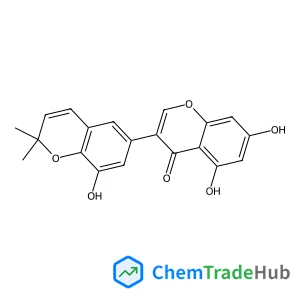
5,7,8'-Trihydroxy-2',2'-dimethyl-2'H,4H-3,6'-bichromen-4-one
CAS Number:
129280-33-7
Molecular Formula:
C20H16O6
Recommended Suppliers






Disclaimer
This page provides academic journal information for reference and research purposes only. We are not affiliated with any journal publishers and do not handle publication submissions. For publication-related inquiries, please contact the respective journal publishers directly.
If you notice any inaccuracies in the information displayed, please contact us at support@chemtradehub.com. We will promptly review and address your concerns.