












Optical properties of thickness-controlled PtSe2 thin films studied via spectroscopic ellipsometry
Literature Information
Publication Date
2020-10-27
DOI
10.1039/D0CP04021E
Impact Factor
3.676
Authors
Junbo He, Wei Jiang, Xudan Zhu, Rongjun Zhang, Jianlu Wang, Meiping Zhu, Songyou Wang, Yuxiang Zheng, Liangyao Chen
View Original
Abstract
Platinum diselenide (PtSe2) has attracted huge attention due to its intriguing physical properties for both fundamental research and promising applications in electronics and optoelectronics. Here, we explored the optical properties of chemical vapor deposition-grown PtSe2 thin films with varied thicknesses via spectroscopic ellipsometry. The dielectric function was extracted by using a Lorentz model over the spectral range of 1.25–6.0 eV. We firstly ascribed the resonant energies, extracted from the Lorentz model, to different interband electronic transitions between valence bands and conduction bands in the Brillouin zone. A predicted exciton is observed at 2.18 eV for the monolayer and the corresponding exciton binding energy is 0.65 eV, in line with previous theoretical calculation and the measured absorption spectra. Additionally, the exciton peak shows a red shift with the increase of thickness, which is the consequence of strong interlayer interaction. These results enrich the fundamental understanding of PtSe2 and are conducive to its potential applications.
Related Literature
The photophysics of selectively metallated arrays of quinoxaline-fused tetraarylporphyrins
James A. Hutchison, Paul J. Sintic, Maxwell J. Crossley, Toshihiko Nagamura, Kenneth P. Ghiggino
2009-03-03
Paper
DOI: 10.1039/B820969C
Minimum electrophilicity principle: an analysis based upon the variation of both chemical potential and absolute hardness
Christophe Morell, Vanessa Labet, André Grand, Henry Chermette
2009-02-26
Paper
DOI: 10.1039/B818534D
Dipole effects on molecular and electronic structures in a novel conjugate of oligo(phenyleneethynylene) and helical peptide
Hidenori Nakayama, Tomoyuki Morita, Shunsaku Kimura
2009-03-10
Paper
DOI: 10.1039/B817685J
Jet-cooled spectroscopy of paracetamol
Joseph M. Beames, Andrew J. Hudson
2010-02-26
Paper
DOI: 10.1039/B923202H
Proton transfer in adsorbed water dimers
Xiao Liang Hu, Jiří Klimeš, Angelos Michaelides
2010-02-25
Communication
DOI: 10.1039/B924422K
Ligand-dependent blinking of zinc-blende CdSe/ZnS core/shell nanocrystals
Yongwook Kim, Hyunung Yu, Dae Won Moon, Sung Jun Lim, Wonjung Kim, Hye-Joo Yoon, Seung Koo Shin
2009-03-03
Paper
DOI: 10.1039/B822351C
A combinatorial approach toward fabrication of surface-adsorbed metal nanoparticles for investigation of an enzyme reaction
H. Takei, T. Yamaguchi
2010-03-25
Paper
DOI: 10.1039/B924233N
Combining density functional theory (DFT) and pair distribution function (PDF) analysis to solve the structure of metastable materials: the case of metakaolin
Claire E. White, John L. Provis, Thomas Proffen, Daniel P. Riley, Jannie S. J. van Deventer
2010-02-22
Paper
DOI: 10.1039/B922993K
Two-dimensional network stability of nucleobases and amino acids on graphite under ambient conditions: adenine, l-serine and l-tyrosine
Ilko Bald, Sigrid Weigelt, Xiaojing Ma, Pengyang Xie, Ramesh Subramani, Mingdong Dong, Chen Wang, Wael Mamdouh, Jianguo Wang, Flemming Besenbacher
2010-03-09
Paper
DOI: 10.1039/B924098E
On the use and influence of electron-blocking interlayers in polymer light-emitting diodes
Peter A. Levermore, Jingsong Huang, Xuhua Wang, Donal D. C. Bradley
2009-03-06
Paper
DOI: 10.1039/B819200F
You might also like
Compound Q&A
How should waste containing 2-Ethyl-4-Methyl-1H-Imidazole-5-Carbaldehyde (CAS: 88634-80-4) be handled?
Waste containing 2-Ethyl-4-Methyl-1H-Imidazole-5-Carbaldehyde (CAS: 88634-80-4) ...
88634-80-42-Ethyl-4-Methyl-1H-...
Compound Q&A
What industries use Triethoxy(octyl)silane (CAS: 1385031-14-0)?
Triethoxy(octyl)silane (CAS: 1385031-14-0) is widely used in the pharmaceuticals...
1385031-14-0Triethoxy(octyl)sila...
Compound Q&A
Are there alternatives to 3-iodo-7-nitro-1H-indazole (CAS: 864724-64-1) in synthesis?
Several alternatives to 3-iodo-7-nitro-1H-indazole (CAS: 864724-64-1) exist in t...
864724-64-13-iodo-7-nitro-1H-in...
Compound Q&A
Are there alternatives to Benzene, bis[(trimethoxysilyl)ethyl] (CAS: 266317-71-9) in synthesis?
Yes, there are alternatives to Benzene, bis[(trimethoxysilyl)ethyl] (CAS: 266317...
266317-71-9Benzene, bis[(trimet...
Compound Q&A
Is Isothiazole-3-carbonitrile (CAS: 1452-17-1) safe?
Isothiazole-3-carbonitrile (CAS: 1452-17-1) is generally considered safe when us...
1452-17-1Isothiazole-3-carbon...
Compound Q&A
Is (3-Chlorophenyl)methanol (CAS: 873-63-2) safe?
(3-Chlorophenyl)methanol (CAS: 873-63-2) is considered low to moderately toxic. ...
873-63-2(3-Chlorophenyl)meth...
Compound Q&A
How is (2S,3S)-2-Hydroxy-3-({[(2-methyl-2-propanyl)oxy]carbonyl}amino)-3-(2-naphthyl)propanoic acid (CAS: 959583-98-3) typically synthesized?
(2S,3S)-2-Hydroxy-3-({[(2-methyl-2-propanyl)oxy]carbonyl}amino)-3-(2-naphthyl)pr...
959583-98-3(2S,3S)-2-Hydroxy-3-...
Compound Q&A
What precautions should be taken when handling Methyl 2-(bromomethyl)-5-methoxybenzoate (CAS: 788081-99-2)?
Proper handling of methyl 2-(bromomethyl)-5-methoxybenzoate requires the use of ...
788081-99-2Methyl 2-(bromomethy...
Compound Q&A
What is 6,8-Dibromoimidazo[1,2-a]pyridine-2-carboxylic acid (CAS: 904805-36-3)?
6,8-Dibromoimidazo[1,2-a]pyridine-2-carboxylic acid (CAS: 904805-36-3) is an aro...
904805-36-36,8-Dibromoimidazo[1...
Compound Q&A
Is 3-Amino-5-bromo-2-pyridinecarbonitrile (CAS: 573675-27-1) safe?
3-Amino-5-bromo-2-pyridinecarbonitrile is considered safe when handled under pro...
573675-27-13-Amino-5-bromo-2-py...
Source Journal
Physical Chemistry Chemical Physics

CiteScore:
5.5
Self-citation Rate:
10.3%
Articles per Year:
3036
Physical Chemistry Chemical Physics (PCCP) is an international journal co-owned by 19 physical chemistry and physics societies from around the world. This journal publishes original, cutting-edge research in physical chemistry, chemical physics and biophysical chemistry. To be suitable for publication in PCCP, articles must include significant innovation and/or insight into physical chemistry; this is the most important criterion that reviewers and Editors will judge against when evaluating submissions. The journal has a broad scope and welcomes contributions spanning experiment, theory, computation and data science. Topical coverage includes spectroscopy, dynamics, kinetics, statistical mechanics, thermodynamics, electrochemistry, catalysis, surface science, quantum mechanics, quantum computing and machine learning. Interdisciplinary research areas such as polymers and soft matter, materials, nanoscience, energy, surfaces/interfaces, and biophysical chemistry are welcomed if they demonstrate significant innovation and/or insight into physical chemistry. Joined experimental/theoretical studies are particularly appreciated when complementary and based on up-to-date approaches.
Recommended Compounds
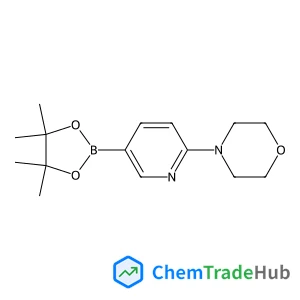
4-(5-(4,4,5,5-tetramethyl-1,3,2-dioxaborolan-2-yl)pyridin-2-yl)morpholine
CAS Number:
485799-04-0
Molecular Formula:
C15H23BN2O3
Recommended Suppliers






Disclaimer
This page provides academic journal information for reference and research purposes only. We are not affiliated with any journal publishers and do not handle publication submissions. For publication-related inquiries, please contact the respective journal publishers directly.
If you notice any inaccuracies in the information displayed, please contact us at support@chemtradehub.com. We will promptly review and address your concerns.