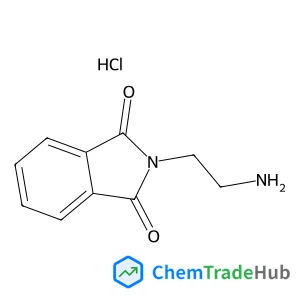
2-(2-Aminoethyl)-1H-isoindole-1,3(2H)-dione hydrochloride (1:1)
CAS Number:
30250-67-0
Molecular Formula:
C10H11ClN2O2
Claire E. White, John L. Provis, Thomas Proffen, Daniel P. Riley, Jannie S. J. van Deventer
Understanding the atomic structure of complex metastable (including glassy) materials is of great importance in research and industry, however, such materials resist solution by most standard techniques. Here, a novel technique combining thermodynamics and local structure is presented to solve the structure of the metastable aluminosilicate material metakaolin (calcined kaolinite) without the use of chemical constraints. The structure is elucidated by iterating between least-squares real-space refinement using neutron pair distribution function data, and geometry optimisation using density functional modelling. The resulting structural representation is both energetically feasible and in excellent agreement with experimental data. This accurate structural representation of metakaolin provides new insight into the local environment of the aluminium atoms, with evidence of the existence of tri-coordinated aluminium. By the availability of this detailed chemically feasible atomic description, without the need to artificially impose constraints during the refinement process, there exists the opportunity to tailor chemical and mechanical processes involving metakaolin and other complex metastable materials at the atomic level to obtain optimal performance at the macro-scale.
Qandeel Saleem, Milad Torabfam
DOI: 10.1039/D2RE00049K
Sean Timothy Okonsky, J. V. Jayarama Krishna
DOI: 10.1039/D2RE00144F
Abollé Abollé, Elvina Barré, Vincent Coeffard, François-Xavier Felpin
DOI: 10.1039/D1RE00509J
Chaoqiang Wu, Chengyong Wang, Kequan Chen, Fei Cao, Pingkai Ouyang
DOI: 10.1039/D2RE00118G
Qiang Geng, Guoqiang Huang
DOI: 10.1039/D1RE00569C
Jianli Chen, Xiaoxuan Xie, Jiming Liu, Zhiqun Yu, Weike Su
DOI: 10.1039/D2RE00001F
Flavio Tollini, Alice Occhetta, Francesca Broglia, Vincenzo Calemma, Stefano Carminati, Giuseppe Storti, Mattia Sponchioni, Davide Moscatelli
DOI: 10.1039/D2RE00191H
DOI: 10.1039/D2RE00228K
Jianguo Liu, Xinghua Zhang, Lungang Chen, Longlong Ma, Qi Zhang
DOI: 10.1039/D2RE00180B
(1R,3S)-1,3-Cyclopentanediol finds applications in various industries. In the ph...
When handling N'-[4-(Dimethylamino)phenyl]-N,N-dimethyl-1,4-benzenediamine, it i...
There are several alternatives to 5-(2,4-Difluorophenyl)-2-methoxypyrimidine in ...
1-(3-Methoxyphenoxy)propan-2-ol (CAS: 382141-68-6) must comply with the Globally...
Tetrodotoxin Citrate is extremely dangerous and should be handled with extreme c...
2-Methyl-2-propanyl [(1R,3S)-3-hydroxycyclopentyl]carbamate (CAS: 225641-84-9) i...
Waste containing 4-(2-Hydroxyhexafluoroisopropyl)Benzoic Acid (CAS: 16261-80-6) ...
2-Methyl-2-proanyl {(2S)-1-[(benzyloxy)amino]-3-hydroxy-3-methyl-1-oxo-2-butanyl...
Benzeneethanamine, α-ethyl-, hydrochloride (1:1) is an organic compound with the...
In the synthesis of compounds similar to 3-{(E)-[4-(Dimethylamino)phenyl]diazeny...

Physical Chemistry Chemical Physics (PCCP) is an international journal co-owned by 19 physical chemistry and physics societies from around the world. This journal publishes original, cutting-edge research in physical chemistry, chemical physics and biophysical chemistry. To be suitable for publication in PCCP, articles must include significant innovation and/or insight into physical chemistry; this is the most important criterion that reviewers and Editors will judge against when evaluating submissions. The journal has a broad scope and welcomes contributions spanning experiment, theory, computation and data science. Topical coverage includes spectroscopy, dynamics, kinetics, statistical mechanics, thermodynamics, electrochemistry, catalysis, surface science, quantum mechanics, quantum computing and machine learning. Interdisciplinary research areas such as polymers and soft matter, materials, nanoscience, energy, surfaces/interfaces, and biophysical chemistry are welcomed if they demonstrate significant innovation and/or insight into physical chemistry. Joined experimental/theoretical studies are particularly appreciated when complementary and based on up-to-date approaches.