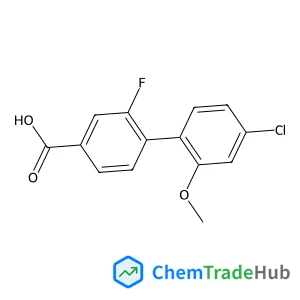
4-(4-Chloro-2-methoxyphenyl)-3-fluorobenzoic acid
CAS Number:
1261970-23-3
Molecular Formula:
C14H10ClFO3
C. Pattyn, N. Maira, A. Remy, N. C. Roy, S. Iseni, D. Petitjean, F. Reniers
A needle-water DC microplasma system working at atmospheric pressure in N2/O2 gas mixtures is used to study the fundamental mechanisms of nitrate/nitrite synthesis in highly complex and yet little-known plasma–water systems. Plasma properties are investigated by means of optical emission spectroscopy while the activated water is analyzed following the treatment using ionic chromatography and UV-Vis absorbance spectroscopy. Experiments highlight that the energy efficiency and selectivity of the process are influenced by the oxygen content and the plasma-induced water heating, with strong differences when the water surface is the anode or the cathode electrode. Nitrates are successfully synthesized without residual nitrites in the solution with a comparatively higher energy efficiency when the water is the cathode. The possible reactions involved in the gas phase and aqueous phase chemistry are presented and future scope for the optimization of the system is discussed.
Yong Yan, Xiang Lin, Sihai Yang, Alexander J. Blake, Anne Dailly, Neil R. Champness, Peter Hubberstey, Martin Schröder
DOI: 10.1039/B900013E
Isamu Shiina, Hiroki Fukui
DOI: 10.1039/B814375G
Feng Wang, Wataru Ueda
DOI: 10.1039/B817118A
Hideyuki Otsuka, Takatoshi Muta, Masahide Sakada, Takeshi Maeda, Atsushi Takahara
DOI: 10.1039/B818014H
Ferdinand Gonzaga, Gilbert Yu, Michael A. Brook
DOI: 10.1039/B821788B
Tai-Shan Hu
DOI: 10.1039/B900342H
Daniel Oves-Costales, Lijiang Song, Gregory L. Challis
DOI: 10.1039/B823147H
Mark Bartholomä, John Valliant, Kevin P. Maresca, John Babich, Jon Zubieta
DOI: 10.1039/B814903H
Jaskiranjit Kang, Jonathan P. Richardson, Derek Macmillan
DOI: 10.1039/B815888F
Sumito Tokuji, Yuji Takahashi, Hideyuki Shinmori, Hiroshi Shinokubo, Atsuhiro Osuka
DOI: 10.1039/B819284G
(5-Sulfamoyl-3-pyridinyl)boronic acid is primarily used in chemical synthesis, p...
Benzyl 2-methyl-2-(methylsulfonyl)-4-pentenoate is typically synthesized via est...
When handling 8-Fluoroquinolin-6-ol (CAS: 209353-22-0), it is important to use p...
1,3-Dibromo-5-(2-methyl-2-propanyl)benzene (CAS: 129316-09-2) is a crystalline c...
Ethyl 7-chloro-4-oxo-1-(1,3-thiazol-2-yl)-1,4-dihydro-1,8-naphthyridine-3-carbox...
When handling Delta-7-Avenasterol (CAS: 23290-26-8), it is important to wear app...
Proper handling involves the use of personal protective equipment such as gloves...
When handling 2-Methyl-2-proanyl 4-[(2-aminophenyl)amino]-1-piperidinecarboxylat...
N-Methyl-4-chlorobenzylamine hydrochloride (CAS: 65542-24-7) is a organic compou...
[2-(Dodecyloxy)ethoxy]acetic acid (CAS: 27306-90-7) is generally considered safe...

Physical Chemistry Chemical Physics (PCCP) is an international journal co-owned by 19 physical chemistry and physics societies from around the world. This journal publishes original, cutting-edge research in physical chemistry, chemical physics and biophysical chemistry. To be suitable for publication in PCCP, articles must include significant innovation and/or insight into physical chemistry; this is the most important criterion that reviewers and Editors will judge against when evaluating submissions. The journal has a broad scope and welcomes contributions spanning experiment, theory, computation and data science. Topical coverage includes spectroscopy, dynamics, kinetics, statistical mechanics, thermodynamics, electrochemistry, catalysis, surface science, quantum mechanics, quantum computing and machine learning. Interdisciplinary research areas such as polymers and soft matter, materials, nanoscience, energy, surfaces/interfaces, and biophysical chemistry are welcomed if they demonstrate significant innovation and/or insight into physical chemistry. Joined experimental/theoretical studies are particularly appreciated when complementary and based on up-to-date approaches.