












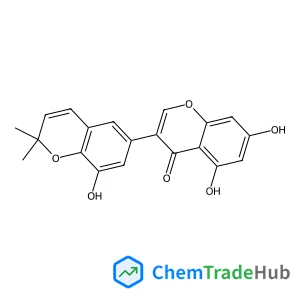
5,7,8'-Trihydroxy-2',2'-dimethyl-2'H,4H-3,6'-bichromen-4-one
CAS Number:
129280-33-7
Molecular Formula:
C20H16O6
David Willmer, Kyle Anthony Baldwin, David John Fairhurst
Sessile droplets of aqueous poly(ethylene oxide) solution, with average molecular weight of 100 kDa, are monitored during evaporative drying at ambient conditions over a range of initial concentrations c0. For all droplets with c0 ≥ 3%, central conical structures, which can be hollow and nearly 50% taller than the initial droplet, are formed during a growth stage. Although the formation of superficially similar structures has been explained for glass-forming polymers using a skin-buckling model which predicts the droplet to have constant surface area during the growth stage (L. Pauchard and C. Allain, Europhys. Lett., 2003, 62, 897–903), we demonstrate that this model is not applicable here as the surface area is shown to increase during growth for all c0. We interpret our experimental data using a proposed drying and deposition process comprising the four stages: pinned drying; receding contact line; “bootstrap” growth, during which the liquid droplet is lifted upon freshly-precipitated solid; and late drying. Additional predictions of our model, including a criterion for predicting whether a conical structure will form, compare favourably with observations. We discuss how the specific chemical and physical properties of PEO, in particular its amphiphilic nature, its tendency to form crystalline spherulites rather than an amorphous glass at high concentrations and its anomalous surface tension values for MW = 100 kDa may be critical to the observed drying process.
Nicolas Mattias Del Rio Fuenzalida, Eirin Alme, Frida Johanne Lundevall, Hans-René Bjørsvik
DOI: 10.1039/D2RE00071G
DOI: 10.1039/D2RE90024F
DOI: 10.1039/D2RE00228K
Runze Jin, Ke Ma, Shutao Xu, Yingxu Wei, Lijuan Song, Zhijun Li, Penghui Zhang, Yufeng Wang, Jiaofei Wang, Zhuangzhuang Zhang, Haobin Hu, Chengyi Dai, Xinwen Guo
DOI: 10.1039/D2RE00065B
Lídia A. S. Cavaca, Jaime A. S. Coelho, Susana D. Lucas, Rui M. S. Loureiro, Rafael F. A. Gomes, Carlos A. M. Afonso
DOI: 10.1039/D2RE00292B
Yuuki Mochizuki, Javzandolgor Bud, Enkhsaruul Byambajav, Naoto Tsubouchi
DOI: 10.1039/D2RE00003B
Yu Chen, Chong Liu, Yaoting Duan, Dongkun Yu, Zhenghui Liu, Yuting Li, Ruifen Shi, Yuting Guo, Tiancheng Mu
DOI: 10.1039/D2RE00137C
Iryna Kubitska, Volodymyr Ivasiv, Roman Nebesnyi, Igor I. Potemkin
DOI: 10.1039/D2RE00252C
Jing Song, Chencan Du, Junjie Wang, Yongjin Cui, Yujun Wang, Jian Deng, Guangsheng Luo
DOI: 10.1039/D2RE00224H
(1R,3S)-1,3-Cyclopentanediol finds applications in various industries. In the ph...
When handling N'-[4-(Dimethylamino)phenyl]-N,N-dimethyl-1,4-benzenediamine, it i...
There are several alternatives to 5-(2,4-Difluorophenyl)-2-methoxypyrimidine in ...
1-(3-Methoxyphenoxy)propan-2-ol (CAS: 382141-68-6) must comply with the Globally...
Tetrodotoxin Citrate is extremely dangerous and should be handled with extreme c...
2-Methyl-2-propanyl [(1R,3S)-3-hydroxycyclopentyl]carbamate (CAS: 225641-84-9) i...
Waste containing 4-(2-Hydroxyhexafluoroisopropyl)Benzoic Acid (CAS: 16261-80-6) ...
2-Methyl-2-proanyl {(2S)-1-[(benzyloxy)amino]-3-hydroxy-3-methyl-1-oxo-2-butanyl...
Benzeneethanamine, α-ethyl-, hydrochloride (1:1) is an organic compound with the...
In the synthesis of compounds similar to 3-{(E)-[4-(Dimethylamino)phenyl]diazeny...

Physical Chemistry Chemical Physics (PCCP) is an international journal co-owned by 19 physical chemistry and physics societies from around the world. This journal publishes original, cutting-edge research in physical chemistry, chemical physics and biophysical chemistry. To be suitable for publication in PCCP, articles must include significant innovation and/or insight into physical chemistry; this is the most important criterion that reviewers and Editors will judge against when evaluating submissions. The journal has a broad scope and welcomes contributions spanning experiment, theory, computation and data science. Topical coverage includes spectroscopy, dynamics, kinetics, statistical mechanics, thermodynamics, electrochemistry, catalysis, surface science, quantum mechanics, quantum computing and machine learning. Interdisciplinary research areas such as polymers and soft matter, materials, nanoscience, energy, surfaces/interfaces, and biophysical chemistry are welcomed if they demonstrate significant innovation and/or insight into physical chemistry. Joined experimental/theoretical studies are particularly appreciated when complementary and based on up-to-date approaches.
![N,N'-1,2-Ethanediylbis[2-(vinylsulfonyl)acetamide] structure](https://static.chemtradehub.com/structs/667/66710-66-5-b556.webp "N,N'-1,2-Ethanediylbis[2-(vinylsulfonyl)acetamide] structure")
![Ethyl 3-((6-(4,5-dihydro-1H-benzo[d]azepin-3(2H)-yl)-2-(pyridin-2-yl)pyrimidin-4-yl)amino)propanoate structure](https://static.chemtradehub.com/structs/137/1373423-53-0-496a.webp "Ethyl 3-((6-(4,5-dihydro-1H-benzo[d]azepin-3(2H)-yl)-2-(pyridin-2-yl)pyrimidin-4-yl)amino)propanoate structure")
![N-[(1S,2R,4S)-2-Amino-4-(dimethylcarbamoyl)cyclohexyl]-N'-(5-chloro-2-pyridinyl)ethanediamide structure](https://static.chemtradehub.com/structs/480/480452-37-7-0898.webp "N-[(1S,2R,4S)-2-Amino-4-(dimethylcarbamoyl)cyclohexyl]-N'-(5-chloro-2-pyridinyl)ethanediamide structure")



