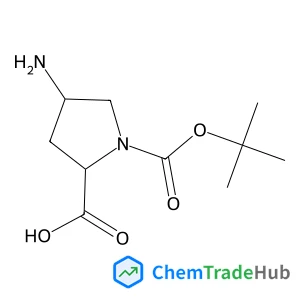
(2R,4R)-1-Boc-4-Aminopyrrolidine-2-carboxylic acid
CAS Number:
132622-98-1
Molecular Formula:
C10H18N2O4
Abhishek Khedkar, Michael Roemelt
Organoferrates(III) of the composition [FeR3R′]− have previously been identified in multiple studies as reaction intermediates during Fe-mediated cross coupling reactions. They are readily formed under reaction conditions and are able to efficiently eliminate cross coupling products which is a key step of the total reaction. However, only little is known about the electronic and structural properties of these organoferrates(III) and the mechanistic details of the reductive elimination. In this work modern ab initio electronic structure methods on the basis of the density matrix renormalization group (DMRG) are used to study the properties and reactivity of a set of eight organoferrates(III) with composition [Ph3FeR]− that have been investigated previously by mass-spectrometry experiments. The presented results provide a detailed picture about the reaction mechanism that explains the experimentally observed chemoselectivity in the gas-phase for the majority of cases. An interesting aspect of the proposed mechanism is the central role of the total spin which changes in the course of the reaction and governs the type of reaction mechanism. Eventually the applied computational procedures are thoroughly discussed in view of the conceptual and technical difficulties that were faced during the conducted studies.

Proceedings of the National Academy of Sciences of the United States of America

Pure and Applied Chemistry

Journal of Medicinal Chemistry

Organic Preparations and Procedures International

Science Progress

Pharmacological Reviews

Journal of Heterocyclic Chemistry

Journal of Physics and Chemistry of Solids

Russian Chemical Reviews

Science
Sonu Kumar, Rituparna Acharya, Urmi Chatterji, Priyadarsi De
DOI: 10.1039/C4PY00620H
Qiaorong Han, Yuliang Jiang, Can Jin, Shanshan Cheng, Xiaoxia Wang, Xiangyu Wang, Bingxiang Wang
DOI: 10.1039/C4PY00787E
Xiqi Zhang, Bin Yang, Yang Yang, Yen Wei
DOI: 10.1039/C4PY00794H
Bo Zhang, Hui Tang, Peiyi Wu
DOI: 10.1039/C4PY00653D
Arumugam Balasubramanian, Ting-Chia Ku, Hong-Pin Shih, Alishetty Suman, Huang-Jyun Lin, Ting-Wen Shih, Chien-Chung Han
DOI: 10.1039/C4PY00521J
Mutyala Naidu Ganivada, Pawan Kumar, Pintu Kanjilal, Himadri Dinda, Jayasri Das Sarma, Raja Shunmugam
DOI: 10.1039/C6PY00615A
When considering alternatives to 1-(4-Chlorophenyl)-N-hydroxymethanimine (CAS: 3...
This compound should be stored in a cool, dry place away from direct sunlight. I...
3-(4-Bromophenyl)-5-(2-fluorophenyl)-1,2,4-oxadiazole is synthesized through a m...
5-Chloro-2-(4-chlorophenyl)-4-methyl-6-[3-(1-piperidinyl)propoxy]pyrimidine (CAS...
2-Chloro-4-(difluoromethoxy)pyridine is used in the pharmaceutical industry for ...
3-Chloro-6-methylpyridazine (CAS: 1121-79-5) is classified under the Globally Ha...
Several alternatives can be used in the synthesis of Methyl 4,5-dimethyl-2-nitro...
Alternatives to (2E,2'E)-3,3'-(1,4-Phenylene)bisacrylaldehyde include other acry...
3-Amino-5-chloropyridin-2-ol hydrochloride is an organic compound with the CAS n...
When handling 6,7-Difluoro-2,3-dihydro-4H-chromen-4-one, it is essential to wear...

Physical Chemistry Chemical Physics (PCCP) is an international journal co-owned by 19 physical chemistry and physics societies from around the world. This journal publishes original, cutting-edge research in physical chemistry, chemical physics and biophysical chemistry. To be suitable for publication in PCCP, articles must include significant innovation and/or insight into physical chemistry; this is the most important criterion that reviewers and Editors will judge against when evaluating submissions. The journal has a broad scope and welcomes contributions spanning experiment, theory, computation and data science. Topical coverage includes spectroscopy, dynamics, kinetics, statistical mechanics, thermodynamics, electrochemistry, catalysis, surface science, quantum mechanics, quantum computing and machine learning. Interdisciplinary research areas such as polymers and soft matter, materials, nanoscience, energy, surfaces/interfaces, and biophysical chemistry are welcomed if they demonstrate significant innovation and/or insight into physical chemistry. Joined experimental/theoretical studies are particularly appreciated when complementary and based on up-to-date approaches.
![6-Bromo-2,3-dihydro-1H-pyrido[2,3-b][1,4]oxazine structure](https://static.chemtradehub.com/structs/120/1203499-17-5-b4d1.webp "6-Bromo-2,3-dihydro-1H-pyrido[2,3-b][1,4]oxazine structure")