












Chain-growth cationic polymerization of 2-halogenated thiophenes promoted by Brønsted acids
Literature Information
Publication Date
2014-06-16
DOI
10.1039/C4PY00521J
Impact Factor
5.582
Authors
Arumugam Balasubramanian, Ting-Chia Ku, Hong-Pin Shih, Alishetty Suman, Huang-Jyun Lin, Ting-Wen Shih, Chien-Chung Han
View Original
Abstract
Brønsted acids are found to be effective and generally applicable catalysts for inducing the cationic chain-growth polymerization of a wide variety of 2-halogenated-3-substituted-thiophenes with hydrogen, alkyl, alkylthio, alkoxy, and dialkoxy substituent groups. The effectiveness of the cationic polymerization depends on the acid strength and the electron density of the 2-halothiophene monomer. For the most electron-rich monomer, like EDOT, the polymerization can be initiated essentially with any acid that is stronger than acetic acid. While for the electron-poor 2-bromothiophene, it only works with the strongest acid, e.g., trifluoromethanesulfonic acid. Using this new polymerization method, highly solution-processable and conductive poly(alkylthiothiophene)s with a conductivity greater than 180 S cm−1 can be conveniently prepared. Control experiments indicate that Lewis acid like BF3 and SnCl4 (0.5 equiv.) can also induce the polymerization of 3-alkylthio-2-bromothiophenes in a similar fashion, but their polymerization failed totally in the presence of a trace amount of acid scavenger (e.g., <0.1 equiv. NEt3). On the other hand, similar polymerizations with Brønsted acid did not show any noticeable adverse effect under the same condition. The polymerization with Brønsted acid may involve the coupling between the monomer (as the nucleophile) and its protonated form (as the electrophile), followed by the elimination of HBr (or HCl) to convert the unstable nonconjugated dimeric intermediate 11 (Scheme 2) into the more stable conjugated chain growing species 12, which then initiates the polymerization by repeating the propagation steps of coupling with additional monomers, and then undergoes HX-elimination to regenerate the chain-growing centres.
Recommended Journals
Related Literature
Colorimetric and fluorometric dual-readout sensor for lysozyme
Hanye Zheng, Kefeng Xu, Linguang Luo, Yibiao Song, Zhenyu Lin, Longhua Guo, Bin Qiu, Guonan Chen
2013-08-05
Paper
DOI: 10.1039/C3AN01194A
Highly selective and sensitive detection of Cu2+ with lysine enhancing bovine serum albumin modified-carbon dots fluorescent probe
Jia-Ming Liu, Li-ping Lin, Xin-Xing Wang, Shao-Qin Lin, Wen-Lian Cai, Li-Hong Zhang, Zhi-Yong Zheng
2012-04-05
Paper
DOI: 10.1039/C2AN35130G
Electrochemical detection of dihydromyricetin using a DNA immobilized ethylenediamine/polyglutamic modified electrode
Lina Zou, Ying Xu, Peili Luo, Shusheng Zhang, Baoxian Ye
2011-11-23
Paper
DOI: 10.1039/C1AN15720E
Fluorescence observation supporting capillary chromatography based on tube radial distribution of carrier solvents under laminar flow conditions
Naoya Jinno, Mari Murakami, Kiyoshi Mizohata, Masahiko Hashimoto, Kazuhiko Tsukagoshi
2010-12-02
Paper
DOI: 10.1039/C0AN00820F
Cadmium binding in mixtures of phytochelatins and their fragments: A voltammetric study assisted by multivariate curve resolution and mass spectrometry
Rui Gusmão, Cristina Ariño, José Manuel Díaz-Cruz, Miquel Esteban
2009-11-13
Paper
DOI: 10.1039/B918293D
Simultaneous analysis of phosphopeptides and intact glycopeptides from secretome with mode switchable solid phase extraction
Rui Chen, Sam Williamson, Kelly M. Fulton, Susan M. Twine, Jianjun Li
2019-10-01
Paper
DOI: 10.1039/C9AY01756A
You might also like
Compound Q&A
Are there alternatives to 1-(4-Chlorophenyl)-N-hydroxymethanimine (CAS: 3848-36-0) in synthesis?
When considering alternatives to 1-(4-Chlorophenyl)-N-hydroxymethanimine (CAS: 3...
3848-36-01-(4-Chlorophenyl)-N...
Compound Q&A
How should (1R,9S,10S,12S,14E,16S,19R,20R,21S,22R)-3,9,21-Trihydroxy-5,10,12,14,16,20,22-heptamethyl-23,24-dioxatetracyclo[17.3.1.1~6,9~.0~2,7~]tetracosa-2,5,7,14-tetraen-4-one (CAS: 183202-73-5) be stored?
This compound should be stored in a cool, dry place away from direct sunlight. I...
183202-73-5(1R,9S,10S,12S,14E,1...
Compound Q&A
How is 3-(4-Bromophenyl)-5-(2-fluorophenyl)-1,2,4-oxadiazole (CAS: 419553-16-5) typically synthesized?
3-(4-Bromophenyl)-5-(2-fluorophenyl)-1,2,4-oxadiazole is synthesized through a m...
419553-16-53-(4-Bromophenyl)-5-...
Compound Q&A
How is 5-Chloro-2-(4-chlorophenyl)-4-methyl-6-[3-(1-piperidinyl)propoxy]pyrimidine (CAS: 1639220-19-1) typically synthesized?
5-Chloro-2-(4-chlorophenyl)-4-methyl-6-[3-(1-piperidinyl)propoxy]pyrimidine (CAS...
1639220-19-15-Chloro-2-(4-chloro...
Compound Q&A
What industries use 2-Chloro-4-(difluoromethoxy)pyridine (CAS: 1206978-15-5)?
2-Chloro-4-(difluoromethoxy)pyridine is used in the pharmaceutical industry for ...
1206978-15-52-Chloro-4-(difluoro...
Compound Q&A
What regulatory guidelines apply to 3-Chloro-6-methylpyridazine (CAS: 1121-79-5)?
3-Chloro-6-methylpyridazine (CAS: 1121-79-5) is classified under the Globally Ha...
1121-79-53-Chloro-6-methylpyr...
Compound Q&A
Are there alternatives to Methyl 4,5-dimethyl-2-nitrobenzoate in synthesis?
Several alternatives can be used in the synthesis of Methyl 4,5-dimethyl-2-nitro...
90922-74-0Methyl 4,5-dimethyl-...
Compound Q&A
Are there alternatives to (2E,2'E)-3,3'-(1,4-Phenylene)bisacrylaldehyde in synthesis?
Alternatives to (2E,2'E)-3,3'-(1,4-Phenylene)bisacrylaldehyde include other acry...
63405-68-5(2E,2'E)-3,3'-(1,4-P...
Compound Q&A
What is 3-Amino-5-chloropyridin-2-ol hydrochloride (CAS: 1261906-29-9)?
3-Amino-5-chloropyridin-2-ol hydrochloride is an organic compound with the CAS n...
1261906-29-93-Amino-5-chloropyri...
Compound Q&A
What precautions should be taken when handling 6,7-Difluoro-2,3-dihydro-4H-chromen-4-one (CAS: 1092349-93-3)?
When handling 6,7-Difluoro-2,3-dihydro-4H-chromen-4-one, it is essential to wear...
1092349-93-36,7-Difluoro-2,3-dih...
Source Journal
Polymer Chemistry

CiteScore:
8.6
Self-citation Rate:
7.3%
Articles per Year:
457
Polymer Chemistry welcomes submissions in all areas of polymer science that have a strong focus on macromolecular chemistry. Manuscripts may cover a broad range of fields, yet no direct application focus is required.
Recommended Compounds
![2-{[(1R,2S)-2-Aminocyclohexyl]amino}-4-{[3-(2H-1,2,3-triazol-2-yl)phenyl]amino}-5-pyrimidinecarboxamide structure](https://static.chemtradehub.com/structs/137/1370261-96-3-40df.webp "2-{[(1R,2S)-2-Aminocyclohexyl]amino}-4-{[3-(2H-1,2,3-triazol-2-yl)phenyl]amino}-5-pyrimidinecarboxamide structure")
2-{[(1R,2S)-2-Aminocyclohexyl]amino}-4-{[3-(2H-1,2,3-triazol-2-yl)phenyl]amino}-5-pyrimidinecarboxamide
CAS Number:
1370261-96-3
Molecular Formula:
C19H23N9O
![[4-(Isobutyrylamino)phenyl]boronic acid structure](https://static.chemtradehub.com/structs/874/874219-50-8-6ab5.webp "[4-(Isobutyrylamino)phenyl]boronic acid structure")
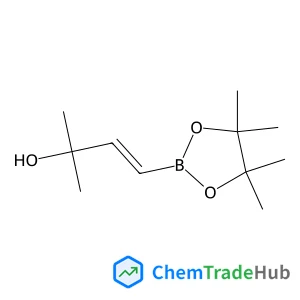
(E)-2-methyl-4-(4,4,5,5-tetramethyl-1,3,2-dioxaborolan-2-yl)but-3-en-2-ol
CAS Number:
581802-26-8
Molecular Formula:
C11H21BO3
Recommended Suppliers




Disclaimer
This page provides academic journal information for reference and research purposes only. We are not affiliated with any journal publishers and do not handle publication submissions. For publication-related inquiries, please contact the respective journal publishers directly.
If you notice any inaccuracies in the information displayed, please contact us at support@chemtradehub.com. We will promptly review and address your concerns.