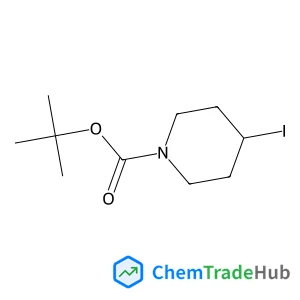
2-Methyl-2-propanyl 4-iodo-1-piperidinecarboxylate
CAS Number:
301673-14-3
Molecular Formula:
C10H18INO2
Shuang Wang, Yuejie Liu, Jingxiang Zhao
The electrochemical reduction of nitrobenzene (NBER) holds great promise for not only removing toxic pollutants, but also producing valuable aniline, in which the development of catalysts with high-efficiency still remains a huge challenge. In this work, by means of density functional theory (DFT) computations, we proposed several single transition metal (TM) atoms embedded into the single vacancy of graphene with nitrogen-doping (TMN3/G, TM = Ni, Cu, Pd, and Pt) as the catalysts for NBER. Our results revealed that, among these candidates, PtN3/G is the most active catalyst for the NBER due to its smallest limiting potential (−0.21 V), in which the hydrogenation of Ph-NO2* to Ph-NOOH* is identified as the potential-determining step. Compared with other catalysts, the strongest binding strength of Ph-NOOH* with PtN3/G is responsible for its superior catalytic activity towards NBER, which can be deeply understood on the basis of the corresponding electronic structure analysis. Thus, PtN3/G is a quite promising single-atom-catalyst with high efficiency for nitrobenzene reduction, which provides a rational paradigm for converting harmful nitrobenzene to valuable aniline under ambient conditions.
K. Bartl, A. Funk, K. Schwing, H. Fricke, G. Kock, H.-D. Martin, M. Gerhards
DOI: 10.1039/B813425A
Yang Pan, Lidong Zhang, Taichang Zhang, Huijun Guo, Xin Hong, Liusi Sheng, Fei Qi
DOI: 10.1039/B813268B
Christophe Legein, Jean-Yves Buzaré
DOI: 10.1039/B812091A
Aditya Savara, Alon Danon, Wolfgang M.H. Sachtler, Eric Weitz
DOI: 10.1039/B815605K
Erik G. Brandt, Mikko Hellgren, Tore Brinck, Tomas Bergman, Olle Edholm
DOI: 10.1039/B815482A
Kenji Furuya, Akihiro Ide, Hiroshi Okumura, Akira Harata
DOI: 10.1039/B814147A
Ji Hoon Ryu, Dong Hwa Seo, Da Hye Kim, Hyuck Mo Lee
DOI: 10.1039/B813689K
A. Molina, C. Serna, J. Gonzalez, J. A. Ortuño, E. Torralba
DOI: 10.1039/B816843C
DOI: 10.1039/B811925B
When considering alternatives to 1-(4-Chlorophenyl)-N-hydroxymethanimine (CAS: 3...
This compound should be stored in a cool, dry place away from direct sunlight. I...
3-(4-Bromophenyl)-5-(2-fluorophenyl)-1,2,4-oxadiazole is synthesized through a m...
5-Chloro-2-(4-chlorophenyl)-4-methyl-6-[3-(1-piperidinyl)propoxy]pyrimidine (CAS...
2-Chloro-4-(difluoromethoxy)pyridine is used in the pharmaceutical industry for ...
3-Chloro-6-methylpyridazine (CAS: 1121-79-5) is classified under the Globally Ha...
Several alternatives can be used in the synthesis of Methyl 4,5-dimethyl-2-nitro...
Alternatives to (2E,2'E)-3,3'-(1,4-Phenylene)bisacrylaldehyde include other acry...
3-Amino-5-chloropyridin-2-ol hydrochloride is an organic compound with the CAS n...
When handling 6,7-Difluoro-2,3-dihydro-4H-chromen-4-one, it is essential to wear...

Physical Chemistry Chemical Physics (PCCP) is an international journal co-owned by 19 physical chemistry and physics societies from around the world. This journal publishes original, cutting-edge research in physical chemistry, chemical physics and biophysical chemistry. To be suitable for publication in PCCP, articles must include significant innovation and/or insight into physical chemistry; this is the most important criterion that reviewers and Editors will judge against when evaluating submissions. The journal has a broad scope and welcomes contributions spanning experiment, theory, computation and data science. Topical coverage includes spectroscopy, dynamics, kinetics, statistical mechanics, thermodynamics, electrochemistry, catalysis, surface science, quantum mechanics, quantum computing and machine learning. Interdisciplinary research areas such as polymers and soft matter, materials, nanoscience, energy, surfaces/interfaces, and biophysical chemistry are welcomed if they demonstrate significant innovation and/or insight into physical chemistry. Joined experimental/theoretical studies are particularly appreciated when complementary and based on up-to-date approaches.
![2,2'-{2,2-Propanediylbis[(2,6-dibromo-4,1-phenylene)oxy]}diethanol structure](https://static.chemtradehub.com/structs/416/4162-45-2-b3d6.webp "2,2'-{2,2-Propanediylbis[(2,6-dibromo-4,1-phenylene)oxy]}diethanol structure")