


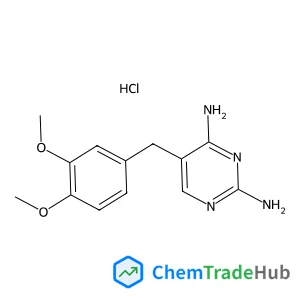
5-(3,4-Dimethoxybenzyl)-2,4-pyrimidinediamine hydrochloride (1:1)
CAS Number:
2507-23-5
Molecular Formula:
C13H17ClN4O2
Aditya Savara, Alon Danon, Wolfgang M.H. Sachtler, Eric Weitz
The mechanism of temperature-programmed desorption (TPD) of nitric acid chemisorbed on BaNa–Y was studied over the temperature range from 200 to 400 °C, in the presence and absence of CO. Nitric acid dissociates to form H+ and NO3− when chemisorbed on BaNa–Y. The results of these experiments are consistent with H+ and NO3− either reacting directly to produce OH and NO2 or recombining to produce HNO3, which is desorbed and rapidly decomposes within the zeolite pores to OH and NO2. The kinetics and stoichiometry suggest that the hydroxyl radicals produced react with CO and NO2 to form CO2 + H and NO + HO2, respectively. The H atoms thus formed react with OH in preference to NO2, a change in mechanism consistent with literature rate constants and the expectation that the zeolite pore walls act as a third body for the reaction of H with OH. Finally, OH may react with NO2 to form HO2, which can undergo further reactions to form O2, H2O, and/or H2. No reaction between CO and NO3 or CO and surface-bound NO3− was observed.

Journal of Natural Medicines

New Journal of Chemistry

Russian Journal of Applied Chemistry

Current Opinion in Solid State & Materials Science

Chemistry Education Research and Practice

Russian Chemical Bulletin

Russian Journal of Bioorganic Chemistry

Crystallography Reports

Chemical Communications

Organic Process Research & Development
Yungang Zhou, Chengfei Yang, Xia Xiang, Xiaotao Zu
DOI: 10.1039/C3CP51518D
Jaume Puy, Joan Cecília, Josep Galceran
DOI: 10.1039/C3CP51038G
Daeil Yoon, Qing Su, Haiyan Wang, Arumugam Manthiram
DOI: 10.1039/C3CP52679H
Chang-Lyoul Lee, Shinuk Cho, Seung-Hwan Oh, Seung-Hyeon Moon, Ahmed Elbarbary
DOI: 10.1039/C3CP52151F
Guo-zhen Zhu, Andrew P. Knights, Gianluigi A. Botton
DOI: 10.1039/C3CP51135A
Diana Paiva, Galya Ivanova, Maria do Carmo Pereira, Sandra Rocha
DOI: 10.1039/C3CP51215K
Jukka Jokisaari, Juha Vaara
DOI: 10.1039/C3CP50625H
Martin J. Hollamby
DOI: 10.1039/C3CP50293G
Makoto Uchida, Young-Chul Park, Katsuyoshi Kakinuma, Hiroshi Yano, Donald A. Tryk, Takeo Kamino, Hiroyuki Uchida, Masahiro Watanabe
DOI: 10.1039/C3CP51801A
Tetsuhiro Kudo, Hajime Ishihara
DOI: 10.1039/C3CP51969D
When considering alternatives to 1-(4-Chlorophenyl)-N-hydroxymethanimine (CAS: 3...
This compound should be stored in a cool, dry place away from direct sunlight. I...
3-(4-Bromophenyl)-5-(2-fluorophenyl)-1,2,4-oxadiazole is synthesized through a m...
5-Chloro-2-(4-chlorophenyl)-4-methyl-6-[3-(1-piperidinyl)propoxy]pyrimidine (CAS...
2-Chloro-4-(difluoromethoxy)pyridine is used in the pharmaceutical industry for ...
3-Chloro-6-methylpyridazine (CAS: 1121-79-5) is classified under the Globally Ha...
Several alternatives can be used in the synthesis of Methyl 4,5-dimethyl-2-nitro...
Alternatives to (2E,2'E)-3,3'-(1,4-Phenylene)bisacrylaldehyde include other acry...
3-Amino-5-chloropyridin-2-ol hydrochloride is an organic compound with the CAS n...
When handling 6,7-Difluoro-2,3-dihydro-4H-chromen-4-one, it is essential to wear...

Physical Chemistry Chemical Physics (PCCP) is an international journal co-owned by 19 physical chemistry and physics societies from around the world. This journal publishes original, cutting-edge research in physical chemistry, chemical physics and biophysical chemistry. To be suitable for publication in PCCP, articles must include significant innovation and/or insight into physical chemistry; this is the most important criterion that reviewers and Editors will judge against when evaluating submissions. The journal has a broad scope and welcomes contributions spanning experiment, theory, computation and data science. Topical coverage includes spectroscopy, dynamics, kinetics, statistical mechanics, thermodynamics, electrochemistry, catalysis, surface science, quantum mechanics, quantum computing and machine learning. Interdisciplinary research areas such as polymers and soft matter, materials, nanoscience, energy, surfaces/interfaces, and biophysical chemistry are welcomed if they demonstrate significant innovation and/or insight into physical chemistry. Joined experimental/theoretical studies are particularly appreciated when complementary and based on up-to-date approaches.
![2-{[(1R,2S)-2-Aminocyclohexyl]amino}-4-{[3-(2H-1,2,3-triazol-2-yl)phenyl]amino}-5-pyrimidinecarboxamide structure](https://static.chemtradehub.com/structs/137/1370261-96-3-40df.webp "2-{[(1R,2S)-2-Aminocyclohexyl]amino}-4-{[3-(2H-1,2,3-triazol-2-yl)phenyl]amino}-5-pyrimidinecarboxamide structure")




