












Elucidating the role of structural fluctuations, and intermolecular and vibronic interactions in the spectroscopic response of a bacteriophytochrome
Literature Information
Publication Date
2020-03-23
DOI
10.1039/D0CP00372G
Impact Factor
3.676
Authors
Veronica Macaluso, Lorenzo Cupellini, Giacomo Salvadori, Filippo Lipparini, Benedetta Mennucci
View Original
Abstract
We present the first comprehensive multiscale computational investigation of Resonance Raman, absorption and Circular Dichroism spectra of the resting state of the Deinococcus radiodurans phytochrome. The spectra are simulated in all their components, namely the energy position and the lineshapes of both the far-red and the blue bands. To achieve such a goal, we have combined a 4.5 μs MD simulation of the solvated dimeric phytochrome with a hybrid quantum mechanics/molecular mechanics (QM/MM) model, which accounts for both electrostatic and mutual polarization effects between the QM and the MM subsystems. A good agreement with experiments is found for all the three spectra. Moreover, we find a transient H-bond network within the binding pocket of the biliverdin chromophore that, unexpectedly, does not significantly affect the spectra. In parallel, we characterize the vibrations that are more strongly coupled to the biliverdin excitation, confirming the important role of the hydrogen-out-of-plane mode of its vinyl C–H together with the expected CC stretching of the double bond involved in the photoisomerization.
Related Literature
Transition metal-free and temperature dependent one-pot access to phenanthrene-fused heterocycles via a 1,3-dipolar cycloaddition pathway
Mokilla Ramachandra Reddy, Eerappa Rajakumara, Gedu Satyanarayana
2023-10-25
Communication
DOI: 10.1039/D3CC04473D
A heteropolytungstate based 2D layered porous framework with high proton conductivity
Mengnan Yang, Yao Zhang, Shiyan Ji, Huafeng Li, Xinyi Ma, Yuzhen Jin, Pengtao Ma, Jingping Wang, Jingyang Niu
2023-10-17
Communication
DOI: 10.1039/D3CC04517J
Access to pyrrolines and fused diaziridines by selective radical addition to homoallylic diazirines‡
Zhigang Ma, Xinxin Wu, Haotian Li, Zhu Cao
2023-12-29
Edge Article
DOI: 10.1039/D3SC04886A
Water-soluble organic macrocycles based on dye chromophores and their applications
Luying Zhang, Yanqing Xu, Wei Wei
2023-10-20
Feature Article
DOI: 10.1039/D3CC04159J
Facile synthesis of supported CuNi nano-clusters as an electrochemical CO2 reduction catalyst with broad potential range
Jiale Wang, Fan Li, Runhua Li, Qian Xiang, Wencong Zhang, Chengyi Song, Peng Tao, Wen Shang
2023-10-16
Communication
DOI: 10.1039/D3CC03758D
Transient absorption spectroscopy reveals that slow bimolecular recombination in SrTiO3 underpins its efficient photocatalytic performance
Anna A. Wilson, Lucy Hart, Thomas Shalvey, Michael Sachs, Weidong Xu, Benjamin Moss, Eva Mazzolini, Asim Mumtaz
2023-10-25
Communication
DOI: 10.1039/D3CC04616H
Poly(ferrocenylene iminoborane): an inorganic–organic hybrid polymer comprising a backbone of moderately interacting ferrocenes‡
Vivien Zeh, Johannes S. Schneider, Jonas Bachmann, Ivo Krummenacher, Holger Braunschweig, Holger Helten
2023-10-26
Communication
DOI: 10.1039/D3CC03523A
Visible-light-induced bifunctionalisation of (homo)propargylic amines with CO2 and arylsulfinates
2023-10-31
Communication
DOI: 10.1039/D3CC04160C
Facile synthesis of wide bandgap ZrS2 colloidal quantum dots for solution processed solar-blind UV photodetectors
2023-10-24
Communication
DOI: 10.1039/D3CC03594H
You might also like
Compound Q&A
What are the main uses of (5-Sulfamoyl-3-pyridinyl)boronic acid (CAS: 951233-61-7)?
(5-Sulfamoyl-3-pyridinyl)boronic acid is primarily used in chemical synthesis, p...
951233-61-7(5-Sulfamoyl-3-pyrid...
Compound Q&A
How is Benzyl 2-methyl-2-(methylsulfonyl)-4-pentenoate (CAS: 1942858-50-5) typically synthesized?
Benzyl 2-methyl-2-(methylsulfonyl)-4-pentenoate is typically synthesized via est...
1942858-50-5Benzyl 2-methyl-2-(m...
Compound Q&A
What precautions should be taken when handling 8-Fluoroquinolin-6-ol (CAS: 209353-22-0)?
When handling 8-Fluoroquinolin-6-ol (CAS: 209353-22-0), it is important to use p...
209353-22-08-Fluoroquinolin-6-o...
Compound Q&A
What are the physical and chemical properties of 1,3-Dibromo-5-(2-methyl-2-propanyl)benzene (CAS: 129316-09-2)?
1,3-Dibromo-5-(2-methyl-2-propanyl)benzene (CAS: 129316-09-2) is a crystalline c...
129316-09-21,3-Dibromo-5-(2-met...
Compound Q&A
What industries use Ethyl 7-chloro-4-oxo-1-(1,3-thiazol-2-yl)-1,4-dihydro-1,8-naphthyridine-3-carboxylate (CAS: 174726-87-5)?
Ethyl 7-chloro-4-oxo-1-(1,3-thiazol-2-yl)-1,4-dihydro-1,8-naphthyridine-3-carbox...
174726-87-5Ethyl 7-chloro-4-oxo...
Compound Q&A
What precautions should be taken when handling Delta-7-Avenasterol (CAS: 23290-26-8)?
When handling Delta-7-Avenasterol (CAS: 23290-26-8), it is important to wear app...
23290-26-8Delta-7-Avenasterol
Compound Q&A
What precautions should be taken when handling N-({(5R)-3-[3-Fluoro-4-(4-morpholinyl)phenyl]-2-oxo-1,3-oxazolidin-5-yl}methyl)acetamide (CAS: 872992-20-6)?
Proper handling involves the use of personal protective equipment such as gloves...
872992-20-6N-({(5R)-3-[3-Fluoro...
Compound Q&A
What precautions should be taken when handling 2-Methyl-2-proanyl 4-[(2-aminophenyl)amino]-1-piperidinecarboxylate (CAS: 79099-00-6)?
When handling 2-Methyl-2-proanyl 4-[(2-aminophenyl)amino]-1-piperidinecarboxylat...
79099-00-62-Methyl-2-propanyl ...
Compound Q&A
What is N-Methyl-4-chlorobenzylamine hydrochloride (CAS: 65542-24-7)?
N-Methyl-4-chlorobenzylamine hydrochloride (CAS: 65542-24-7) is a organic compou...
65542-24-7N-Methyl-4-chloroben...
Compound Q&A
Is [2-(Dodecyloxy)ethoxy]acetic acid (CAS: 27306-90-7) safe?
[2-(Dodecyloxy)ethoxy]acetic acid (CAS: 27306-90-7) is generally considered safe...
27306-90-7[2-(Dodecyloxy)ethox...
Source Journal
Physical Chemistry Chemical Physics

CiteScore:
5.5
Self-citation Rate:
10.3%
Articles per Year:
3036
Physical Chemistry Chemical Physics (PCCP) is an international journal co-owned by 19 physical chemistry and physics societies from around the world. This journal publishes original, cutting-edge research in physical chemistry, chemical physics and biophysical chemistry. To be suitable for publication in PCCP, articles must include significant innovation and/or insight into physical chemistry; this is the most important criterion that reviewers and Editors will judge against when evaluating submissions. The journal has a broad scope and welcomes contributions spanning experiment, theory, computation and data science. Topical coverage includes spectroscopy, dynamics, kinetics, statistical mechanics, thermodynamics, electrochemistry, catalysis, surface science, quantum mechanics, quantum computing and machine learning. Interdisciplinary research areas such as polymers and soft matter, materials, nanoscience, energy, surfaces/interfaces, and biophysical chemistry are welcomed if they demonstrate significant innovation and/or insight into physical chemistry. Joined experimental/theoretical studies are particularly appreciated when complementary and based on up-to-date approaches.
Recommended Compounds
![(4-Methyl-1H-benzo[d]imidazol-2-yl)methanamine structure](https://static.chemtradehub.com/structs/933/933756-31-1-7b0b.webp "(4-Methyl-1H-benzo[d]imidazol-2-yl)methanamine structure")
![2-Azaspiro[4.5]decane-3,8-dione structure](https://static.chemtradehub.com/structs/914/914780-96-4-e94b.webp "2-Azaspiro[4.5]decane-3,8-dione structure")
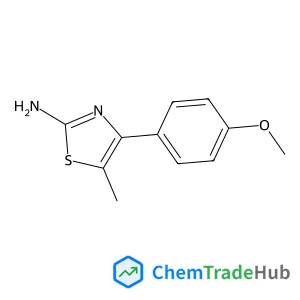
4-(4-Methoxyphenyl)-5-methyl-1,3-thiazol-2-amine
CAS Number:
105512-88-7
Molecular Formula:
C11H12N2OS
Recommended Suppliers





Disclaimer
This page provides academic journal information for reference and research purposes only. We are not affiliated with any journal publishers and do not handle publication submissions. For publication-related inquiries, please contact the respective journal publishers directly.
If you notice any inaccuracies in the information displayed, please contact us at support@chemtradehub.com. We will promptly review and address your concerns.