












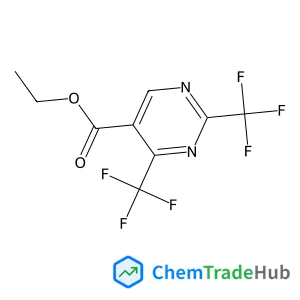
Ethyl 2,4-bis(trifluoromethyl)-5-pyrimidinecarboxylate
CAS Number:
188781-15-9
Molecular Formula:
C9H6F6N2O2
Daniel Wines, Jaron A. Kropp, Gracie Chaney, Can Ataca
Recently, 2D tellurene (Te) structures have been experimentally synthesized. These structures possess high carrier mobility and stability which make them ideal candidates for applications in electronics, optoelectronics and energy devices. We performed density functional theory (DFT) and molecular dynamics (MD) simulations to investigate the stability and electronic structure of 2D α- and β-Te sheets, and hydrogen, oxygen, and fluorine functionalized counterparts, including spin–orbit coupling effects. Our calculations show that bare α and β-Te sheets are stable with band gaps of 0.44 eV and 1.02 eV respectively. When functionalized, α and β monolayers exhibit metallic properties, except for hydrogenated β-Te, which exhibits semiconducting properties with a band gap of 1.37 eV. We see that H, O and F destabilize the structure of α-Te. We also find that F and H cause β-Te layers to separate into functionalized atomic chains and O causes β-Te to transform into a Te3O2-like structure. We also studied single atom and molecule binding on the Te surface, the effects of adatom coverage, and the effects of functionalized Te on a GaSe substrate. Our results indicate that tellurene monolayers and functionalized counterparts are not only suitable for future optoelectronic devices, but can be used as metallic contacts in nanoscale junctions.
Xing-Cai Wu, You-Rong Tao, Qi-Xiu Gao
DOI: 10.1039/B913935D
Shengqing Ye, Ke Gao, Haibo Zhou, Xiaodi Yang
DOI: 10.1039/B909178E
Nicolas A. Uhlich, Peter Sommer, Claudia Bühr, Stefan Schürch, Jean-Louis Reymond, Tamis Darbre
DOI: 10.1039/B912291E
DOI: 10.1039/B908378B
Victor Maurizot, Stéphane Massip, Jean-Michel Léger, Gérard Déléris
DOI: 10.1039/B909446F
A. M. Coto-García, M. T. Fernández-Argüelles, J. M. Costa-Fernández, A. Sanz-Medel
DOI: 10.1039/B909469E
Shigeru Shimada, Yoong-Kee Choe, Takashi Yamashita
DOI: 10.1039/B914316E
Ming-Jhe Li, Chien-Chen Lai, Yi-Hung Liu, Shie-Ming Peng, Sheng-Hsien Chiu
DOI: 10.1039/B906075H
Sarah Rogers, Stephanie Hoeppener
DOI: 10.1039/B911858F
When handling lithium chloride hydrate (1:1:1) (CAS: 16712-20-2), it is importan...
4-(4H-1,2,4-Triazol-4-yl)piperidine is generally considered safe for use in phar...
Waste containing 1,3-Thiazole-2-carboxamide (CAS: 16733-85-0) should be collecte...
5-(Difluoromethyl)-2-fluorobenzonitrile (CAS: 934175-58-3) is subject to regulat...
Methyl 3-acetamido-2-thiophenecarboxylate can be synthesized by the reaction of ...
4-Isoquinolinecarbonitrile is a chemical compound with the CAS number 34846-65-6...
Store Methyl 1H-1,2,3-triazole-4-carboxylate (CAS: 877309-59-6) in a cool, dry p...
6-Bromo[1,3]thiazolo[5,4-b]pyridin-2-amine (CAS: 1160791-13-8) is subject to the...
(2S,3S)-2-Ammonio-3-(3,4-dihydroxyphenyl)-3-hydroxypropanoate (CAS: 23651-95-8) ...
7-Bromo-3-methyl-3,4-dihydroquinazolin-4-one is a solid with a crystalline form....

Physical Chemistry Chemical Physics (PCCP) is an international journal co-owned by 19 physical chemistry and physics societies from around the world. This journal publishes original, cutting-edge research in physical chemistry, chemical physics and biophysical chemistry. To be suitable for publication in PCCP, articles must include significant innovation and/or insight into physical chemistry; this is the most important criterion that reviewers and Editors will judge against when evaluating submissions. The journal has a broad scope and welcomes contributions spanning experiment, theory, computation and data science. Topical coverage includes spectroscopy, dynamics, kinetics, statistical mechanics, thermodynamics, electrochemistry, catalysis, surface science, quantum mechanics, quantum computing and machine learning. Interdisciplinary research areas such as polymers and soft matter, materials, nanoscience, energy, surfaces/interfaces, and biophysical chemistry are welcomed if they demonstrate significant innovation and/or insight into physical chemistry. Joined experimental/theoretical studies are particularly appreciated when complementary and based on up-to-date approaches.

![tert-butyl 8-benzyl-2,8-diazaspiro[4.5]decane-2-carboxylate structure](https://static.chemtradehub.com/structs/336/336191-16-3-bb55.webp "tert-butyl 8-benzyl-2,8-diazaspiro[4.5]decane-2-carboxylate structure")
![(R)-N-[(S)-1-[2-(Diphenylphosphino)phenyl]ethyl]-2-methylpropane-2-sulfinamide structure](https://static.chemtradehub.com/structs/159/1595319-98-4-33e7.webp "(R)-N-[(S)-1-[2-(Diphenylphosphino)phenyl]ethyl]-2-methylpropane-2-sulfinamide structure")



