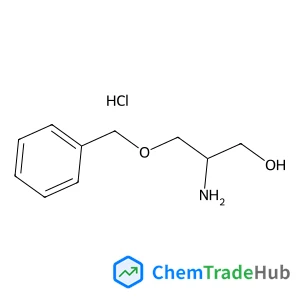
(R)-2-amino-3-(benzyloxy)propan-1-ol hydrochloride
CAS Number:
58577-95-0
Molecular Formula:
C10H16ClNO2
Jhih-Siang Chen, Pin-Fan Chen, Hana Tzu-Han Lin
Inflammation is a complex biological response of the human body to external or internal stimuli, such as invading pathogens, defective cells, or irritating substances. One important indicator of inflammatory conditions or the progress of various diseases, such as cancer, cardiovascular diseases, neurological diseases, connective tissue diseases, sepsis, or Alzheimer's disease, is the concentration level of inflammatory biomarkers, including immunoglobulins, cytokines, and C-reactive protein (CRP). Since inflammatory biomarkers are highly correlated with each other, it is important to measure them simultaneously. To enable continuous and dynamic inflammatory biomarker detection, we utilized localized surface plasmon resonance (LSPR) to perform label-free molecule sensing. Since the LSPR sensing mechanism requires only a small sensing area with simplified optical setup, it can be easily integrated with a microfluidic device. To simplify reagent operation complexity, we developed an automated microfluidic control system to control reagent guiding and switching in the immunoassay with less manual processes and potential operation errors. Our results successfully demonstrated multiplex IgG, TNF-α, and CRP measurement with only 60 μL assay volume and 3.5 h assay time. In each test, 20 sensing spot measurements under four different reagent conditions can be performed. Overall, we envision that the LSPR sensor integrated automated microfluidic control system could perform rapid, multiplex, and multiparallel continuous inflammatory biomarker detection, which would be beneficial for various applications, such as immune status monitoring, diagnosis and prognosis of inflammatory diseases.
Michael G. Burnett, Christopher Hardacre, James M. Mallon, Heather J. Mawhinney, R. Mark Ormerod
DOI: 10.1039/A909612D
Masayoshi Naito, Hiroshi Okamoto, Naoki Tanaka
DOI: 10.1039/A908490H
Tanja van Mourik, David M. Benoit, Sarah L. Price, David C. Clary
DOI: 10.1039/A909183A
Kengo Suzuki, Attila Demeter, Wolfgang Kühnle, Erich Tauer, Klaas A. Zachariasse, Seiji Tobita, Haruo Shizuka
DOI: 10.1039/A908924A
Ingeborg Schreur-Piet, Johan P. A. Heuts
DOI: 10.1039/C7PY01583F
Ethyl 4-chlorothieno[2,3-b]pyridine-5-carboxylate (CAS: 59713-58-5) can be synth...
5-Methyl-1H-indole-3-carbaldehyde (CAS: 52562-50-2) is subject to various regula...
(1,3-Dimethyl-2,4-dioxo-1,2,3,4-tetrahydro-5-pyrimidinyl)boronic acid is a white...
Waste containing Sulfocostunolide A (CAS: 1016983-51-9) should be handled with c...
When handling Murraxocin (CAS: 88478-44-8), ensure proper personal protective eq...
Formvar (CAS: 63148-64-1) is an alkyd resin characterized by a high molecular we...
(S)-4-benzyl-2-((benzyloxy)methyl)morpholine is generally safe when handled with...
Methyl 1-(5-bromo-2-pyrimidinyl)cyclopropanecarboxylate (CAS: 1447607-69-3) is p...
2-Methyl-1-phenyl-1-propanamine hydrochloride (CAS: 24290-47-9) is generally con...
3-(4-Bromophenyl)-2-methylpropanoic acid is synthesized through a multi-step pro...

Analyst publishes analytical and bioanalytical research that reports premier fundamental discoveries and inventions, and the applications of those discoveries, unconfined by traditional discipline barriers.