












In situ stabilizer formation from methacrylic acid macromonomers in emulsion polymerization
Literature Information
Publication Date
2017-10-17
DOI
10.1039/C7PY01583F
Impact Factor
5.582
Authors
Ingeborg Schreur-Piet, Johan P. A. Heuts
View Original
Abstract
Oligomers of methacrylic acid containing a propenyl ω-endgroup (i.e. MAA-macromonomers) were synthesized by cobalt-mediated catalytic chain transfer polymerization and used as precursors to stabilizers in emulsion polymerization. It was found that only in those polymerizations in which these precursors were sufficiently quickly converted into amphiphilic molecules, via a type of polymerization induced self-assembly (PISA) mechanism, stable emulsion polymerization could be carried out. This process was too slow in the emulsion polymerization of methyl methacrylate (MMA) and in order to obtain stable latexes, the addition of a conventional surfactant (sodium dodecyl sulphate, SDS) was necessary. In the emulsion polymerization of butyl acrylate, however, reactions with the macromonomers were faster and because of the more hydrophobic nature of BA (as compared to MMA), stabilizers were sufficiently quickly formed in situ and stable latexes were produced without the need for additional SDS. Also the emulsion polymerization of butyl methacrylate (BMA), which reacts via the same “sulfur-free RAFT” mechanism as MMA, could be carried out in the absence of SDS because of the greater hydrophobicity of the monomer. Copolymerizations of MMA with >30% of BA or 85% BMA also resulted in stable latexes without the addition of SDS. The synthesized macromonomers and in situ formed copolymers were characterized by means of size exclusion chromatography (SEC), 1H NMR spectroscopy and MALDI-ToF MS.
Recommended Journals
Related Literature
Solid-state photoelectron transfer in powdery nanocomposites comprised of a sensitiser, photoacid generators and silicananoparticles
Shinji Horie, Shusaku Nagano
2011-02-21
Paper
DOI: 10.1039/C0CP00034E
Why aggregated carbon nanotubes exhibit low quantum efficiency
Yu-Hsien Lin, Yao-Cheng Lai, Ching-Tung Hsu, Chia-Jung Hu, Wen-Kuang Hsu
2011-03-14
Paper
DOI: 10.1039/C0CP02691C
Singlet nuclear magnetic resonance of nearly-equivalent spins
Michael C. D. Tayler, Malcolm H. Levitt
2011-02-11
Communication
DOI: 10.1039/C0CP02293D
Monomer, clusters, liquid: an integrated spectroscopic study of methanol condensation
Hartawan Laksmono, Shinobu Tanimura, Heather C. Allen, Gerald Wilemski, Mark S. Zahniser, Joanne H. Shorter, David D. Nelson, J. Barry McManus
2011-02-18
Paper
DOI: 10.1039/C0CP02485F
The influence of dye structure on charge recombination in dye-sensitized solar cells
James R. Jennings, Yeru Liu, Qing Wang, Shaik M. Zakeeruddin, Michael Grätzel
2011-03-07
Paper
DOI: 10.1039/C0CP02605K
Molecular elimination of methyl formate in photolysis at 234 nm: roaming vs. transition state-type mechanism
Meng-Hsuan Chao, Po-Yu Tsai, King-Chuen Lin
2011-03-11
Paper
DOI: 10.1039/C0CP02710C
Effects of surface curvature and surface chemistry on the structure and activity of proteins adsorbed in nanopores‡
Lung-Ching Sang, Marc-Olivier Coppens
2011-03-02
Paper
DOI: 10.1039/C0CP02273J
Mechanistic and spectroscopic identification of initial reaction intermediates for prenal decomposition on a platinum model catalyst
D. Loffreda, F. Delbecq, P. Sautet, Y. Jugnet, A. Krupski, K. Wandelt
2011-02-22
Paper
DOI: 10.1039/C0CP02428G
White light excitation of the near infrared Er3+ emission in exchanged zeolite sensitised by oxygen vacancies
Agnieszka Mech, Angelo Monguzzi, Fabio Cucinotta, Francesco Meinardi, Jakub Mezyk, Luisa De Cola, Riccardo Tubino
2011-02-07
Paper
DOI: 10.1039/C0CP02079F
Structure–property relations in crystalline l-leucine obtained from calorimetry, X-rays, neutron and Raman scattering
Pedro F. Façanha Filho, Paulo T. C. Freire, José A. Lima Jr., Adenilson O. dos Santos, Paul F. Henry, Ewout Kremner, Heloisa N. Bordallo
2011-03-07
Paper
DOI: 10.1039/C0CP02278K
You might also like
Compound Q&A
How is Ethyl 4-chlorothieno[2,3-b]pyridine-5-carboxylate (CAS: 59713-58-5) typically synthesized?
Ethyl 4-chlorothieno[2,3-b]pyridine-5-carboxylate (CAS: 59713-58-5) can be synth...
59713-58-5Ethyl 4-chlorothieno...
Compound Q&A
What regulatory guidelines apply to 5-Methyl-1H-indole-3-carbaldehyde (CAS: 52562-50-2)?
5-Methyl-1H-indole-3-carbaldehyde (CAS: 52562-50-2) is subject to various regula...
52562-50-25-Methyl-1H-indole-3...
Compound Q&A
What are the physical and chemical properties of (1,3-Dimethyl-2,4-dioxo-1,2,3,4-tetrahydro-5-pyrimidinyl)boronic acid (CAS: 223418-73-3)?
(1,3-Dimethyl-2,4-dioxo-1,2,3,4-tetrahydro-5-pyrimidinyl)boronic acid is a white...
223418-73-3(1,3-Dimethyl-2,4-di...
Compound Q&A
How should waste containing Sulfocostunolide A (CAS: 1016983-51-9) be handled?
Waste containing Sulfocostunolide A (CAS: 1016983-51-9) should be handled with c...
1016983-51-9Sulfocostunolide A
Compound Q&A
What precautions should be taken when handling Murraxocin (CAS: 88478-44-8)?
When handling Murraxocin (CAS: 88478-44-8), ensure proper personal protective eq...
88478-44-8Murraxocin
Compound Q&A
What are the physical and chemical properties of Formvar (CAS: 63148-64-1)?
Formvar (CAS: 63148-64-1) is an alkyd resin characterized by a high molecular we...
63148-64-1Formvar(R)
Compound Q&A
Is (S)-4-benzyl-2-((benzyloxy)methyl)morpholine (CAS: 205242-66-6) safe?
(S)-4-benzyl-2-((benzyloxy)methyl)morpholine is generally safe when handled with...
205242-66-6(S)-4-benzyl-2-((ben...
Compound Q&A
What industries use Methyl 1-(5-bromo-2-pyrimidinyl)cyclopropanecarboxylate (CAS: 1447607-69-3)?
Methyl 1-(5-bromo-2-pyrimidinyl)cyclopropanecarboxylate (CAS: 1447607-69-3) is p...
1447607-69-3Methyl 1-(5-bromo-2-...
Compound Q&A
Is 2-Methyl-1-phenyl-1-propanamine hydrochloride (CAS: 24290-47-9) safe?
2-Methyl-1-phenyl-1-propanamine hydrochloride (CAS: 24290-47-9) is generally con...
24290-47-92-Methyl-1-phenyl-1-...
Compound Q&A
How is 3-(4-Bromophenyl)-2-methylpropanoic acid (CAS: 66735-01-1) typically synthesized?
3-(4-Bromophenyl)-2-methylpropanoic acid is synthesized through a multi-step pro...
66735-01-13-(4-Bromophenyl)-2-...
Source Journal
Polymer Chemistry

CiteScore:
8.6
Self-citation Rate:
7.3%
Articles per Year:
457
Polymer Chemistry welcomes submissions in all areas of polymer science that have a strong focus on macromolecular chemistry. Manuscripts may cover a broad range of fields, yet no direct application focus is required.
Recommended Compounds
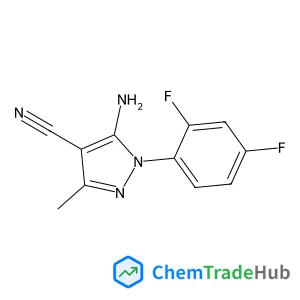
5-Amino-1-(2,4-difluorophenyl)-3-methyl-1H-pyrazole-4-carbonitrile
CAS Number:
1020057-92-4
Molecular Formula:
C11H8F2N4
Recommended Suppliers






Disclaimer
This page provides academic journal information for reference and research purposes only. We are not affiliated with any journal publishers and do not handle publication submissions. For publication-related inquiries, please contact the respective journal publishers directly.
If you notice any inaccuracies in the information displayed, please contact us at support@chemtradehub.com. We will promptly review and address your concerns.