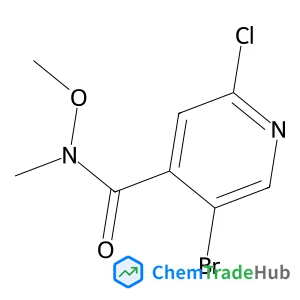
5-Bromo-2-chloro-N-methoxy-N-methylisonicotinamide
CAS Number:
1256790-08-5
Molecular Formula:
C8H8BrClN2O2
The first page of this article is displayed as the abstract.
Shudi Zhang, Zhenda Tan, Biao Xiong, Huan Feng Jiang
DOI: 10.1039/C7OB02919E
Ryo Katoono, Keiichi Kusaka, Yuki Tanaka, Kenshu Fujiwara, Takanori Suzuki
DOI: 10.1039/C7OB03057F
Liang Qi, Huacui Hou, Fei Ling, Weihui Zhong
DOI: 10.1039/C7OB02606D
Lei Wang, Pascale Coric, Kexin Zhu, Wang-Qing Liu, Serge Bouaziz, Sylvain Broussy
DOI: 10.1039/C7OB02852K
Supojjanee Sansook, Cory A. Ocasio, Iain J. Day, Graham J. Tizzard, Simon J. Coles, Oleg Fedorov, James M. Bennett, Jonathan M. Elkins, John Spencer
DOI: 10.1039/C7OB90195J
DOI: 10.1039/C7OB02628E
Fanghui Ma, Jing Qian, Ping Lu, Yanguang Wang
DOI: 10.1039/C7OB02597A
Ben Niu, Yin Wei
DOI: 10.1039/D1QO00273B
Pierrik Lassalas, Christophe Berini, Jean-Baptiste E. Y. Rouchet, Jonathan Hédouin, Francis Marsais, Cédric Schneider, Christine Baudequin, Christophe Hoarau
DOI: 10.1039/C7OB02866K
Zhongxiao Ma, Xiao Hu, Yanni Li, Deqiang Liang, Ying Dong, Baoling Wang, Weili Li
DOI: 10.1039/D1QO00168J
(3.beta.)-3-Hydroxy-N,N-dimethyl-chol-5-en-24-amide (CAS: 79066-03-8) is primari...
5-(Aminomethyl)-2-methoxyphenol (CAS: 89702-89-6) is classified under GHS as a s...
Thieno[2,3-c]pyridin-7(6H)-one (CAS: 28981-13-7) is a heterocyclic organic compo...
1-[(6-Methoxy-3-pyridinyl)methyl]-4-piperidinamine dihydrochloride is generally ...
[(2E)-3-Phenyl-2-propen-1-yl]phosphonic acid (CAS: 146404-58-2) is regulated und...
6-Bromo-7-methoxyquinoline (CAS: 1620515-86-7) falls under the scope of the Glob...
This compound is primarily used in the pharmaceutical industry for the developme...
1-Ethyl-7-[2-methyl-6-(4H-1,2,4-triazol-3-yl)-3-pyridinyl]-3,5-dihydropyrazino[2...
Alternative reagents such as 2-[(dimethylamino)methyl]phenylboronic acid or rela...
3-(Piperidin-4-yloxy)pyridine (CAS: 310881-48-2) is an organic compound with the...

Chem Soc Rev publishes review articles covering important topics at the forefront of the chemical sciences. Reviews should be of the very highest quality and international impact. We particularly encourage international and multidisciplinary collaborations among our authors. Our scope covers the breadth of the chemical sciences, including interdisciplinary topics where the article has a basis in chemistry. Topics include: Analytical chemistry Biomaterials chemistry Bioorganic/medicinal chemistry Catalysis Chemical Biology Coordination Chemistry Crystal Engineering Energy Sustainable chemistry Green chemistry Inorganic chemistry Inorganic materials Main group chemistry Nanoscience Organic chemistry Organic materials Organometallics Physical chemistry Supramolecular chemistry Synthetic methodology Theoretical and computational chemistry