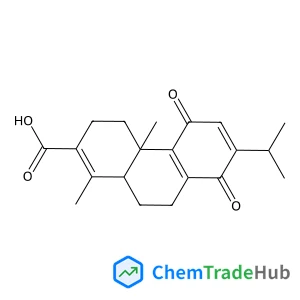
(4aS,10aS)-7-Isopropyl-1,4a-dimethyl-5,8-dioxo-3,4,4a,5,8,9,10,10a-octahydro-2-phenanthrenecarboxylic acid
CAS Number:
142950-86-5
Molecular Formula:
C20H24O4
Lei Wang, Pascale Coric, Kexin Zhu, Wang-Qing Liu, Serge Bouaziz, Sylvain Broussy
Short peptides composed of naturally occurring amino acids are usually unstructured in aqueous media. The installation of covalent constraints within their side chains or backbones, resulting in the formation of macrocyclic peptides, is an appealing approach to stabilize them in defined secondary structures. Therefore, with the objective to stabilize α-turn conformation, we designed, synthesized and characterized constrained 13-membered macrocyclic peptides. Their design was inspired by previous work using the replacement of a hydrogen bond by a covalent bond, for the stabilization of α-helical secondary structures. Their synthesis employed our recently published solid-phase method based on Fukuyama–Mitsunobu alkylation reactions. We report herein an optimized synthesis leading to three water-soluble 13-membered macrocyclic peptides 10a–c, including respectively two, one and zero glycine residues. They were characterized by CD and NMR, which indicated the presence of equilibrating conformers. The detailed conformational analysis was based on extensive NMR and molecular dynamics studies. We found that the peptide without glycine residues 10c was mostly present as slowly interconverting conformers whereas the peptide with two glycine residues 10a was mostly present as rapidly interconverting conformers. We did not find a good match between the conformers of 10a and α-turns occurring in proteins, due to the high flexibility of the glycine backbone. Interestingly, we found that the major conformer of 10c accurately matched the “non-classical” or “tight” α-turn of type II-αLS, with a RMSD value of 0.42 Å for heavy atoms constituting the macrocycle. This is, to the best of our knowledge, the first molecule reported to mimic this type of α-turn found in proteins.
Olivier Balmes, Andrea Resta, Didier Wermeille, Roberto Felici, Maria E. Messing, Knut Deppert, Zhi Liu, Michael E. Grass, Hendrik Bluhm, Richard van Rijn, Joost W. M. Frenken, Rasmus Westerström, Sara Blomberg, Johan Gustafson, Jesper N. Andersen, Edvin Lundgren
DOI: 10.1039/C2CP22873D
Julien Scalbert, Frederic C. Meunier, Cecile Daniel, Yves Schuurman
DOI: 10.1039/C1CP22620G
Sebastian Weibels, Adrian Syguda, Christian Herrmann, Hermann Weingärtner
DOI: 10.1039/C2CP24041F
Simon Petrie, Phillip Gatt, Robert Stranger, Ron J. Pace
DOI: 10.1039/C2CP23935C
Oleg Opanasyuk, Lennart B.-Å. Johansson
DOI: 10.1039/C1CP22483B
Eugenii Ya. Misochko, Alexander V. Akimov, Denis V. Korchagin, Artem A. Masitov, Konstantin N. Shavrin
DOI: 10.1039/C2CP22853J
Song-Ho Chong, Sihyun Ham
DOI: 10.1039/C2CP23326F
Geoffrey Rojas, Scott Simpson, Xumin Chen, Donna A. Kunkel, Justin Nitz, Jie Xiao, Peter A. Dowben, Eva Zurek, Axel Enders
DOI: 10.1039/C2CP40254H
Katsuya Shimura, Hisao Yoshida
DOI: 10.1039/C2CP23220K
(3.beta.)-3-Hydroxy-N,N-dimethyl-chol-5-en-24-amide (CAS: 79066-03-8) is primari...
5-(Aminomethyl)-2-methoxyphenol (CAS: 89702-89-6) is classified under GHS as a s...
Thieno[2,3-c]pyridin-7(6H)-one (CAS: 28981-13-7) is a heterocyclic organic compo...
1-[(6-Methoxy-3-pyridinyl)methyl]-4-piperidinamine dihydrochloride is generally ...
[(2E)-3-Phenyl-2-propen-1-yl]phosphonic acid (CAS: 146404-58-2) is regulated und...
6-Bromo-7-methoxyquinoline (CAS: 1620515-86-7) falls under the scope of the Glob...
This compound is primarily used in the pharmaceutical industry for the developme...
1-Ethyl-7-[2-methyl-6-(4H-1,2,4-triazol-3-yl)-3-pyridinyl]-3,5-dihydropyrazino[2...
Alternative reagents such as 2-[(dimethylamino)methyl]phenylboronic acid or rela...
3-(Piperidin-4-yloxy)pyridine (CAS: 310881-48-2) is an organic compound with the...

Organic & Biomolecular Chemistry (OBC) publishes original and high impact research and reviews in organic chemistry. We welcome research that shows new or significantly improved protocols or methodologies in total synthesis, synthetic methodology or physical and theoretical organic chemistry as well as research that shows a significant advance in the organic chemistry or molecular design aspects of chemical biology, catalysis, supramolecular and macromolecular chemistry, theoretical chemistry, mechanism-oriented physical organic chemistry, medicinal chemistry or natural products. Articles published in the journal should report new work which makes a highly-significant impact in the field. Routine and incremental work is generally not suitable for publication in the journal. More details about key areas of our scope are below. In all cases authors should include in their article clear rationale for why their research has been carried out.
![7-Bromo-5-chloro-1H-pyrazolo[4,3-b]pyridine structure](https://static.chemtradehub.com/structs/135/1351813-70-1-a716.webp "7-Bromo-5-chloro-1H-pyrazolo[4,3-b]pyridine structure")