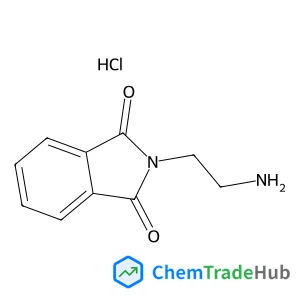
2-(2-Aminoethyl)-1H-isoindole-1,3(2H)-dione hydrochloride (1:1)
CAS Number:
30250-67-0
Molecular Formula:
C10H11ClN2O2
The first page of this article is displayed as the abstract.

Science Progress

Proceedings of the National Academy of Sciences of the United States of America

Kinetics and Catalysis

Journal of Heterocyclic Chemistry

Journal of Catalysis

Molecular Pharmacology

Israel Journal of Chemistry

Pure and Applied Chemistry

European Journal of Wood and Wood Products

Journal of Medicinal Chemistry
Kuiwen Zhao, Huiying Wu
DOI: 10.1039/C7CP04693F
Jianzhong Fan, Lili Lin, Chuan-Kui Wang
DOI: 10.1039/C7CP05451C
Marcos Juanes, Jean Demaison, Iker León, Alberto Lesarri, Heinz Dieter Rudolph
DOI: 10.1039/C7CP06135H
Ling Zhang, Wenzhong Wang
DOI: 10.1039/C7CP06067J
J. Axel Zeitler, Timothy M. Korter
DOI: 10.1039/C7CP04666A
Yu-Te Chan, Ming-Kang Tsai
DOI: 10.1039/C7CP06024F
S. Benedetti, A. di Bona, G. Vinai, C. Castan-Guerrero, A. Catellani, P. Torelli, A. Calzolari
DOI: 10.1039/C7CP05864K
Yong Zheng Luo, Ming Gang Zeng, Lei Shen, Yun Hao Lu, Jun Zhou, Shi Jie Wang, Iam Keong Sou
DOI: 10.1039/C7CP04583B
Aleksandra Kurowska, Pawel Zassowski, Tatyana Yu. Zheleznova, Kseniya V. Andryukhova, Adam Pron, Wojciech Domagala
DOI: 10.1039/C7CP05155G
(1R,3S)-1,3-Cyclopentanediol finds applications in various industries. In the ph...
When handling N'-[4-(Dimethylamino)phenyl]-N,N-dimethyl-1,4-benzenediamine, it i...
There are several alternatives to 5-(2,4-Difluorophenyl)-2-methoxypyrimidine in ...
1-(3-Methoxyphenoxy)propan-2-ol (CAS: 382141-68-6) must comply with the Globally...
Tetrodotoxin Citrate is extremely dangerous and should be handled with extreme c...
2-Methyl-2-propanyl [(1R,3S)-3-hydroxycyclopentyl]carbamate (CAS: 225641-84-9) i...
Waste containing 4-(2-Hydroxyhexafluoroisopropyl)Benzoic Acid (CAS: 16261-80-6) ...
2-Methyl-2-proanyl {(2S)-1-[(benzyloxy)amino]-3-hydroxy-3-methyl-1-oxo-2-butanyl...
Benzeneethanamine, α-ethyl-, hydrochloride (1:1) is an organic compound with the...
In the synthesis of compounds similar to 3-{(E)-[4-(Dimethylamino)phenyl]diazeny...

ChemComm publishes urgent research which is of outstanding significance and interest to experts in the field, while also appealing to the journal’s broad chemistry readership. Our communication format is ideally suited to short, urgent studies that are of such importance that they require accelerated publication. Our scope covers all topics in chemistry, and research at the interface of chemistry and other disciplines (such as materials science, nanoscience, physics, engineering and biology) where there is a significant novelty in the chemistry aspects. Major topic areas covered include: Analytical Chemistry Catalysis Chemical Biology and medicinal chemistry Computational Chemistry and Machine Learning Energy and sustainable chemistry Environmental Chemistry Green Chemistry Inorganic Chemistry Materials Chemistry Nanoscience Organic Chemistry Physical Chemistry Polymer Chemistry Supramolecular Chemistry