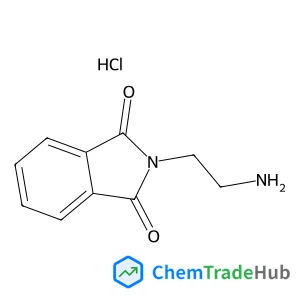
2-(2-Aminoethyl)-1H-isoindole-1,3(2H)-dione hydrochloride (1:1)
CAS Number:
30250-67-0
Molecular Formula:
C10H11ClN2O2
Marcos Juanes, Jean Demaison, Iker León, Alberto Lesarri, Heinz Dieter Rudolph
An experimental-computational methodology combining rotational data, high-level ab initio calculations and predicate least-squares fitting is applied to the axial–equatorial isomerism and semiexperimental equilibrium structure determination of fluorocyclohexane. New supersonic-jet microwave measurements of the rotational spectra of the two molecular conformations, together with all 13C isotopologues of both isomeric forms are reported. Equilibrium rotational constants are obtained from the ground-state rotational constants corrected for vibration–rotation interactions and electronic contributions. Equilibrium structures were determined by the mixed estimation (ME) method. Different computational methods were tested for the evaluation of predicate values of the structural parameters, and a computationally effective procedure for estimating reliable dihedral angles is proposed. Structural parameters were fitted concurrently to predicate parameters and moments of inertia, affected with appropriate uncertainties. The new structures of the title compound are regarded as accurate to 0.001 Å and 0.2°, illustrating the advantages of this methodology. Structural comparisons are offered with the cyclohexane prototype, revealing subtle substituent effects. For comparison purposes the equilibrium structures for the two fluorocyclohexane isomers and cyclohexanone are computed from high-level ab initio theory with inclusion of adjustments for basis set dependence and correlation of the core electrons.
Ashu Choudhary
DOI: 10.1039/C7CP08109J
Elton Oyarzua, Harvey A. Zambrano
DOI: 10.1039/C7CP05749K
Alexandra Baumann, Hammad Cheema, Md Abdus Sabuj, Louis E. McNamara, Yanbing Zhang, Adithya Peddapuram, Suong T. Nguyen, Davita L. Watkins, Nathan I. Hammer, Neeraj Rai, Jared H. Delcamp
DOI: 10.1039/C8CP03065K
Joani Mato, Mark S. Gordon
DOI: 10.1039/C7CP06837A
A. Ramírez-Solís, J. I. Amaro-Estrada, C. I. León-Pimentel, J. Hernández-Cobos, S. E. Garrido-Hoyos, H. Saint-Martin
DOI: 10.1039/C8CP01673A
Götz Bucher, Mukul Lal, Anup Rana, Michael Schmittel
DOI: 10.1039/C8CP03311K
E. Barrez, G. Laurent, C. Pavageau, M. Sliwa, R. Métivier
DOI: 10.1039/C7CP06541H
Goran Dražić
DOI: 10.1039/C7CP07693B
Pei Zhao, Hao Jin, Xingshuai Lv, Baibiao Huang, Yandong Ma, Ying Dai
DOI: 10.1039/C8CP02300J
Elisa I. Martín, Antonio Sánchez-Coronilla, Javier Navas, Roberto Gómez-Villarejo, Paloma Martínez-Merino, Rodrigo Alcántara, Concha Fernández-Lorenzo
DOI: 10.1039/C7CP05384C
(1R,3S)-1,3-Cyclopentanediol finds applications in various industries. In the ph...
When handling N'-[4-(Dimethylamino)phenyl]-N,N-dimethyl-1,4-benzenediamine, it i...
There are several alternatives to 5-(2,4-Difluorophenyl)-2-methoxypyrimidine in ...
1-(3-Methoxyphenoxy)propan-2-ol (CAS: 382141-68-6) must comply with the Globally...
Tetrodotoxin Citrate is extremely dangerous and should be handled with extreme c...
2-Methyl-2-propanyl [(1R,3S)-3-hydroxycyclopentyl]carbamate (CAS: 225641-84-9) i...
Waste containing 4-(2-Hydroxyhexafluoroisopropyl)Benzoic Acid (CAS: 16261-80-6) ...
2-Methyl-2-proanyl {(2S)-1-[(benzyloxy)amino]-3-hydroxy-3-methyl-1-oxo-2-butanyl...
Benzeneethanamine, α-ethyl-, hydrochloride (1:1) is an organic compound with the...
In the synthesis of compounds similar to 3-{(E)-[4-(Dimethylamino)phenyl]diazeny...

Physical Chemistry Chemical Physics (PCCP) is an international journal co-owned by 19 physical chemistry and physics societies from around the world. This journal publishes original, cutting-edge research in physical chemistry, chemical physics and biophysical chemistry. To be suitable for publication in PCCP, articles must include significant innovation and/or insight into physical chemistry; this is the most important criterion that reviewers and Editors will judge against when evaluating submissions. The journal has a broad scope and welcomes contributions spanning experiment, theory, computation and data science. Topical coverage includes spectroscopy, dynamics, kinetics, statistical mechanics, thermodynamics, electrochemistry, catalysis, surface science, quantum mechanics, quantum computing and machine learning. Interdisciplinary research areas such as polymers and soft matter, materials, nanoscience, energy, surfaces/interfaces, and biophysical chemistry are welcomed if they demonstrate significant innovation and/or insight into physical chemistry. Joined experimental/theoretical studies are particularly appreciated when complementary and based on up-to-date approaches.