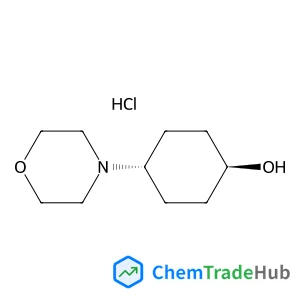
trans-4-(4-Morpholinyl)cyclohexanol hydrochloride (1:1)
CAS Number:
1588441-09-1
Molecular Formula:
C10H20ClNO2
Xiangfei Yuan, Cui Sun, Jia-Ning Duan, Jingmin Fan, Ruming Yuan, Jiajia Chen, Jeng-Kuei Chang, Mingsen Zheng, Quanfeng Dong
Solid electrolytes have been considered as some of the most promising candidates for next generation lithium-based batteries because they eliminate the potential safety hazards of liquid organic electrolytes and further increase the energy density of batteries. However, inherent defects such as low conductivity and poor interface compatibility with electrodes critically hinder their extensive application. Polyoxometalate Li7[V15O36(CO3)] (LVC) can dissociate Li+ in electrolyte and possesses a high diffusion coefficient, which constitute a pathway for Li+ transmission. Herein, a polyoxometalate-based polymer electrolyte (PPE) with an improved electrode interface and ion conductivity for high-safety all-solid-state batteries has been designed and synthesized to further enhance their electrochemistry behaviour. Compared with the routine PEO18LiTFSI electrolyte, the ionic conductivity was enhanced. Meanwhile, LVC can improve the interface compatibility between the electrode and electrolyte significantly, which promotes reaction kinetics and suppresses lithium dendrites against Li metal. When employed in LiFePO4|Li batteries, the specific discharge capacity after 180 cycles reached 148 mA h g−1 with a high coulombic efficiency of around 99.9% at 0.5C. According to the result of ARC, LiFePO4|C batteries with PPEs are endowed with superior safety as the onset temperature of the self-heating process reaches up to 181.4 °C and the thermal runaway process does not occur within the range of 360 °C, indicating the potential of the PPE for high-safety all-solid-state batteries.
Masakazu Nakajima, Yi-Ting Liu, Ching Hua Chang, Kenji Seiki, Yoshihiro Sumiyoshi, Yasuhiro Ohshima, Jian Tang, Yasuki Endo
DOI: 10.1039/D2CP00516F
Tom A. Young, Tristan Johnston-Wood, Hanwen Zhang, Fernanda Duarte
DOI: 10.1039/D2CP02978B
DOI: 10.1039/D2CP00356B
Duomei Xue, Zeren Chen, Jingyao Liu, Di Wu, Zhiru Li, Ying Li
DOI: 10.1039/D2CP00967F
Markus Joos, Ashkan Rad, Payam Kaghazchi, Rotraut Merkle, Robert E. Dinnebier, Thomas Schleid, Joachim Maier
DOI: 10.1039/D2CP01836E
Dominique R. T. Appadoo, Stephanie A. Boer, Nicholas G. White
DOI: 10.1039/D2CP00796G
Junjie Jiang, Bifeng Zhu, Xin Jiang, Bo Lu, Xiaoqing Zeng
DOI: 10.1039/D2CP02986C
Yu Zou, Bote Qi, Jingwang Tan, Yehong Gong, Qingwen Zhang
DOI: 10.1039/D2CP02353A
Huijuan Yang, Jinfei Mei, Wen Xu, Xiaohong Ma, Bo Sun, Hongqi Ai
DOI: 10.1039/D2CP00569G
Xing Zou, Li-Li Liu, Anrong Wang, Shi-Fa Wang, Yong Wei, Chun-Ming Yang, Lei Hu
DOI: 10.1039/D2CP03069A
Ethyl 4-chlorothieno[2,3-b]pyridine-5-carboxylate (CAS: 59713-58-5) can be synth...
5-Methyl-1H-indole-3-carbaldehyde (CAS: 52562-50-2) is subject to various regula...
(1,3-Dimethyl-2,4-dioxo-1,2,3,4-tetrahydro-5-pyrimidinyl)boronic acid is a white...
Waste containing Sulfocostunolide A (CAS: 1016983-51-9) should be handled with c...
When handling Murraxocin (CAS: 88478-44-8), ensure proper personal protective eq...
Formvar (CAS: 63148-64-1) is an alkyd resin characterized by a high molecular we...
(S)-4-benzyl-2-((benzyloxy)methyl)morpholine is generally safe when handled with...
Methyl 1-(5-bromo-2-pyrimidinyl)cyclopropanecarboxylate (CAS: 1447607-69-3) is p...
2-Methyl-1-phenyl-1-propanamine hydrochloride (CAS: 24290-47-9) is generally con...
3-(4-Bromophenyl)-2-methylpropanoic acid is synthesized through a multi-step pro...

Journal of Materials Chemistry A, B & C cover high quality studies across all fields of materials chemistry. The journals focus on those theoretical or experimental studies that report new understanding, applications, properties and synthesis of materials. The journals have a strong history of publishing quality reports of interest to interdisciplinary communities and providing an efficient and rigorous service through peer review and publication. The journals are led by an international team of Editors-in-Chief and Associate Editors who are all active researchers in their fields. Journal of Materials Chemistry A, B & C are separated by the intended application of the material studied. Broadly, applications in energy and sustainability are of interest to Journal of Materials Chemistry A, applications in biology and medicine are of interest to Journal of Materials Chemistry B, and applications in optical, magnetic and electronic devices are of interest to Journal of Materials Chemistry C. More than one Journal of Materials Chemistry journal may be suitable for certain fields and researchers are encouraged to submit their paper to the journal that they feel best fits for their particular article. Example topic areas within the scope of Journal of Materials Chemistry A are listed below. This list is neither exhaustive nor exclusive. Artificial photosynthesis Batteries Carbon dioxide conversion Catalysis Fuel cells Gas capture/separation/storage Green/sustainable materials Hydrogen generation Hydrogen storage Photocatalysis Photovoltaics Self-cleaning materials Self-healing materials Sensors Supercapacitors Thermoelectrics Water splitting Water treatment
![[2-(Benzyloxy)-3-bromo-5-methylphenyl]boronic acid structure](https://static.chemtradehub.com/structs/870/870777-20-1-24ac.webp "[2-(Benzyloxy)-3-bromo-5-methylphenyl]boronic acid structure")