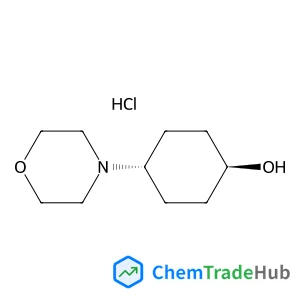
trans-4-(4-Morpholinyl)cyclohexanol hydrochloride (1:1)
CAS Number:
1588441-09-1
Molecular Formula:
C10H20ClNO2
Huijuan Yang, Jinfei Mei, Wen Xu, Xiaohong Ma, Bo Sun, Hongqi Ai
Amyloid precursor protein (APP) is the core of the pathogenesis of Alzheimer's disease (AD). Existing studies have shown that the soluble secreted APP (sAPPα) fragment obtained from the hydrolysis of APP by α-secretase has a synaptic function. Thereinto, a nine-residue fragment (APP9mer) of the extension domain region of sAPPα can bind directly and selectively to the N-terminal sushi1 domain (SD1) of the γ-aminobutyric acid type B receptor subunit 1a (GABABR1a) protein, which can influence synaptic transmission and plasticity by changing the GABABR1a conformation. APP9mer is a highly flexible, disordered region, and as such it is difficult to experimentally determine the optimal APPmer-SD1 binding complex. In this study we constructed two types of APP9mer-SD1 complexes through molecular docking and molecular dynamics simulation, aiming to explore the recognition function and mechanism of the specific binding of APP9mer with SD1, from which the most probable APPmer-SD1 model conformation is predicted. All the data from the analyses of RMSD, RMSF, PCA, DCCM and MM/PBSA binding energy as well as comparison with the experimental dissociation constant Kd suggest that 2NC is the most likely conformation to restore the crystal structure of the experimental APP9mer-SD1 complex. Of note, the key recognition residues of APP9mer are D24, D25, D27, W29 and W30, which mainly act on the 9–45 residue domain of SD1 (consisting of two loops and three short β-chains at the N-terminus of SD1). The mini-model with key residues identified establishes the molecular basis with deep insight into the interaction between APP and GABABR1a and provides a target for the development of therapeutic strategies for modulating GABABR1a-specific signaling in neurological and psychiatric disorders. More importantly, the study offers a theoretical solution for how to determine a biomolecular structure with a highly flexible, disordered fragment embedded within. The flexible fragment involved in a protein structure has to be deserted usually during the structural determination with experimental methods (e.g. X-ray crystallography, etc.).
Wei Liu, Maxime Pouvreau, Andrew G. Stack, Xiaoning Yang, Aurora E. Clark
DOI: 10.1039/D2CP01997C
Weiqiao Huang, Changgeng Wei
DOI: 10.1039/D2CP02120J
Toshiko Mizokuro, Kenji Kamada, Yoriko Sonoda
DOI: 10.1039/D1CP04784A
Carolyn J. Moll, Alexander A. Korotkevich, Jan Versluis, Huib J. Bakker
DOI: 10.1039/D1CP05471F
Jing Xu, Shijun Luo, Bin Xu, Jing Zhang, Fei Wang
DOI: 10.1039/D2CP02209E
Deniz Akgül, Viktorya Aviyente
DOI: 10.1039/D2CP00043A
DOI: 10.1039/D2CP00829G
DOI: 10.1039/D2CP02624D
R. Heid
DOI: 10.1039/D2CP00522K
Ritam Mansour, Saikat Mukherjee, Max Pinheiro, Jr., Jennifer A. Noble, Christophe Jouvet
DOI: 10.1039/D2CP01056A
Ethyl 4-chlorothieno[2,3-b]pyridine-5-carboxylate (CAS: 59713-58-5) can be synth...
5-Methyl-1H-indole-3-carbaldehyde (CAS: 52562-50-2) is subject to various regula...
(1,3-Dimethyl-2,4-dioxo-1,2,3,4-tetrahydro-5-pyrimidinyl)boronic acid is a white...
Waste containing Sulfocostunolide A (CAS: 1016983-51-9) should be handled with c...
When handling Murraxocin (CAS: 88478-44-8), ensure proper personal protective eq...
Formvar (CAS: 63148-64-1) is an alkyd resin characterized by a high molecular we...
(S)-4-benzyl-2-((benzyloxy)methyl)morpholine is generally safe when handled with...
Methyl 1-(5-bromo-2-pyrimidinyl)cyclopropanecarboxylate (CAS: 1447607-69-3) is p...
2-Methyl-1-phenyl-1-propanamine hydrochloride (CAS: 24290-47-9) is generally con...
3-(4-Bromophenyl)-2-methylpropanoic acid is synthesized through a multi-step pro...

Physical Chemistry Chemical Physics (PCCP) is an international journal co-owned by 19 physical chemistry and physics societies from around the world. This journal publishes original, cutting-edge research in physical chemistry, chemical physics and biophysical chemistry. To be suitable for publication in PCCP, articles must include significant innovation and/or insight into physical chemistry; this is the most important criterion that reviewers and Editors will judge against when evaluating submissions. The journal has a broad scope and welcomes contributions spanning experiment, theory, computation and data science. Topical coverage includes spectroscopy, dynamics, kinetics, statistical mechanics, thermodynamics, electrochemistry, catalysis, surface science, quantum mechanics, quantum computing and machine learning. Interdisciplinary research areas such as polymers and soft matter, materials, nanoscience, energy, surfaces/interfaces, and biophysical chemistry are welcomed if they demonstrate significant innovation and/or insight into physical chemistry. Joined experimental/theoretical studies are particularly appreciated when complementary and based on up-to-date approaches.
![4-[(1-Methyl-1H-pyrrol-2-yl)methylene]-1,3(2H,4H)-isoquinolinedione structure](https://static.chemtradehub.com/structs/110/1104546-89-5-a600.webp "4-[(1-Methyl-1H-pyrrol-2-yl)methylene]-1,3(2H,4H)-isoquinolinedione structure")