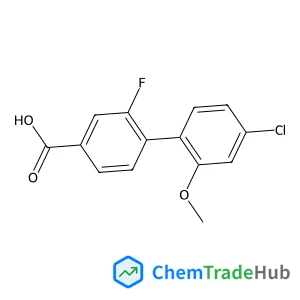
4-(4-Chloro-2-methoxyphenyl)-3-fluorobenzoic acid
CAS Number:
1261970-23-3
Molecular Formula:
C14H10ClFO3
Marie-Hélène Tremblay, Kelly Schutt, Yadong Zhang, Jongchul Lim, Yen-Hung Lin, Jonathan H. Warby, Stephen Barlow, Henry J. Snaith, Seth R. Marder
A crosslinkable acrylate random copolymer with both hole-transporting bis(triarylamine) and photocrosslinkable cinnamate side chains is compared to the widely used poly(4-butyl-triphenylamine-4′,4′′-diyl) (PolyTPD) as a hole-transport material (HTM) in positive–intrinsic–negative (p–i–n) perovskite solar cells (PSCs). The crosslinked films of this HTM exhibit improved wettability by precursor solutions of the perovskite relative to PolyTPD; this facilitates high-quality full film coverage by the subsequently deposited perovskite layer on smooth substrates, which is difficult to achieve with PolyTPD without the use of additional interlayers. PSCs fabricated using undoped and crosslinked copolymer achieve steady-state power outputs that are comparable to those of cells incorporating p-doped PolyTPD (with interlayers) as the HTM. The devices made with this material also exhibited improved initial stability under high-intensity ultraviolet LED irradiation, in comparison to those with the PolyTPD analogue. Remarkably, after 3000 h of aging in an oven at 85 °C in a nitrogen-filled glovebox, device efficiency showed no degradation; the SPO was comparable to the initial performance.
Tianyue Li, Yue Hu, Carole A. Morrison, Wenjun Wu, Hongwei Han, Neil Robertson
DOI: 10.1039/C6SE00061D
Cheng Liu, Yi Yang, Jiahong Pan, Jianxi Yao, Linhua Hu
DOI: 10.1039/C6SE00041J
Wen-Hsin Wang, Li-Yu Ting, Jayachandran Jayakumar, Chih-Li Chang, Wei-Cheng Lin, Chih-Chia Chung, Mohamed Hammad Elsayed, Chia-Yeh Lu, Ahmed M. Elewa, Ho-Hsiu Chou
DOI: 10.1039/D0SE00928H
Sanjeewa R. Karunathilaka, Gary W. Small
DOI: 10.1039/C5AN00258C
James Murowchick, Xiaobo Chen
DOI: 10.1039/C6SE00058D
S. Rajkumar, E. Elanthamilan, J. Princy Merlin, I. Jenisha Daisy Priscillal, I. Sharmila Lydia
DOI: 10.1039/D0SE00913J
Younes Benhouria, Syeda R. Naqvi, Pritam K. Panda
DOI: 10.1039/D0SE00709A
Kerstin Strupat, Dijana Šagi, Heiko Bönisch, Günter Schäfer, Jasna Peter-Katalinic
DOI: 10.1039/A908977B
Suzanne Z. Ackloo, Richard W. Smith, Johan K. Terlouw, Brian E. McCarry
DOI: 10.1039/A908419C
2-(2-Chloroacetamido)-3-phenylpropanoic acid (CAS: 7765-11-9) is generally consi...
2-(Benzyloxy)-5-bromobenzoic acid can be handled safely if appropriate precautio...
(4-Methyl-1,2,5-oxadiazol-3-yl)methanamine hydrochloride is a chemical compound ...
2-(5-Hexylthiophen-2-yl)-4,4,5,5-tetramethyl-1,3,2-dioxaborolane (CAS: 917985-54...
While 4-(8-Methyl-9H-1,3-dioxolo[4,5-h][2,3]benzodiazepin-5-yl)benzenamine (CAS:...
The market for tert-butyl 3-hydroxy-4,5,7,8-tetrahydro-2H-pyrazolo[3,4-d]azepine...
Waste containing 3,5-Diamino-1H-pyrazole-4-carbonitrile (CAS: 6844-58-2) should ...
(6-Fluoro-3-pyridinyl)boronic acid can be synthesized through the reaction of 6-...
Dibenzyl carbonimidoylbiscarbamate (CAS: 10065-79-9) finds applications in vario...
The market for (beta,beta,2,3,4,5,6-~2~H_7_)Phenylalanine (CAS: 74228-83-4) is g...
![4,10-Dihydroxy-3H-pyrano[3,4,5-kl]xanthen-3-one structure](https://static.chemtradehub.com/structs/125/1259330-61-4-de48.webp "4,10-Dihydroxy-3H-pyrano[3,4,5-kl]xanthen-3-one structure")
![[3-Fluoro-4-(1-pyrrolidinylcarbonyl)phenyl]boronic acid structure](https://static.chemtradehub.com/structs/874/874289-09-5-e3d4.webp "[3-Fluoro-4-(1-pyrrolidinylcarbonyl)phenyl]boronic acid structure")