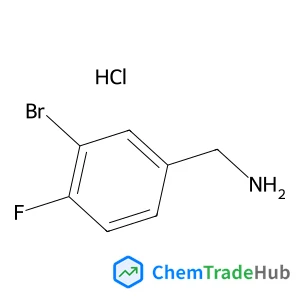
1-(3-Bromo-4-fluorophenyl)methanamine hydrochloride (1:1)
CAS Number:
202865-68-7
Molecular Formula:
C7H8BrClFN
Tsuyoshi Ohtani, Yuto Tsuchiya, Daisuke Uraguchi
A diastereoselective borylcyclopropanation of α-MIDA-boryl styrenes with 1,1-diiodoborylmethane is developed using 1,2,3,5-tetrakis(carbazol-9-yl)-4,6-dicyanobenzene (4CzIPN) as a catalyst under visible-light irradiation. The scope of this photocatalytic method is explored, and the utility of the resulting doubly borylated cyclopropanes is demonstrated by the selective transformation of one of the two boryl groups.
Wei-Hsun Hu, Kai-Wei Huang, Shiao-Wei Kuo
DOI: 10.1039/C2PY20090B
Yan Guo, Ying Jin, Zhaohui Su
DOI: 10.1039/C2PY00582D
Hang Lu, Lang Fan, Qiuming Liu, Jingren Wei, Tianbin Ren
DOI: 10.1039/C2PY20181J
Fei Cheng, Edward M. Bonder, Ami Doshi, Frieder Jäkle
DOI: 10.1039/C2PY00556E
Daisuke Abe, Yuji Sasanuma
DOI: 10.1039/C2PY20118F
Hongzhang Han, Nicolay V. Tsarevsky
DOI: 10.1039/C1PY00495F
Arulraj Arulkashmir, Rajashree Y. Mahale, Satej S. Dharmapurikar, Manoj K. Jangid, Kothandam Krishnamoorthy
DOI: 10.1039/C2PY20146A
Radovan Vukićević, Ivana Vukovic, Hristiyan Stoyanov, Andreas Korwitz, Doris Pospiech, Guggi Kofod, Katja Loos, Gerrit ten Brinke, Sabine Beuermann
DOI: 10.1039/C2PY20166F
When considering alternatives to 1-(4-Chlorophenyl)-N-hydroxymethanimine (CAS: 3...
This compound should be stored in a cool, dry place away from direct sunlight. I...
3-(4-Bromophenyl)-5-(2-fluorophenyl)-1,2,4-oxadiazole is synthesized through a m...
5-Chloro-2-(4-chlorophenyl)-4-methyl-6-[3-(1-piperidinyl)propoxy]pyrimidine (CAS...
2-Chloro-4-(difluoromethoxy)pyridine is used in the pharmaceutical industry for ...
3-Chloro-6-methylpyridazine (CAS: 1121-79-5) is classified under the Globally Ha...
Several alternatives can be used in the synthesis of Methyl 4,5-dimethyl-2-nitro...
Alternatives to (2E,2'E)-3,3'-(1,4-Phenylene)bisacrylaldehyde include other acry...
3-Amino-5-chloropyridin-2-ol hydrochloride is an organic compound with the CAS n...
When handling 6,7-Difluoro-2,3-dihydro-4H-chromen-4-one, it is essential to wear...

Organic Chemistry Frontiers publishes high-quality research from across organic chemistry. Emphases are placed on studies that make significant contributions to the field of organic chemistry by reporting either new or significantly improved protocols or methodologies. Topics include, but are not limited to the following: Organic synthesis Development of synthetic methodologies Catalysis Natural products Functional organic materials Supramolecular and macromolecular chemistry Physical and computational organic chemistry