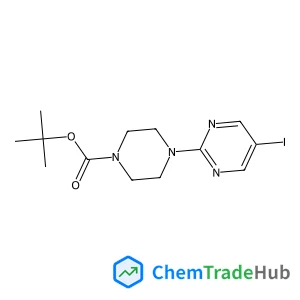
2-Methyl-2-propanyl 4-(5-iodo-2-pyrimidinyl)-1-piperazinecarboxylate
CAS Number:
1027616-32-5
Molecular Formula:
C13H19IN4O2
Shang-Pin Wen, Jack G. Saunders, Lee A. Fielding
Polymerisation-induced self-assembly (PISA) has become widely recognised as a versatile and efficient strategy to prepare well-defined diblock copolymer nanoparticles in a range of solvents. In this article, we report the synthesis of anionic, sterically-stabilised, sulfonate-functional diblock copolymer nanoparticles via PISA using a reversible addition–fragmentation chain-transfer (RAFT) polymerisation formulation. Anionic poly(potassium 3-sulfopropyl methacrylate) (PKSPMA) macromolecular chain-transfer agents (macro-CTAs) were synthesised via RAFT solution polymerisation followed by chain-extension with benzyl methacrylate (BzMA) in alcohol/water mixtures to form PKSPMA–PBzMA nanoparticles. The influence of solvent quality on the formation of these nanoparticles was investigated by judiciously changing the alcohol/water ratio, the alcohol co-solvent (ethanol or methanol) and relative copolymer composition. The resulting diblock copolymer nanoparticles were analysed by dynamic light scattering (DLS), transmission electron microscopy (TEM), small-angle X-ray scattering (SAXS), and aqueous electrophoresis. The results demonstrated that nanoparticles with controllable diameters for a fixed copolymer composition can be prepared by altering the co-solvent composition. More specifically, when using different ratios of ethanol/water or methanol/water, the nanoparticle diameter can be tuned from approximately 20 to 200 nm with fixed copolymer composition. This indicates that the solvency of both the stabiliser and core-forming block has a marked impact on both the aggregation of polymer chains during self-assembly and the resulting nanoparticles. Additionally, these nanoparticles remain colloidally stable and highly anionic over a wide pH range from 4 to 10, as judged by aqueous electrophoresis.
Daniel P. Brooke, Leah M. C. McGee, Federica Giordani, Jasmine M. Cross, Abedawn I. Khalaf, Craig Irving, Craig D. Shaw, Katharine C. Carter, Michael P. Barrett, Colin J. Suckling, Fraser J. Scott
DOI: 10.1039/D1MD00110H
Maximillian Taro William Lee, William Mahy, Mark David Rackham
DOI: 10.1039/D1MD00113B
Winnie Deuther-Conrad, Daniel Diez-Iriepa, Isabel Iriepa, Francisco López-Muñoz, María Angeles Martínez-Grau, Michael Gütschow, José Marco-Contelles
DOI: 10.1039/D1MD00105A
Ronel Müller, Tiaan M. Gerwel, Magambo Phillip Kimuda, Özlem Tastan Bishop, Clinton G. L. Veale, Heinrich C. Hoppe
DOI: 10.1039/D1MD00237F
Atukuri Dorababu
DOI: 10.1039/D0MD00288G
Anmol Gulati, Charles S. Yeung, Blair Lapointe, Solomon D. Kattar, Hakan Gunaydin, Jack D. Scott, Kaleen K. Childers, Joey L. Methot, Vladimir Simov, Ravi Kurukulasuriya, Barbara Pio, Greg J. Morriello, Ping Liu, Haiqun Tang, Santhosh Neelamkavil, Harold B. Wood, Vanessa L. Rada, Michael J. Ardolino, Xin Cindy Yan, Rachel Palte, Karin Otte, Robert Faltus, Janice Woodhouse, Laxminarayan G. Hegde, Paul Ciaccio, Ellen C. Minnihan, Erin F. DiMauro, Matthew J. Fell, Peter H. Fuller, J. Michael Ellis
DOI: 10.1039/D1MD00097G
Ruibin Liu, Neha Verma, Jack A. Henderson, Shaoqi Zhan, Jana Shen
DOI: 10.1039/D1MD00277E
Waste containing 6-Chloro-5-(2'-hydroxy-3'-methoxy-4-biphenylyl)-3-(3-methoxyphe...
(3alpha,5alpha)-3-Hydroxypregnane-11,20-dione is primarily used in the pharmaceu...
The market for 4-Amino-6-chloro-2-pyridinecarboxylic acid (CAS: 546141-56-4) is ...
Alternatives to (2-Benzoylethyl)trimethylammonium chloride (CAS: 24472-88-6) in ...
N-[4-Nitro-3-(trifluoromethyl)phenyl]acetamide (CAS: 393-12-4) is generally safe...
Alternative reagents such as other phosphates or similar functional groups can b...
There are alternatives to N,N'-Bis(3-aminopropyl)-1,3-propanediamine (CAS: 4605-...
When handling Aluminium trihexadecanoate, it is important to use appropriate per...
(1,1-Dioxido-3-oxo-1,2-benzothiazol-2(3H)-yl)acetic acid is a chemical compound ...
Several alternatives to 5,5-dimethyloxolan-2-one (CAS: 3123-97-5) can be used in...

Polymer Chemistry welcomes submissions in all areas of polymer science that have a strong focus on macromolecular chemistry. Manuscripts may cover a broad range of fields, yet no direct application focus is required.
![Benzo[b]naphtho[2,1-d]thiophene structure](https://static.chemtradehub.com/structs/239/239-35-0-ff90.webp "Benzo[b]naphtho[2,1-d]thiophene structure")
![2-Methyl-2-propanyl [2-(2-oxa-6-azaspiro[3.3]hept-6-yl)ethyl]carbamate structure](https://static.chemtradehub.com/structs/141/1415562-38-7-c0a4.webp "2-Methyl-2-propanyl [2-(2-oxa-6-azaspiro[3.3]hept-6-yl)ethyl]carbamate structure")