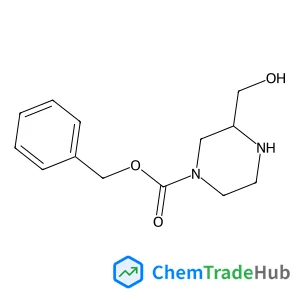
Benzyl 3-(hydroxymethyl)-1-piperazinecarboxylate
CAS Number:
191739-40-9
Molecular Formula:
C13H18N2O3
Chien-Ho Huang, Ying-Ling Liu
Furan-functionalized Meldrum's acid (MAF) has been utilized as a monomer for the preparation of self-crosslinkable polymers which possess Meldrum's acid (MA) moieties as the reactive sites. As MAF contains acidic C–H and furan groups, both are reactive toward maleimide groups, and polymerization has been carried out between MAF and multi-functional maleimide compounds. Both linear and hyperbranched MA-containing self-crosslinkable polymers have been prepared. The prepared polymers show good solubility in aprotic high polar solvents and high film formability. Self-standing and highly flexible crosslinked films have been obtained. The polymer film shows high solvent resistance, a high glass transition temperature of 298 °C, a high thermal stability above 340 °C, and attractive mechanical properties with a Young's modulus of 3.58 GPa and a stress at break of 34.4 MPa. Moreover, the crosslinked polymer films have relatively low-dielectric constants of about 2.85–2.78. An effective approach has been demonstrated for the preparation of high molecular weight MA-containing polymers and the corresponding thermosetting resin based self-standing and flexible polymer films.
Min Huang, Gengyu Cao
DOI: 10.1039/C6CP01362G
Geon-Hyoung An, Eun-Hwan Lee
DOI: 10.1039/C6CP01964A
Gildas Goldsztejn, Denis Céolin, Rajesh K. Kushawaha, Ralph Püttner
DOI: 10.1039/C6CP01998F
Thuy-Duong Nguyen-Phan, Jordi Llorca, Shawn Sallis, Shyam Kattel, Wenqian Xu, Louis F. J. Piper, Dmitry E. Polyansky, Sanjaya D. Senanayake, Dario J. Stacchiola
DOI: 10.1039/C6CP00472E
Teresa S. Ripolles, Ajay K. Baranwal, Koji Nishinaka, Yuhei Ogomi, Germà Garcia-Belmonte, Shuzi Hayase
DOI: 10.1039/C6CP01427E
Lixiu Guan, Guifeng Chen, Junguang Tao
DOI: 10.1039/C6CP01803C
A. Stamm, D. Bernhard, M. Gerhards
DOI: 10.1039/C6CP01675H
Grzegorz Gabka, Piotr Bujak, Jan Żukrowski, Damian Zabost, Kamil Kotwica, Karolina Malinowska, Andrzej Ostrowski, Ireneusz Wielgus, Wojciech Lisowski, Janusz W. Sobczak, Adam Pron
DOI: 10.1039/C6CP01887D
E. Mostaani, N. D. Drummond, C. J. Lambert
DOI: 10.1039/C5CP07891A
4-Benzyl-2,2-dimethylmorpholine is generally considered safe when handled under ...
(5,6-Dimethoxy-3-pyridinyl)boronic acid is a chemical compound with the molecula...
1,1,3,3-Tetramethyl-1,3-bis(2-methyl-2-propanyl)disiloxane is synthesized throug...
(2R,4S)-1-Boc-4-methylpyrrolidine-2-carboxylic acid is primarily used as a build...
When handling 2,3-Dichloroacrylonitrile, it is crucial to wear appropriate perso...
(S)-1-(o-Tolyl)ethanamine hydrochloride should be stored in a cool, dry place to...
Benzyl [1-(hydroxyamino)-1-imino-2-methyl-2-propanyl]carbamate (CAS: 518047-98-8...
2-Methyloxazole-5-carbaldehyde is used in the pharmaceutical industry for the sy...
The market for 2-Methyl-2-propanyl 4-[(1S)-1-hydroxyethyl]-1-piperidinecarboxyla...
1-Butyl-3-methylpyridinium bromide is generally considered safe for laboratory u...

Polymer Chemistry welcomes submissions in all areas of polymer science that have a strong focus on macromolecular chemistry. Manuscripts may cover a broad range of fields, yet no direct application focus is required.
![1,4-Piperazinediylbis{[6-(1H-benzimidazol-2-yl)-2-pyridinyl]methanone} structure](https://static.chemtradehub.com/structs/191/1912399-75-7-b9f0.webp "1,4-Piperazinediylbis{[6-(1H-benzimidazol-2-yl)-2-pyridinyl]methanone} structure")