


Quasiparticle and excitonic gaps of one-dimensional carbon chains
Literature Information
Publication Date
2016-04-12
DOI
10.1039/C5CP07891A
Impact Factor
3.676
Authors
E. Mostaani, N. D. Drummond, C. J. Lambert
View Original
Abstract
We report diffusion quantum Monte Carlo (DMC) calculations of the quasiparticle and excitonic gaps of hydrogen-terminated oligoynes and extended polyyne. The electronic gaps are found to be very sensitive to the atomic structure in these systems. We have therefore optimised the geometry of polyyne by directly minimising the DMC energy with respect to the lattice constant and the Peierls-induced carbon–carbon bond-length alternation. We find the bond-length alternation of polyyne to be 0.136(2) Å and the excitonic and quasiparticle gaps to be 3.30(7) and 3.4(1) eV, respectively. The DMC zone-centre longitudinal optical phonon frequency of polyyne is 2084(5) cm−1, which is consistent with Raman spectroscopic measurements for large oligoynes.
Recommended Journals

Biocatalysis and Biotransformation

Journal of Chemical Sciences

Critical Reviews in Solid State and Materials Sciences

Main Group Chemistry

Herald of the Russian Academy of Sciences

Bioorganic & Medicinal Chemistry

Atomization and Sprays

Bioorganic & Medicinal Chemistry Letters

Medicinal Chemistry Research

Electroanalysis
Related Literature
Recent advances in tandem selenocyclization and tellurocyclization with alkenes and alkynes
Xin Wang, Chao Li, He Wang, Lei Li
2020-08-18
Review Article
DOI: 10.1039/D0QO00849D
An improved synthesis of the [5.6.7]-tricyclic core of cyrneine B and glaucopine C
Guo-Jie Wu, Xiu Han
2020-08-25
Research Article
DOI: 10.1039/D0QO00758G
Modular synthesis and immunological evaluation of suspected allergenic galactooligosaccharides
Hidde Elferink, Emiel Rossing, Linqiu Cao, Dianne J. Delsing, Andre Groeneveld, Thomas J. Boltje
2019-02-26
Communication
DOI: 10.1039/C9OB00108E
Rapid synthesis of hexahydropyrrolo[3,4-b]pyrrole-fused quinolines via a consecutive [3 + 2] cycloaddition and reduction/intramolecular lactamization cascade
Yan-Liang Lin, Yun-Ta Lee, Yi-Ting Huang
2020-08-10
Research Article
DOI: 10.1039/D0QO00858C
Direct remote δ-C(sp2)–H olefination of β-aryl-substituted aliphatic aldehydes via palladium/enamine co-catalysis
Rajesh Kumar, Xiaofeng Zhang
2020-08-31
Research Article
DOI: 10.1039/D0QO00911C
Iron catalyzed ketoalkylation and ketoalkylation/etherification of styrenes initiated by selective C–C bond cleavage
Meng-Ting Suo, Shuo Yang, Jun-Cheng Yang, Ze-Yu Liu, Jun-Jie Zhang, Li-Na Guo
2020-07-15
Research Article
DOI: 10.1039/D0QO00671H
Remote C(sp3)–H vinylation via radical-mediated consecutive fission of C–H and C–C bonds
Tao Niu, Shan Yang, Xinxin Wu
2020-09-02
Research Article
DOI: 10.1039/D0QO00952K
Rhodium(iii)-catalyzed carboxylate-directed ortho-selective thiolation of benzoic acids
Dongjie Wang, Kehan Zhou, Jingyu Zhang, Yingsheng Zhao
2020-09-18
Research Article
DOI: 10.1039/D0QO00940G
Nucleophile-assisted cyclization of β-propargylamino acrylic compounds catalyzed by gold(i): a rapid construction of multisubstituted tetrahydropyridines and their fused derivatives
Petr Matouš, Michal Kadaník, Marek Timoracký, Jiří Kuneš, Jana Maříková, Aleš Růžička, Milan Pour
2020-06-30
Research Article
DOI: 10.1039/D0QO00653J
You might also like
Compound Q&A
Is 2-(2-chloroacetamido)-3-phenylpropanoic acid (CAS: 7765-11-9) safe?
2-(2-Chloroacetamido)-3-phenylpropanoic acid (CAS: 7765-11-9) is generally consi...
7765-11-92-(2-chloroacetamido...
Compound Q&A
Is 2-(Benzyloxy)-5-bromobenzoic acid (CAS: 62176-31-2) safe?
2-(Benzyloxy)-5-bromobenzoic acid can be handled safely if appropriate precautio...
62176-31-22-(Benzyloxy)-5-brom...
Compound Q&A
What is (4-Methyl-1,2,5-oxadiazol-3-yl)methanamine hydrochloride (CAS: 1159825-48-5)?
(4-Methyl-1,2,5-oxadiazol-3-yl)methanamine hydrochloride is a chemical compound ...
1159825-48-5(4-Methyl-1,2,5-oxad...
Compound Q&A
What is 2-(5-Hexylthiophen-2-yl)-4,4,5,5-tetramethyl-1,3,2-dioxaborolane (CAS: 917985-54-7)?
2-(5-Hexylthiophen-2-yl)-4,4,5,5-tetramethyl-1,3,2-dioxaborolane (CAS: 917985-54...
917985-54-72-(5-Hexylthiophen-2...
Compound Q&A
Are there alternatives to 4-(8-Methyl-9H-1,3-dioxolo[4,5-h][2,3]benzodiazepin-5-yl)benzenamine (CAS: 102771-26-6) in synthesis?
While 4-(8-Methyl-9H-1,3-dioxolo[4,5-h][2,3]benzodiazepin-5-yl)benzenamine (CAS:...
102771-26-64-(8-Methyl-9H-1,3-d...
Compound Q&A
What is the market or research trend for tert-butyl 3-hydroxy-4,5,7,8-tetrahydro-2H-pyrazolo[3,4-d]azepine-6-carboxylate (CAS: 851376-80-2)?
The market for tert-butyl 3-hydroxy-4,5,7,8-tetrahydro-2H-pyrazolo[3,4-d]azepine...
851376-80-2tert-butyl 3-hydroxy...
Compound Q&A
How should waste containing 3,5-Diamino-1H-pyrazole-4-carbonitrile (CAS: 6844-58-2) be handled?
Waste containing 3,5-Diamino-1H-pyrazole-4-carbonitrile (CAS: 6844-58-2) should ...
6844-58-23,5-Diamino-1H-pyraz...
Compound Q&A
How is (6-Fluoro-3-pyridinyl)boronic acid (CAS: 351019-18-6) typically synthesized?
(6-Fluoro-3-pyridinyl)boronic acid can be synthesized through the reaction of 6-...
351019-18-6(6-Fluoro-3-pyridiny...
Compound Q&A
What industries use Dibenzyl carbonimidoylbiscarbamate (CAS: 10065-79-9)?
Dibenzyl carbonimidoylbiscarbamate (CAS: 10065-79-9) finds applications in vario...
10065-79-9Dibenzyl carbonimido...
Compound Q&A
What is the market or research trend for (beta,beta,2,3,4,5,6-~2~H_7_)Phenylalanine (CAS: 74228-83-4)?
The market for (beta,beta,2,3,4,5,6-~2~H_7_)Phenylalanine (CAS: 74228-83-4) is g...
74228-83-4(beta,beta,2,3,4,5,6...
Source Journal
Physical Chemistry Chemical Physics

CiteScore:
5.5
Self-citation Rate:
10.3%
Articles per Year:
3036
Physical Chemistry Chemical Physics (PCCP) is an international journal co-owned by 19 physical chemistry and physics societies from around the world. This journal publishes original, cutting-edge research in physical chemistry, chemical physics and biophysical chemistry. To be suitable for publication in PCCP, articles must include significant innovation and/or insight into physical chemistry; this is the most important criterion that reviewers and Editors will judge against when evaluating submissions. The journal has a broad scope and welcomes contributions spanning experiment, theory, computation and data science. Topical coverage includes spectroscopy, dynamics, kinetics, statistical mechanics, thermodynamics, electrochemistry, catalysis, surface science, quantum mechanics, quantum computing and machine learning. Interdisciplinary research areas such as polymers and soft matter, materials, nanoscience, energy, surfaces/interfaces, and biophysical chemistry are welcomed if they demonstrate significant innovation and/or insight into physical chemistry. Joined experimental/theoretical studies are particularly appreciated when complementary and based on up-to-date approaches.
Recommended Compounds
![{3-[Bis(4-hydroxyphenyl)methyl]-1-[2-(dimethylamino)ethyl]-1H-indol-2-yl}[4-(2-chlorophenyl)-1-piperazinyl]methanone structure](https://static.chemtradehub.com/structs/170/170365-25-0-e4d7.webp "{3-[Bis(4-hydroxyphenyl)methyl]-1-[2-(dimethylamino)ethyl]-1H-indol-2-yl}[4-(2-chlorophenyl)-1-piperazinyl]methanone structure")
{3-[Bis(4-hydroxyphenyl)methyl]-1-[2-(dimethylamino)ethyl]-1H-indol-2-yl}[4-(2-chlorophenyl)-1-piperazinyl]methanone
CAS Number:
170365-25-0
Molecular Formula:
C36H37ClN4O3
![(3S,4aS,8aS)-2-[(2R,3S)-3-Amino-2-hydroxy-4-phenylbutyl]-N-(2-methyl-2-propanyl)decahydro-3-isoquinolinecarboxamide structure](https://static.chemtradehub.com/structs/136/136522-17-3-4d77.webp "(3S,4aS,8aS)-2-[(2R,3S)-3-Amino-2-hydroxy-4-phenylbutyl]-N-(2-methyl-2-propanyl)decahydro-3-isoquinolinecarboxamide structure")
(3S,4aS,8aS)-2-[(2R,3S)-3-Amino-2-hydroxy-4-phenylbutyl]-N-(2-methyl-2-propanyl)decahydro-3-isoquinolinecarboxamide
CAS Number:
136522-17-3
Molecular Formula:
C24H39N3O2
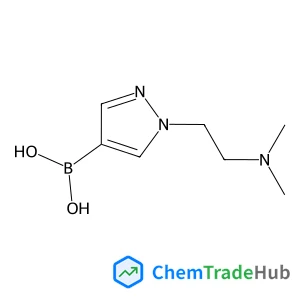
(1-(2-(Dimethylamino)ethyl)-1H-pyrazol-4-yl)boronic acid
CAS Number:
1086063-73-1
Molecular Formula:
C7H14BN3O2
Recommended Suppliers






Disclaimer
This page provides academic journal information for reference and research purposes only. We are not affiliated with any journal publishers and do not handle publication submissions. For publication-related inquiries, please contact the respective journal publishers directly.
If you notice any inaccuracies in the information displayed, please contact us at support@chemtradehub.com. We will promptly review and address your concerns.