












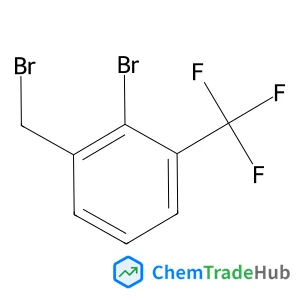
2-Bromo-1-(bromomethyl)-3-(trifluoromethyl)benzene
CAS Number:
1214372-35-6
Molecular Formula:
C8H5Br2F3
Jérémy Demarteau, Asier Fernandez de Añastro, Alexander S. Shaplov, David Mecerreyes
The synthesis of poly(diallyldimethylammonium)-b-polystyrene di- and triblock ABA copolymers was investigated by Macromolecular Design by Interchange of Xanthate/Reversible-Addition Fragmentation Transfer (MADIX/RAFT) using Polymerization-Induced Self-Assembly (PISA) conditions. A diallyldimethylammonium chloride (DADMAC) monomer was firstly polymerized in water using a mono- or difunctional MADIX agent at 60 °C with a water-soluble azo initiator. Then, PISA was implemented using poly(diallyldimethylammonium chloride) as a cationic macromolecular chain transfer agent and styrene for the emulsion phase, leading to latexes made of di- or triblock copolymers. After anion exchange between the chloride and bis(trifluoromethanesulfonyl)imide, the corresponding poly(ionic liquid)-b-polystyrene copolymers were obtained. The block copolymers were mixed with an ionic liquid electrolyte commonly used in sodium batteries composed of a mixture of a propyl-N-methylpyrrolidinium bis(fluorosulfonyl)imide ionic liquid and a sodium bis(fluorosulfonyl)imide salt. After casting, self-standing ionogel membranes were obtained. Compared to diblock copolymers, triblock copolymers showed the best self-standing properties, which may be related to the physical cross-linking of the two external polystyrene blocks. Interestingly, the ionogels based on triblock copolymers showed superior ionic conductivity values to previous electrolytes using homopoly(ionic liquid) matrices.
Zhihua Yang, Bin Yang, Shilie Pan
DOI: 10.1039/C6CP01288D
Alexander Yu. Tolbin, Mikhail S. Savelyev, Alexander Yu. Gerasimenko
DOI: 10.1039/C6CP01862A
Chantal Sleiman, Sergio González, Stephen J. Klippenstein, Dahbia Talbi, Gisèle El Dib, André Canosa
DOI: 10.1039/C6CP01982J
DOI: 10.1039/C6CP00790B
Mrinal Dutta, Kanad Ray, Daisuke Fujita, Anirban Bandyopadhyay
DOI: 10.1039/C6CP00447D
Elizabeth K. Galván-Miranda, Hiram M. Castro-Cruz, J. Arturo Arias-Orea, Matteo Iurlo, Giovanni Valenti, Massimo Marcaccio, Norma A. Macías-Ruvalcaba
DOI: 10.1039/C6CP01926A
Biman Bandyopadhyay, Partha Biswas, Pradeep Kumar
DOI: 10.1039/C6CP02407F
Edward Matthews, Ananya Sen, Naruo Yoshikawa, Ed Bergström, Caroline E. H. Dessent
DOI: 10.1039/C6CP01676F
Vitaly Gurylev, Chung-Yi Su, Tsong-Pyng Perng
DOI: 10.1039/C6CP01768A
Jonas Wirth, Harald Kirsch, Sebastian Wlosczyk, Yujin Tong, Peter Saalfrank, R. Kramer Campen
DOI: 10.1039/C6CP01397J
4-Benzyl-2,2-dimethylmorpholine is generally considered safe when handled under ...
(5,6-Dimethoxy-3-pyridinyl)boronic acid is a chemical compound with the molecula...
1,1,3,3-Tetramethyl-1,3-bis(2-methyl-2-propanyl)disiloxane is synthesized throug...
(2R,4S)-1-Boc-4-methylpyrrolidine-2-carboxylic acid is primarily used as a build...
When handling 2,3-Dichloroacrylonitrile, it is crucial to wear appropriate perso...
(S)-1-(o-Tolyl)ethanamine hydrochloride should be stored in a cool, dry place to...
Benzyl [1-(hydroxyamino)-1-imino-2-methyl-2-propanyl]carbamate (CAS: 518047-98-8...
2-Methyloxazole-5-carbaldehyde is used in the pharmaceutical industry for the sy...
The market for 2-Methyl-2-propanyl 4-[(1S)-1-hydroxyethyl]-1-piperidinecarboxyla...
1-Butyl-3-methylpyridinium bromide is generally considered safe for laboratory u...

Polymer Chemistry welcomes submissions in all areas of polymer science that have a strong focus on macromolecular chemistry. Manuscripts may cover a broad range of fields, yet no direct application focus is required.
![5-Fluoro-4-(4-fluoro-2-methoxyphenyl)-N-{4-[(S-methylsulfonimidoyl)methyl]-2-pyridinyl}-2-pyridinamine structure](https://static.chemtradehub.com/structs/161/1610358-53-6-afd1.webp "5-Fluoro-4-(4-fluoro-2-methoxyphenyl)-N-{4-[(S-methylsulfonimidoyl)methyl]-2-pyridinyl}-2-pyridinamine structure")





